In the field of powder processing, the selection of ultrafine grinding equipment has a direct impact on product quality, production efficiency, and cost control. The Jet Mill and the Μύλος ταξινομητή αέρα (ACM) are two mainstream dry ultrafine grinding technologies. Both use airflow as the working medium to achieve particle size reduction and classification. However, they differ significantly in operating principles, performance characteristics, and application scenarios.
Jet mills rely primarily on high-pressure airflow to drive particle-to-particle collisions for size reduction, whereas ACMs combine mechanical impact grinding with dynamic air classification.
Choosing the right equipment depends on material properties, target particle size, production scale, purity requirements, and energy consumption budget.
This article compares the two technologies in terms of principles, advantages and disadvantages, applications, and selection guidelines to help you make the best decision for your production line.
Comparison of Working Principles
Jet Mill
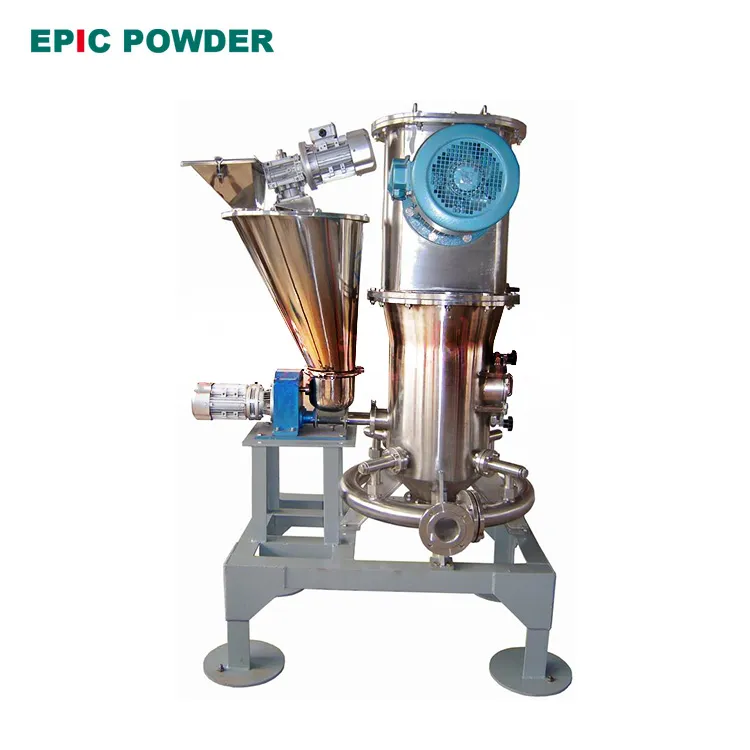
A jet mill uses compressed air or steam accelerated to supersonic velocity through Laval nozzles.
The material is accelerated in the grinding chamber, where particles collide, rub, and shear against each other to achieve size reduction.
Main types include flat jet mills, fluidized bed opposed jet mills, and loop-type jet mills.
- No moving parts in most designs; grinding relies purely on inter-particle collisions
- Built-in static or dynamic classifiers; coarse particles are recycled back to the grinding zone
- Typical particle size: submicron level (d97 < 5 μm, even < 1 μm)
Μύλος ταξινομητή αέρα (ACM)
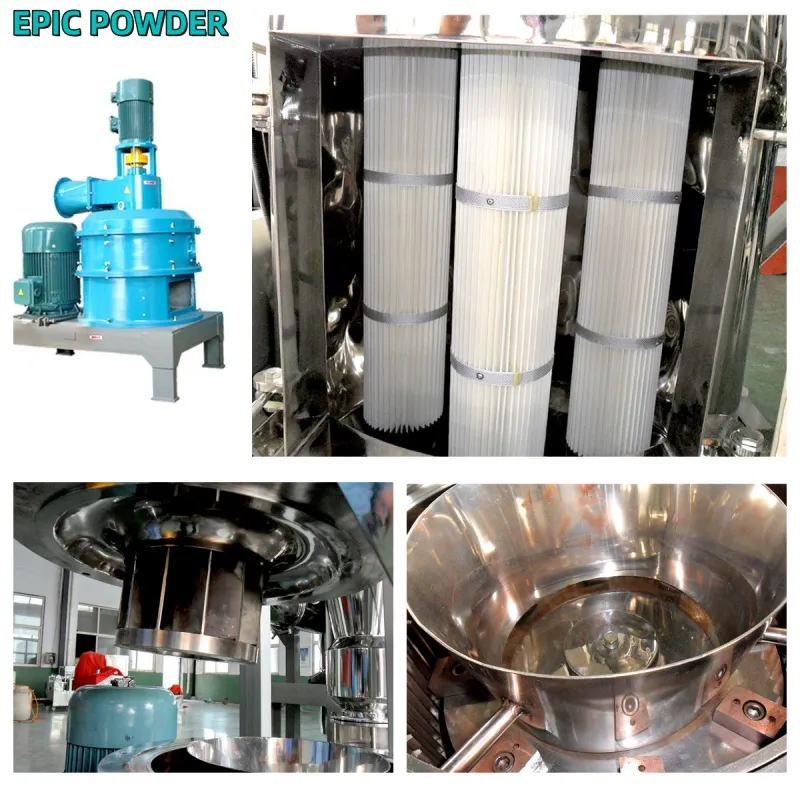
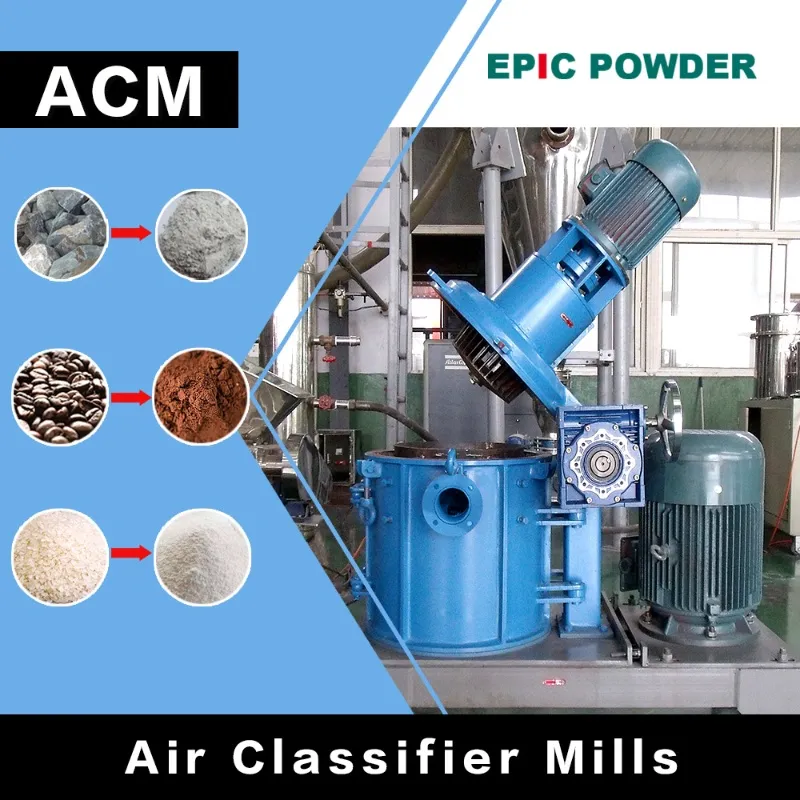
Ενα ACM integrates a mechanical impact mill with a dynamic air classifier.
Material enters the grinding chamber and is first impacted by high-speed rotating hammers or pin discs.
The upward airflow carries particles into the classifier wheel, where fine particles pass through and coarse particles are returned for further grinding.
- Equipped with moving parts (such as hammers and classifier wheels)
- Grinding and classification occur simultaneously in a single machine
- Typical particle size: d97 = 10–150 μm, suitable for fine to medium-fine powders
Advantages and Disadvantages Comparison
| Είδος | Jet Mill | Μύλος Ταξινόμησης Αέρα (ACM) |
|---|---|---|
| Grinding fineness | Extremely fine (submicron to a few microns), narrow PSD | Fine to medium (10–150 μm), controllable but wider PSD |
| Purity / contamination | Very low contamination (no moving parts) | Potential metal contamination, but easy to clean |
| Απόδοση | Relatively low (requires high-pressure air) | Higher (simultaneous grinding and classification) |
| Κατανάλωση ενέργειας | High (compressed air intensive) | Relatively low (mechanical + airflow) |
| Heat sensitivity | Excellent (low-temperature grinding) | Moderate (mechanical friction, cooling optional) |
| Συντήρηση | Simple (few moving parts) | More complex (hammers and classifier wheels require replacement) |
| Cost | Medium equipment cost, high operating cost | Lower equipment cost, better overall cost-effectiveness |
| Material adaptability | Hard, brittle, heat-sensitive, explosive materials | Wide range, including medium-hard and slightly sticky materials |
Typical Application Scenarios
Applications Suitable for Jet Mills
- Ultrafine powders (<5 μm), such as lithium battery materials, advanced ceramics, pharmaceutical APIs, and high-purity pigments
- High-purity requirements with zero metal contamination, such as electronic materials, food, and pharmaceuticals
- Heat-sensitive or explosive materials requiring low-temperature and spark-free processing
- Typical materials: silicon carbide, zirconia, ultrafine pharmaceutical actives
Applications Suitable for ACMs
- Medium to large-scale production with high throughput requirements, such as chemicals, food, and mineral fillers
- Narrow particle size distribution but not extreme fineness, such as powder coatings, plastic fillers, spices, and mineral powders
- Cost-sensitive applications prioritizing energy efficiency and ease of maintenance
- Typical materials: ground calcium carbonate, talc, food additives, powder coatings
Production Line Selection Guidelines
- Evaluate material properties:
High hardness and ultrafine requirements → Jet Mill
Medium hardness and high throughput → ACM - Στοχευόμενο μέγεθος σωματιδίων:
Submicron products require Jet Mills
Products above 10 μm are more efficiently produced with ACMs - Throughput and cost:
Small batches of high-value products → Jet Mill
Large-scale continuous production → ACM - Safety and environmental considerations:
Heat-sensitive or explosive materials → Jet Mill
General materials → ACM is more economical - Overall system design:
Pre-grinding + Jet Mill for extreme fineness
Single-stage ACM for fine and medium-fine grinding
In practice, pilot or semi-industrial trials are recommended.
Material testing with real feedstock and evaluation of energy consumption and output data are essential for accurate decision-making.
συμπέρασμα
Jet mills and air classifier mills each offer distinct advantages. There is no universally superior solution—only the most suitable one for a given application.
If your production line requires ultrafine particle sizes, ultra-high purity, and maximum protection for heat-sensitive or high-value materials, a Jet Mill is the optimal choice. If your priority is high throughput, stable particle size control, lower energy consumption, and overall cost efficiency, an Air Classifier Mill (ACM) provides clear advantages.
With more than 20 years of experience in ultrafine powder processing, Επική σκόνη offers a complete range of jet mills, air classifier mills, precision classifiers, and integrated grinding-classification systems. By combining in-depth material testing, customized process design, and reliable equipment manufacturing, Epic Powder helps customers build optimized solutions such as “pre-grinding + jet milling” or “ACM with precision classification”, tailored to specific product and market requirements.
Choosing the right grinding solution is not just about equipment—it is about process optimization, long-term stability, and economic performance. With Epic Powder’s professional technical support and advanced powder processing equipment, you can confidently select the most suitable solution for your production line and future growth.

«Ευχαριστώ που διαβάσατε. Ελπίζω το άρθρο μου να σας βοηθήσει. Παρακαλώ αφήστε ένα σχόλιο παρακάτω. Μπορείτε επίσης να επικοινωνήσετε με τον εκπρόσωπο πελατών της Zelda online για περαιτέρω ερωτήσεις.»
— Δημοσιεύτηκε από την Emily Chen