As a natural raw material rich in minerals, vitamins, dietary fiber, and antioxidants, ultrafine seaweed powder is experiencing rapidly growing demand in health foods, dietary supplements, cosmetics, and organic agriculture. However, seaweed raw materials are typically fibrous and lightweight. Conventional mechanical grinding methods struggle to achieve uniform fine powder, often leading to nutrient degradation or particle agglomeration.
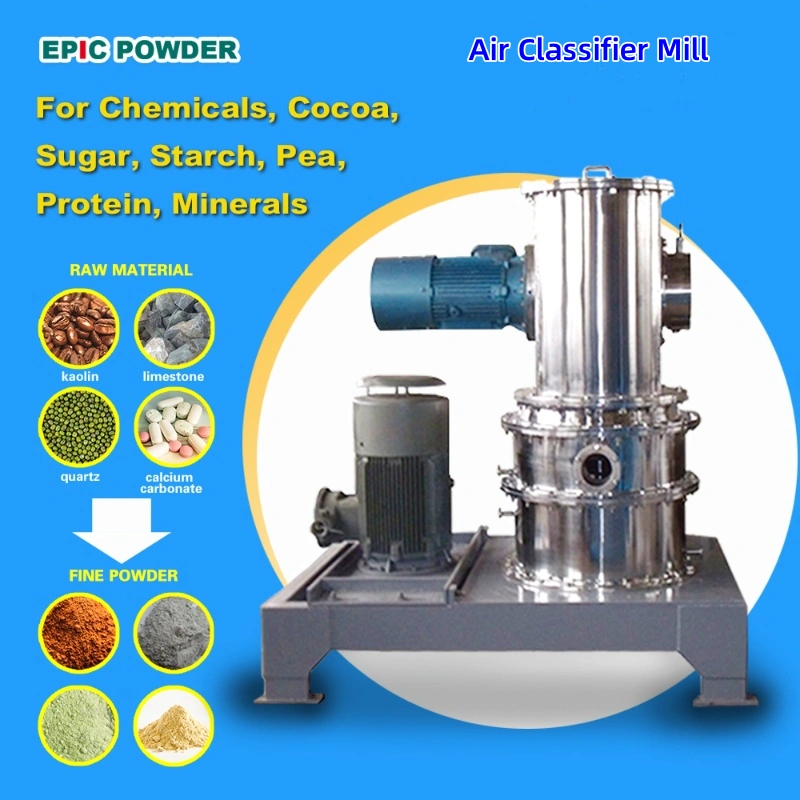
The Air Classifier Mill (ACM) is an ultrafine grinding system that integrates grinding and classification in a single unit. It is particularly well suited for heat-sensitive and fibrous materials such as seaweed. By utilizing high-speed airflow and an internal dynamic classifier, ACM enables low-temperature, media-free ultrafine grinding with precise control over particle size distribution—especially D90 (the particle size below which 90% of the material falls). This ensures fine and uniform powders, significantly improving solubility, bioavailability, and overall application performance.
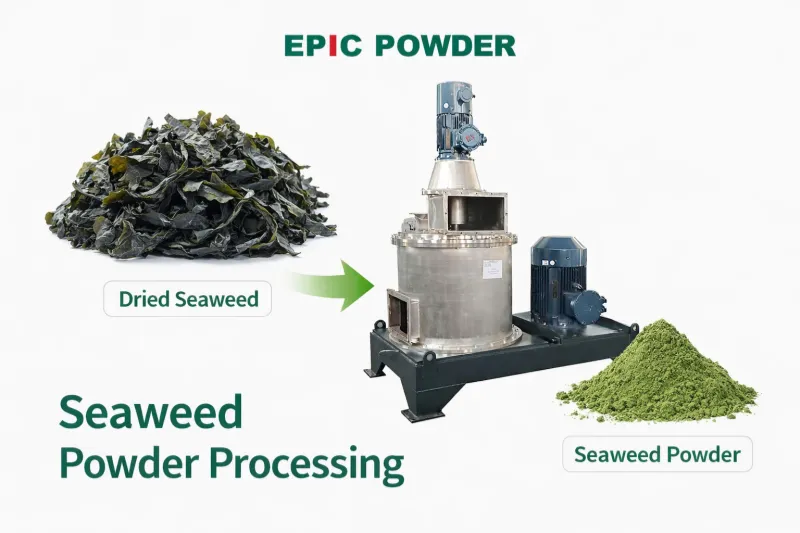
Working Principle of the Air Classifier Mill
An air classifier mill typically consists of a feeding system, grinding chamber, high-speed rotating hammers or pins, a dynamic classifier wheel, an airflow system, and a product collection unit. The operating process is as follows:
- Material Feeding
Dried seaweed material is uniformly fed into the grinding chamber via a screw feeder to prevent uneven load caused by excessive feeding rates. - Grinding Process
High-speed rotating hammers (or pins) inside the grinding chamber apply impact, shear, and friction to the material. Simultaneously, high-pressure airflow entrains the particles and forms a turbulent vortex, which intensifies inter-particle collisions and promotes further size reduction. - Because the system uses no grinding media, it generates minimal heat, making it especially suitable for processing heat-sensitive seaweed materials.
- Airflow Conveying and Classification
The airflow carries the ground particles upward into the built-in dynamic classification zone. The classifier wheel rotates at high speed, generating strong centrifugal force:- Fine particles pass through the gaps between classifier blades and move with the airflow to a cyclone separator or dust collector.
- Centrifugal force rejects coarse particles and directs them back into the grinding zone for secondary milling.
- Product Collection
A pulse-jet dust collector captures the qualified fine powder, achieving an overall powder recovery rate exceeding 99%.
This closed-loop circulation design repeatedly grinds particles until they reach the target fineness, producing a narrow particle size distribution (low span value). Typical fineness ranges from 100–300 mesh (approximately 50–150 μm) or even finer.
Definition and Importance of D90 in Seaweed Powder
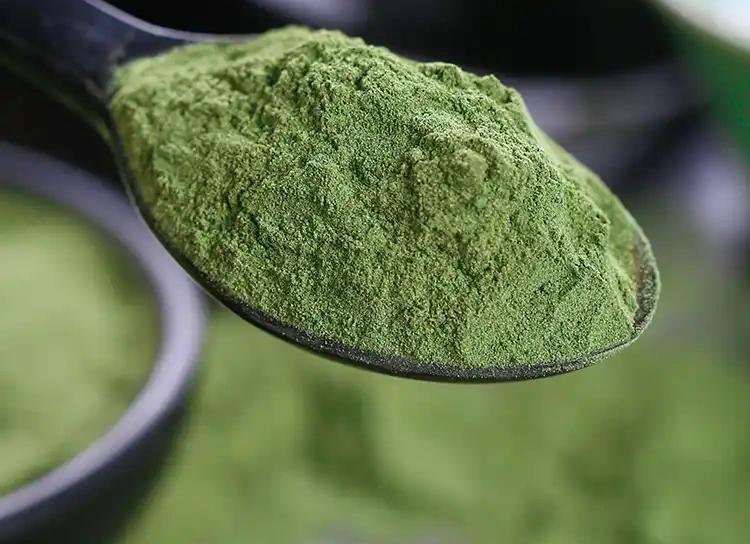
D90 is a key particle size distribution parameter, defined as the particle diameter below which 90% of the cumulative particle volume lies. It primarily controls the coarse fraction of the powder and prevents oversized particles from affecting product uniformity and flowability.
For seaweed powder:
- Excessively large D90:
Results in coarse texture, slow dissolution, poor mouthfeel, and reduced nutrient absorption. - Excessively small D90:
May cause over-grinding, increased energy consumption, and potential loss of active components. - Optimal range:
Typically 10–50 μm, depending on the application, to enhance specific surface area, dissolution rate, and bioavailability.
Precise D90 control allows ultrafine seaweed powder to disperse more easily in supplements, improve skin feel in cosmetics, and enhance flavor and texture in food applications.
Key Parameters and Adjustment Methods for Precise D90 Control
D90 control in an air classifier mill primarily relies on the internal dynamic classifier and optimized process parameters. The key adjustment factors include:
Classifier Wheel Speed (Most Critical Parameter)
- Increasing speed:
Enhances centrifugal force, rejects more coarse particles back to the grinding zone, and reduces D90 (finer powder). - Decreasing speed:
Weakens centrifugal force, allowing larger particles to pass, increasing D90. - Practical operation:
Precisely adjusted via variable frequency drive (VFD). Typical speed ranges from 2,000–6,000 rpm, enabling D90 control accuracy of ±2 μm.
Airflow Rate and Pressure
- Higher airflow pressure (compressed air or nitrogen):
Increases particle collision energy and conveying efficiency, resulting in finer overall particle size and reduced D90. - Optimized airflow:
Must match the feeding rate to avoid system overload and broad particle size distribution. Typical operating pressure is 0.6–1.0 MPa.
Feeding Rate
- Uniform, low-speed feeding:
Ensures stable system load and narrow particle size distribution. - Excessive feeding:
Increases the proportion of coarse particles and raises D90. Feed rate should be linked with airflow control.
Additional Supporting Parameters
- Hammer/pin rotor speed:
Affects initial grinding intensity and indirectly influences D90. - System sealing and secondary air control:
Prevents fine powder back-mixing and ensures high classification efficiency. - Temperature control:
Airflow cooling prevents thermal degradation of heat-sensitive seaweed components.
In industrial production, PLC-based automation systems can be used to monitor particle size in real time (via online laser particle size analyzers). Combined with PID feedback control, classifier speed can be automatically adjusted to achieve excellent batch-to-batch D90 consistency (RSD < 3%).
Processing Considerations for Ultrafine Seaweed Powder
- Pre-treatment:
Seaweed must be thoroughly dried (moisture content < 8%) to prevent wall adhesion and agglomeration. - Inert gas protection:
For oxidation-sensitive seaweed, nitrogen circulation can be used to preserve nutritional components. - Equipment selection:
Food-grade stainless steel construction is recommended for easy cleaning and compliance with GMP standards. - Typical case:
Using a MJW series air classifier mill for seaweed processing can achieve D90 < 30 μm, producing uniform powder with bright color and high nutrient retention.
Conclusion
Thanks to its integrated grinding–classification design, low-heat and contamination-free operation, and precise control of classifier wheel speed and other key parameters, the air classifier mill is an ideal solution for achieving accurate D90 control in ultrafine seaweed powder processing. Through scientific optimization of process conditions, it is possible to produce ultrafine powders with narrow particle size distribution while maximizing the preservation of natural bioactive components.
In an era that demands high-quality functional powders, air classifier milling technology is driving the seaweed industry toward greater refinement, sustainability, and value creation. For specific applications, pilot testing is recommended to determine the optimal parameters for precise D90 control.

“Thanks for reading. I hope my article helps. Please leave a comment down below. You may also contact Zelda online customer representative for any further inquiries.”
— Posted by Emily Chen