In the field of modern ultra-fine powder processing, the Air Classifier Mill (ACM) has become the cornerstone equipment for many industries. It is widely used for industrial minerals (calcium carbonate, talc, kaolin), non-metallic minerals, lithium battery cathode/anode materials, food, and pharmaceuticals. This popularity is thanks to its compact, integrated “grinding-and-classifying” design.
The greatest technical highlight of the air classifier mill (ACM) is its internal efficiency. The pulverized material does not need to be discharged from the machine. Instead, it is instantly screened inside the chamber by a built-in, high-speed classifying wheel. Fine powder meeting the particle size requirements is drawn out by the exhaust fan. Meanwhile, unqualified coarse powder falls directly back into the grinding zone for re-milling. Therefore, the classification efficiency is a critical metric. It directly determines the throughput, energy consumption, and sharpness of the final product’s particle size distribution (PSD).
What exactly drives the classification efficiency of an ACM mill behind the scenes during actual production? This article provides an in-depth analysis across three critical dimensions: structural design, operational process parameters, and material physical characteristics.
I. Core Structural Design: The “Innate Genes” of Classification Efficiency
The mechanical structure of the Air Classifier Mill (ACM) forms the foundation of its classification performance. Once the structure is finalized, the upper limit of efficiency is largely determined.
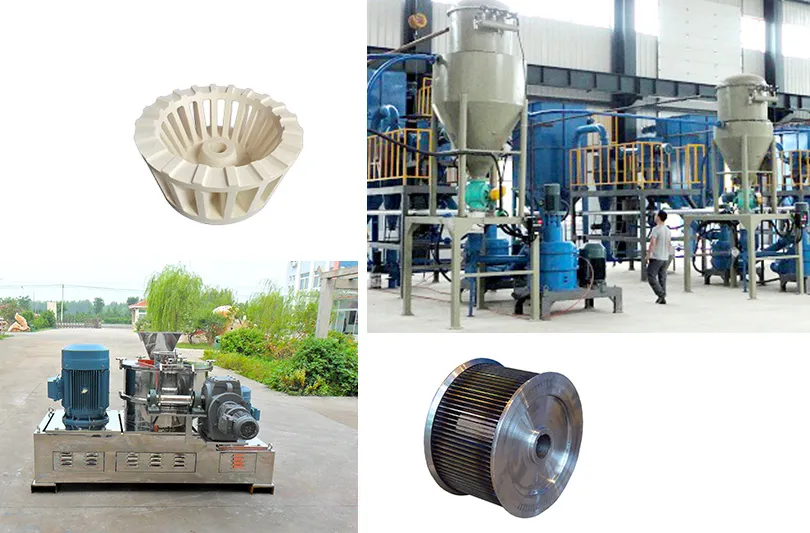
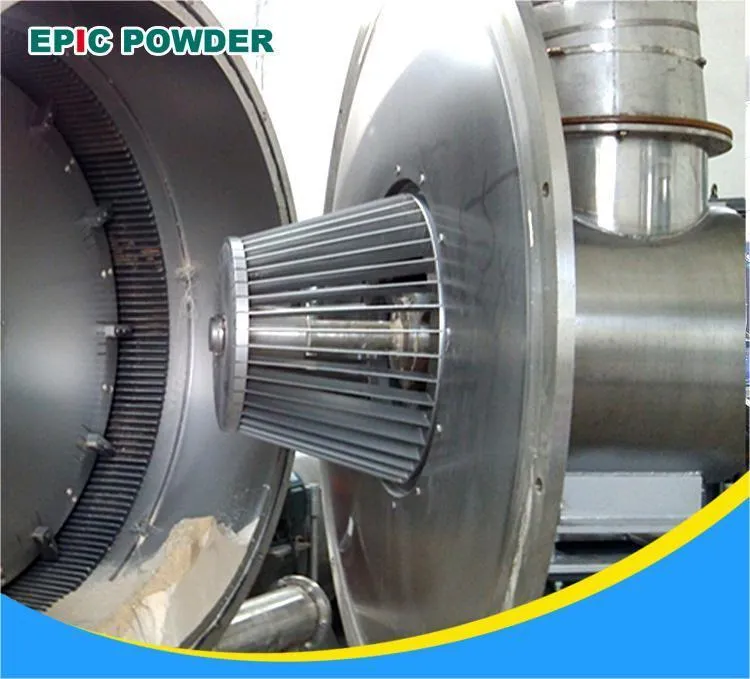
Blade Structure and Geometry of the Classifier Wheel
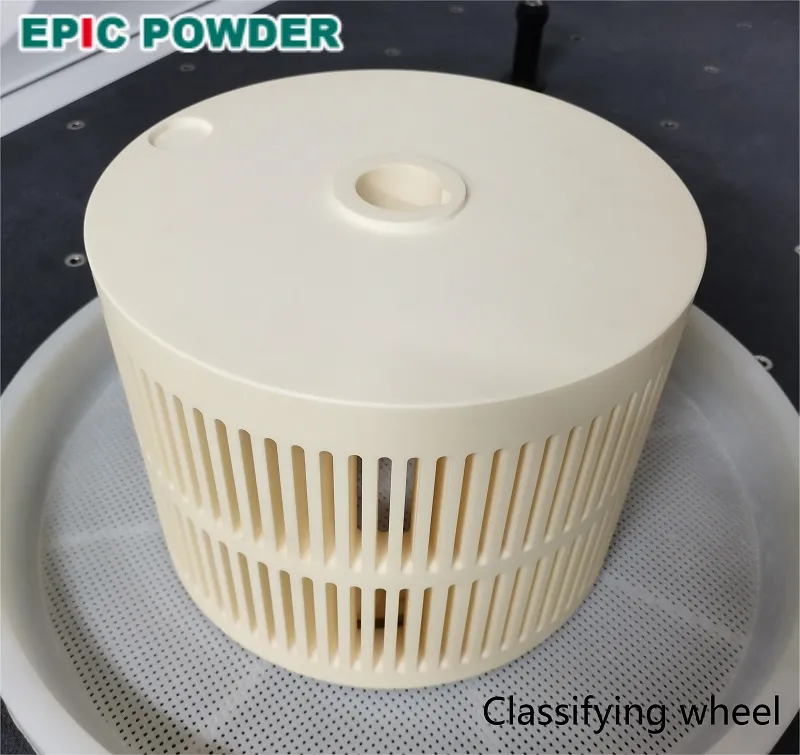
The classifying wheel is the “heart” of the entire classification system. When material enters the classifying zone along with the airflow, it experiences a battle between two forces. These forces act constantly between the blades of the classifying wheel. The first is the centrifugal force generated by the rotation of the wheel, which tends to fling particles outward. The second is the inward aerodynamic drag force generated by the exhaust fan, which tends to pull particles into the interior of the wheel.
- Blade Count and Spacing: A design with a higher number of blades and narrower spacing provides a more uniform flow field. This reduces the probability of large particles “leaking through.” As a result, it delivers a more precise cut size.
- Blade Wear Status: When processing high-hardness materials (such as quartz or zirconium silicate) over long periods, the edges of the classifying wheel blades inevitably wear down. Once the blades warp due to wear, local eddies are generated in the flow field. This causes classification efficiency to drop sharply, and large, over-size particles begin to appear in the finished product.
Clearance Between Classifier Wheel and Sealing Ring
This is a critical area that frequently causes issues, yet many factories overlook it. A clearance must exist between the rotating top of the classifying wheel and the stationary housing components. To prevent unclassified coarse powder from slipping directly through this gap into the finished fine powder, a phenomenon known as “short-circuit flow” occurs. To stop this, a labyrinth seal or an air seal is typically utilized. If this clearance becomes too large, or if the seals wear out, coarse particles will mix directly into the finished product. This causes both classification efficiency and product purity to collapse instantly.
II. Operating Parameters: Dynamic Control “Magic Hands” of Classification
With a fixed equipment structure, engineers adjust operating parameters to switch the ACM mill between different product grades (e.g., D50 from 3 μm to 45 μm). The following four key parameters jointly determine the dynamic balance of classification.
1. Classifier Wheel Speed
Classifier wheel speed is the most direct and effective parameter for controlling product fineness.
- High speed: Centrifugal force is proportional to the square of the rotational speed. When the classifier speed increases, the centrifugal force acting on the particles rises exponentially. Only ultra-fine powder can overcome such massive centrifugal force to be drawn into the wheel. Under these conditions, the product particle size becomes finer. However, if the speed is too high and not matched by the airflow, a large amount of qualified fine powder will fail to enter the wheel. It will be forced back into the grinding zone for “over-grinding.” This lowers classification efficiency and increases system energy consumption.
- Low speed: Reduced centrifugal force allows coarser particles to enter the classifier wheel, resulting in a coarser product.
2. System Airflow and Gas Velocity
Airflow volume directly determines the drag force.
- If the air velocity is too high, the inward drag force becomes excessive. This forcefully pulls coarse particles that have not met the required size into the finished product. Consequently, it causes a drop in classification efficiency and widens the particle size distribution.
- If the air velocity is too low, the inward drag force is insufficient to carry away the qualified fine powder. The fines then stagnate in the classifying zone and undergo secondary agglomeration. Alternatively, they fall straight back into the grinding zone, causing over-grinding. This not only reduces classification efficiency but also causes the temperature inside the ACM mill chamber to rise rapidly.
3. Feed Rate and Material Concentration
Many operators increase feed rate in pursuit of higher output, which often has the opposite effect.
- Excessive feed rate leads to high particle concentration in the classification zone.
- In this crowded environment, frequent collisions and interference between particles occur, causing chaotic settling behavior.
- Fine particles may be carried into the classifier together with coarse ones, while coarse particles block fine ones, forcing them back to the grinding zone.
- High concentration severely disrupts flow field stability, causing a sharp drop in classification efficiency once overload occurs.
III. Physical Characteristics of the Material: The Invisible Variable
The exact same ACM mill can show completely different classification efficiencies depending on the material. Processing calcium carbonate can yield completely different results compared to processing herbal medicines or lithium battery materials. The reason lies in the physical properties of the material itself.
1. Particle Shape
Aerodynamic calculations typically assume that particles are perfect spheres. However, actual materials come in various shapes:
- Spherical or Regular Polyhedral Particles: These experience stable forces in the flow field. This stability results in exceptionally high classification efficiency.
- Flaky or Needle-like Particles (e.g., Talc, Mica): As these particles rise with the airflow, the aerodynamic drag they experience fluctuates wildly. This happens due to constant changes in their facing surface area. For example, a large, flat flake of talc might be pulled directly into the classifying wheel like a kite. This causes “irregular large particles” to appear in the finished product and severely disrupts classification precision.
2. Material Adhesiveness and Moisture
Problems arise if the moisture content of the material exceeds standards. Similar issues occur if the material naturally develops static electricity and adheres easily, such as certain synthetic chemical resins or matcha powder:
- Fine particles will firmly adhere to the blades of the classifying wheel. Over time, they gradually form a crust. This accumulation changes the geometry of the blades and clogs the classification channels, making the flow field turbulent.
- Particles are also prone to secondary agglomeration. Several qualified fine particles cluster into a large agglomerate. The classifying wheel then misinterprets this cluster as a “coarse particle” and flings it back into the grinding zone, causing a wasteful grinding cycle.
IV. Deep-Dive Q&A: Breaking the Air Classifier Mill (ACM) Classification Bottleneck
Technical personnel worldwide face frustrating practical bottlenecks when operating ACM mills. To address these, let us explore two core questions in depth.
Q1: Why is the output of my ACM mill extremely low and the energy consumption drastically high when producing ultra-fine powder (e.g., D97 < 5μm)?
Answer: This is a classic case of an “over-grinding and classification vicious cycle.” When attempting to produce extremely fine powder with an Air Classifier Mill (ACM), you must crank the classifying wheel speed to a very high level. At this point, the threshold for the classifying zone to block fine powder rises significantly.
Ultra-fine powder has a massive specific surface area. Because of this, it is highly prone to severe electrostatic agglomeration and airflow entrapment within the high-concentration classifying chamber. A large volume of qualified fine powder that has already reached 2 -3μm cannot be sucked away during its brief window of passage through the classifying wheel. This failure happens because it is blocked by large particles or clumped together. Instead, it drops back into the grinding zone in large quantities. In the grinding zone, these fines are repeatedly and uselessly milled by the main shaft liners and hammers. This action creates a “cushioning effect.” It not only consumes a massive amount of mechanical energy, causing the machine to overheat, but also severely hinders the pulverization of newly entering bulk materials.
Solutions:
- Introduce Secondary Air: Introduce a well-engineered secondary air stream between the grinding zone and the classifying zone. This secondary air flushes upward from below. It breaks up agglomerated fine powder and performs a “pre-classification” on the falling mixture. This action sends the fines back to the classifying zone and breaks the vicious cycle.
- Add an Appropriate Amount of Grinding Aids: This is helpful for minerals with high hardness or a strong tendency to agglomerate, such as heavy calcium carbonate. A tiny amount of non-toxic surfactant can be sprayed inline. This significantly eliminates static electricity on the particle surfaces. It prevents fine powder from “huddling up” in front of the classifying wheel, boosting classification efficiency by more than 20%.
V. Conclusion and Process Optimization Recommendations
Classification efficiency in an ACM mill is not an isolated parameter but the result of structural design and dynamic airflow balance across the entire system.
To maximize performance in real production:
- Adopt a “high airflow + high speed” strategy rather than “low airflow + overloading”.
Maintain a dilute phase in the classification zone to ensure stable separation conditions. - Use automated PLC control systems.
Link feed rate with classifier current and system pressure in a closed-loop control system to stabilize classification conditions. - Customize components based on material properties.
Select ceramic classifier wheels for anti-contamination and wear resistance, or multi-blade designs for improved efficiency and stability.

“Thanks for reading. I hope my article helps. Please leave a comment down below. You may also contact Zelda online customer representative for any further inquiries.”
— Posted by Emily Chen