Di bidang pengolahan bubuk, mesin penggiling pin (penggiling tumbukan tipe pin) dan mesin penggiling pengklasifikasi udara (penggiling ultrahalus dengan pengklasifikasi internal atau eksternal) termasuk di antara mesin penggiling ultrahalus yang paling sering digunakan—dan paling sering salah dipilih.
Banyak pengguna memilih peralatan mereka hanya berdasarkan satu parameter: ukuran partikel akhir. Hasilnya seringkali mengecewakan setelah pemasangan:
baik karena efisiensi yang sangat rendah, penggilingan berlebihan yang parah, bentuk partikel yang buruk, atau konsumsi energi yang jauh lebih tinggi dari yang diharapkan.
Di bawah ini, kami menguraikan perbedaan kinerja sebenarnya antara kedua mesin ini dengan cara yang paling sederhana, berdasarkan bagaimana keduanya berperilaku dengan material nyata.
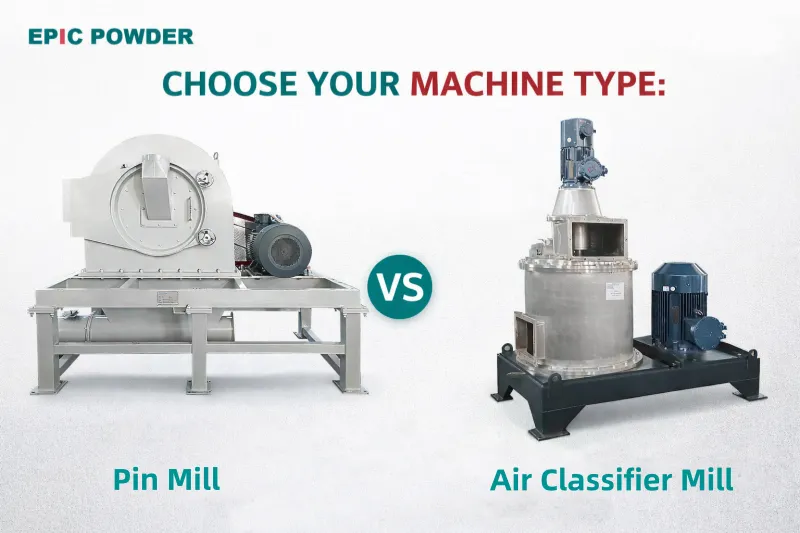
Perbedaan Utama Antara Pin Mill dan Air Classifier Mill
(Performa tipikal model-model utama, 2025)
| Barang | Pin Mill (Cakram pin 2–3 tahap tipikal) | Pengklasifikasi Udara (Tipe pengklasifikasi turbin vertikal/horizontal) | Keuntungan (Skenario Khas) |
|---|---|---|---|
| Prinsip penggilingan | Tabrakan kecepatan tinggi + geser + gesekan | Benturan kecepatan tinggi + penggilingan berulang dengan siklus klasifikasi | – |
| Lebar distribusi ukuran partikel | Relatif sempit (RSD biasanya 0,4–0,65) | Relatif lebar (RSD biasanya 0,7–1,2 atau lebih lebar) | Penggiling pin |
| Kontrol ukuran partikel rata-rata | ★★★★☆ | ★★★☆☆ | Penggiling pin |
| Sensitivitas terhadap kekerasan | Sangat sensitif (keausan parah jika Mohs > 7) | Lebih toleran (masih dapat memproses hingga Mohs 9 dengan susah payah) | ACM |
| Bahan lengket/berserat | Sangat buruk, mudah tersumbat | Jauh lebih baik (tetapi tidak universal) | ACM |
| Bahan dengan titik leleh rendah / sensitif terhadap panas | Lebih baik (penggilingan instan, waktu tinggal singkat) | Cukup buruk (beberapa siklus, kenaikan suhu yang terlihat jelas) | Penggiling pin |
| Kehalusan yang dapat dicapai (D97) | Biasanya stabil pada ukuran 2–8 μm; ukuran <1 μm sulit dicapai. | Lebih mudah mencapai 0,5–2 μm, bahkan submikron. | Penggiling Pengklasifikasi Udara |
| Konsumsi energi spesifik (kWh/t) | Sedang hingga rendah | Sedang-tinggi hingga sangat tinggi (meningkat tajam seiring dengan kehalusan) | Penggiling pin |
| Bentuk partikel | Hampir equiaxed, angular | Lebih berbentuk piring, rasio aspek lebih tinggi | Penggiling pin (sebagian besar penggunaan) |
| Investasi peralatan | Sedang | Sedang-tinggi hingga tinggi | Penggiling pin |
| Biaya perawatan | Keausan pin cepat, suku cadang mahal. | Roda dan pelapis alat pemisah juga mahal, tetapi intervalnya lebih lama. | Kurang lebih sama / pengklasifikasi sedikit lebih baik (tergantung bahan) |
Referensi Cepat: Pabrikan yang Direkomendasikan untuk Material Umum
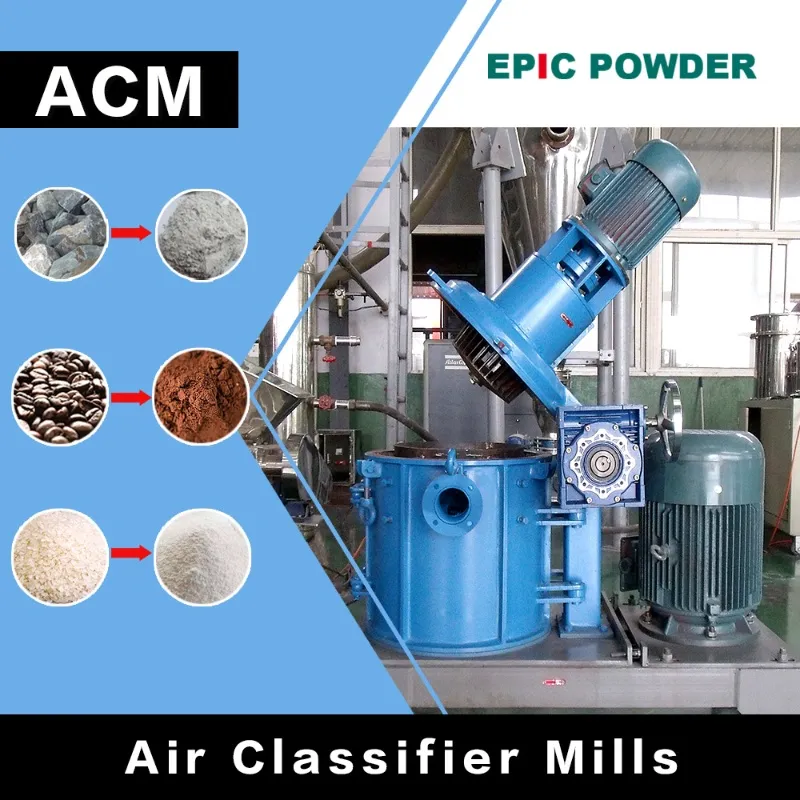
(Panduan praktis untuk tahun 2025–2026)
| Jenis Material | Pilihan Pertama | Alternatif | Alasan Utama |
|---|---|---|---|
| Kalsium karbonat (GCC/PCC), 800–3000 mesh | Penggiling Pengklasifikasi Udara | Penggiling pin (berbasis biaya) | Produksi besar, kehalusan tinggi, efisiensi biaya. |
| Talk (keputihan tinggi, kemurnian tinggi) | Penggiling pin | Penggiling Pengklasifikasi Udara (ultrahalus) | Bentuk partikel sangat penting, hindari lamela yang berlebihan. |
| Mika (serisit, mika yang digiling basah) | Penggiling pin (dengan hati-hati) | – | Bahan berserat mudah menyumbat mesin penggiling pin. |
| Diatomit, wollastonit | Penggiling Pengklasifikasi Udara | Penggiling pin (tahap kasar) | Kekerasan dan porositas yang tinggi menyebabkan keausan pin yang cepat. |
| Grafit (pra-sferonisasi) | Penggiling pin | Penggiling Pengklasifikasi Udara | Membutuhkan partikel yang hampir berbentuk sama besar dan tepi yang tajam. |
| Al₂O₃, ZrO₂, SiC | Pabrik pengklasifikasi udara (arus utama) | Mesin penggiling jet unggun terfluidisasi | Kekerasannya terlalu tinggi untuk mesin penggiling pin. |
| Prekursor material baterai (NCM, LFP) | Penggilingan pin (arus utama) | Penggiling Pengklasifikasi Udara (dalam beberapa kasus) | Sangat sensitif terhadap bentuk, lebar PSD, dan kontaminasi logam. |
| Zat perantara farmasi, antibiotik, PPC | Penggiling pin (tipe suhu rendah) | Pabrik jet | Sensitif terhadap panas, kebersihan tinggi |
| Bahan kimia pertanian, herbisida | Penggiling pin | Penggiling Pengklasifikasi Udara | Sebagian besar memiliki titik leleh rendah dan sensitif terhadap panas. |
| Karbon hitam, silika yang diendapkan | Penggiling Pengklasifikasi Udara | Penggiling pin (tahap kasar) | Sangat halus, struktur terkontrol |
| Serbuk mikro berlian, CBN | Penggiling pin yang jarang | Mesin penggiling bola planet / mesin penggiling jet | Kekerasan ekstrem |
| Zeolit, bentonit, kaolin | Penggiling Pengklasifikasi Udara | Penggiling pin | Penggiling pin yang lengket mudah tersumbat. |
Lima “Ilusi Fatal” dalam Pemilihan Peralatan Nyata
- “Jika saya membutuhkan ukuran 2 μm, mesin penggiling penyaring udara pasti lebih baik.”
→ Untuk banyak material dalam kisaran 3–5 μm, mesin penggiling pin sebenarnya menawarkan kinerja biaya keseluruhan yang jauh lebih baik. - “Kekerasan yang tinggi berarti saya harus memilih penggiling pemisah udara.”
→ Kekerasan memang penting, tetapi jika bentuk partikel, distribusi ukuran partikel (PSD) yang sempit, dan kontaminasi logam yang rendah juga menjadi pertimbangan penting, maka mesin penggiling pin dengan material tahan aus khusus mungkin merupakan solusi yang lebih baik. - “Saya butuh kapasitas produksi yang tinggi—mesin penggiling pin tidak mampu menangani itu.”
→ Mesin penggiling pin besar modern (model 800–1200) dapat mencapai 3–8 t/jam per unit (misalnya GCC 1250 mesh). - “Semakin bagus kualitasnya, semakin tinggi konsumsi energinya—itu normal.”
→ Salah. Kurva energi sangat berbeda tergantung prinsip penggilingan. Pada D97 = 2 μm yang sama, penggiling pin mungkin hanya mengonsumsi 50–70% energi dari penggiling pengklasifikasi udara untuk material tertentu. - “Saya akan mulai dengan mesin kecil untuk pengujian terlebih dahulu.”
→ Perilaku peningkatan skala berbeda secara signifikan antara penggiling pin dan penggiling pengklasifikasi udara. Model kecil yang berkinerja baik mungkin tidak berkinerja baik dalam skala besar—dan sebaliknya.
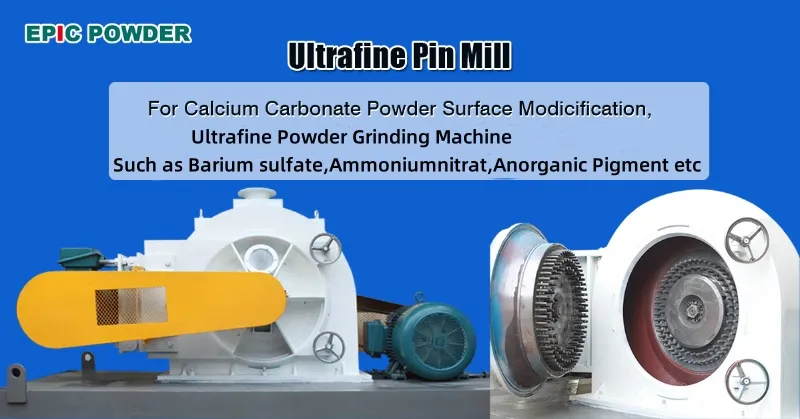
Logika Seleksi Satu Kalimat
- Untuk bentuk partikel yang sangat baik, PSD yang sempit, suhu rendah, dan kehalusan sedang (D97 > 2,5–3 μm) → pilih PIN MILL terlebih dahulu.
- Untuk kehalusan ekstrem (D97 < 2 μm atau submikron), material yang sangat keras, kurang memperhatikan bentuk partikel, dan kapasitas produksi yang sangat tinggi → pilih CLASSIFIER MILL (atau jet mill).
Jadi, di manakah materi Anda termasuk?
Silakan tinggalkan nama material Anda + tingkat kehalusan target + prioritas utama di kolom komentar.
Bubuk Epik akan membantu Anda dengan cepat menilai rute penggilingan mana yang paling tepat untuk Anda.

Terima kasih telah membaca.
Semoga artikel ini bermanfaat. Silakan tinggalkan komentar di bawah. Anda juga dapat menghubungi perwakilan layanan pelanggan online Zelda untuk pertanyaan lebih lanjut.
–Diposkan oleh Emily Chen