Os materiais de carbono poroso são frequentemente chamados de “materiais universais”. Eles apresentam uma estrutura de poros altamente desenvolvida, alta área superficial específica (tipicamente 500–3000 m²/g), excelente capacidade de adsorção e boa condutividade elétrica. São amplamente utilizados em aplicações como carvão ativado para tratamento de água, purificação do ar, ânodos de baterias de íon-lítio/sódio, supercapacitores, suportes de catalisadores e biomedicina. No entanto, a moagem de carbono poroso não se resume a simplesmente tornar as partículas mais finas. Trata-se de um processo de “preservação da estrutura” de alta precisão. O tamanho das partículas deve ser controlado com precisão dentro de um D50 de 5–50 μm, preservando ao máximo a rede de poros micro-meso-macro. Isso evita o colapso dos poros, a redução da área superficial e a perda de desempenho de adsorção ou eletroquímico.
Os equipamentos de moagem tradicionais frequentemente causam danos aos poros devido ao alto impacto mecânico, calor excessivo ou moagem excessiva. Isso leva a uma degradação significativa do desempenho, baixo rendimento e aumento dos custos.
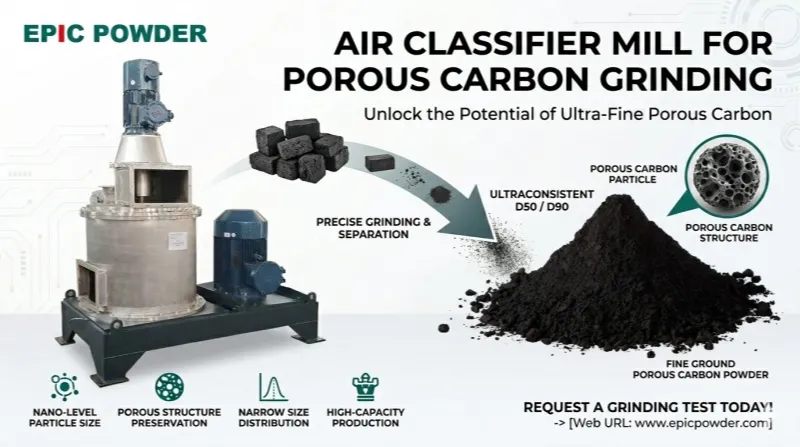
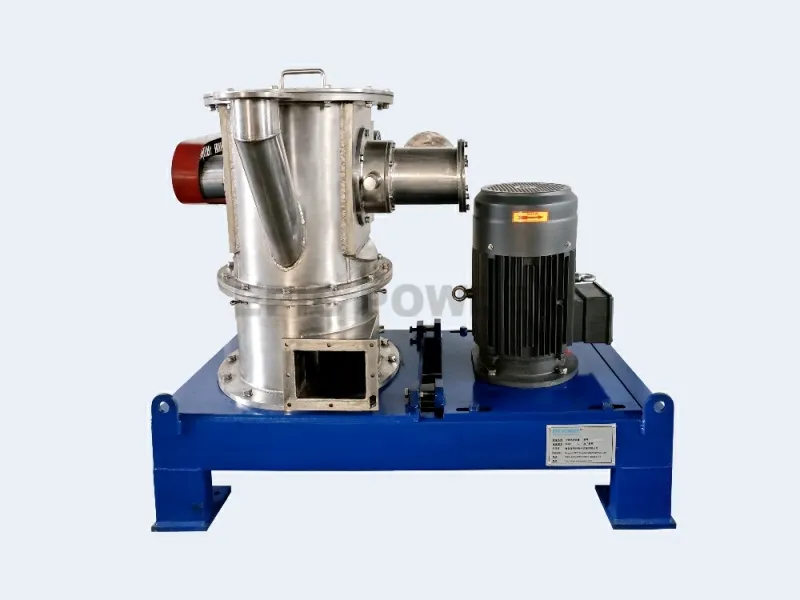
O Moinho Classificador de Ar (ACM)A tecnologia de moagem por impacto, que integra moagem por impacto e classificação interna por ar, tornou-se a solução preferida para o processamento de carbono poroso. Ela permite a moagem "não destrutiva", preservando a estrutura dos poros. Este artigo analisa sistematicamente os desafios, princípios de funcionamento, vantagens, comparações de equipamentos, aplicações e diretrizes de seleção para ajudar as empresas a otimizar o desempenho e reduzir custos.
Características e desafios de moagem do carbono poroso
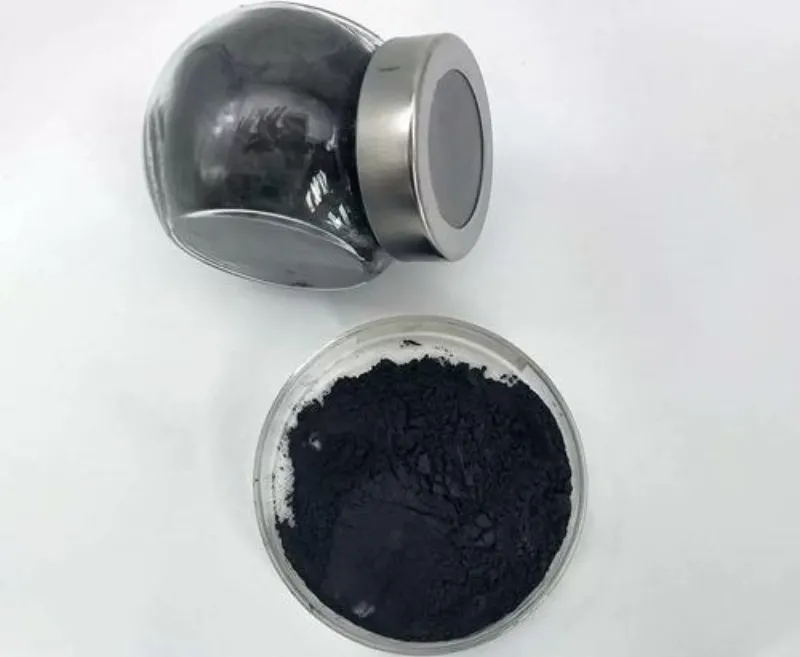
Os materiais de carbono porosos incluem carvão ativado à base de madeira e carvão mineral, biochar, carbono duro, carbono poroso para ânodos de silício-carbono e negro de fumo modificado.
Suas propriedades exigem uma abordagem de moagem "suave":
- Estrutura de poros altamente desenvolvida
Microporos (<2 nm), mesoporos (2–50 nm) e macroporos (>50 nm) coexistem. Impactos mecânicos fortes ou altas temperaturas podem causar o colapso da parede dos poros, o bloqueio dos poros e uma redução de 20–50% na área superficial. Isso afeta diretamente a capacidade de adsorção e o desempenho da bateria. - Baixa densidade e leveza
A densidade aparente varia de 0,2 a 0,6 g/cm³. Os materiais são propensos à formação de poeira, aglomeração e obstrução de equipamentos. - Sensibilidade térmica
A umidade e os componentes voláteis dentro dos poros podem se decompor em altas temperaturas. Os grupos funcionais da superfície podem se desativar, reduzindo o desempenho da adsorção. - Fragilidade e tendência à moagem excessiva
Com baixa dureza (Mohs 1–2), os materiais fraturam-se facilmente. No entanto, a distribuição do tamanho das partículas tende a se alargar, e o excesso de partículas finas pode obstruir os poros e aumentar o consumo de energia. - Requisitos de candidatura rigorosos
- Pó de carvão ativado: D90 < 45 μm com distribuição estreita.
- Carbono poroso de grau para baterias: D50 5–15 μm, retenção de poros > 90%
- Negro de fumo: requer redução de abrasivos e contaminação zero.
Os equipamentos tradicionais têm dificuldade em equilibrar a finura das partículas, a preservação da estrutura e a eficiência, o que frequentemente resulta em valores de adsorção reduzidos, baixo desempenho da bateria e riscos de segurança, como explosões de poeira.
Princípio de funcionamento do Moinho Classificador de Ar (ACM)
O ACM consiste em uma unidade principal de moagem (dentes do rotor e do estator), uma roda classificadora, um ventilador, um separador ciclônico e um coletor de pó pulsado. Ele opera como um processo seco de circuito fechado, integrando moagem por impacto e classificação dinâmica por ar.
O material é alimentado na câmara de moagem por meio de um alimentador de parafuso. O rotor giratório de alta velocidade (velocidade periférica de 60 a 120 m/s) aciona martelos ou pinos que impactam, cortam e colidem com as partículas. Simultaneamente, um forte fluxo de ar gerado pelo ventilador transporta as partículas para a zona da roda classificadora integrada. A roda classificadora gira em alta velocidade (3000 a 6000 rpm) e cria força centrífuga. As partículas maiores que o tamanho de corte são lançadas de volta para a zona de moagem para redução adicional, enquanto as partículas finas qualificadas saem com o fluxo de ar e são coletadas pelo ciclone e pelo filtro de mangas.
Os principais destaques técnicos incluem:
- Resfriamento por fluxo de arGrandes volumes de ar circulante (milhares de m³/h) removem o calor rapidamente. O aumento da temperatura do material geralmente se limita a <10–15°C, muito inferior aos 30–50°C comuns em moinhos de bolas.
- Classificação dinâmicaAjustando a velocidade da roda classificadora e o volume do fluxo de ar, a finura pode ser controlada com precisão de D97 2–100 μm, com uma distribuição de tamanho de partículas estreita (desvio padrão geométrico frequentemente <1,5).
- Entradas de ar secundáriasAlguns modelos (como o Prater CLM) introduzem ar adicional para resfriamento extra e para evitar a aderência de materiais às paredes.
- Sistema fechado de pressão negativaTodo o processo ocorre sob pressão negativa, evitando vazamento de poeira. É adequado para materiais carbonáceos explosivos e pode ser equipado com proteção de gás inerte.
Essa abordagem de "moagem e classificação simultâneas" evita a moagem excessiva, melhora a eficiência energética e realiza a pulverização, a classificação e a coleta em uma única máquina.
Principais características técnicas:
- Resfriamento a arO grande fluxo de ar remove o calor de forma eficiente. O aumento de temperatura é normalmente inferior a 10–15 °C, muito menor do que em moinhos de bolas (30–50 °C).
- Classificação dinâmicaA velocidade ajustável do classificador (3000–6000 rpm) permite um controle preciso de D97 2–100 μm com distribuição estreita (GSD <1,5).
- Entrada de ar secundárioMelhora o resfriamento e evita o acúmulo de material.
- Operação com pressão negativaSistema totalmente fechado que impede a entrada de poeira e oferece proteção com gás inerte para materiais explosivos.
Isso permite a realização simultânea de tarefas. moagem, classificação e coleta, evitando a moagem excessiva e melhorando a eficiência energética.
Por que escolher ACM para moagem de carbono poroso: seis vantagens principais
Retificação não destrutiva com máxima preservação dos poros
O fluxo de ar e as forças de impacto suaves do ACM fazem com que as partículas se rompam principalmente por meio de colisões partícula-partícula e cisalhamento delicado, em vez de impactos mecânicos severos. Dados da indústria mostram que as taxas de retenção de poros podem exceder 95%, significativamente melhores do que as dos moinhos de impacto tradicionais. Projetos especializados otimizados para carbono poroso (como caminhos de fluxo de ar aprimorados e estresse mecânico reduzido) minimizam o colapso da parede dos poros, com perda de área superficial específica tipicamente inferior a 5%. Isso melhora diretamente a capacidade de adsorção do carbono ativado e a capacidade reversível, além da estabilidade de ciclo em materiais de baterias.
Moagem a baixa temperatura
A circulação de ar em alto volume proporciona dissipação de calor imediata, mantendo as temperaturas de saída próximas à temperatura ambiente. Para materiais sensíveis ao calor, como carvão ativado e biochar, a queda no índice de iodo ou na adsorção de azul de metileno é muito menor do que com moinhos de bolas ou de martelo. Isso torna o ACM especialmente adequado para produtos de alta qualidade, tanto para uso ambiental quanto para a indústria alimentícia.
Controle preciso do tamanho das partículas
A roda classificadora integrada permite a análise de pós ultrafinos com D50 de 5 a 20 μm e D97 < 30 μm, além de uma distribuição extremamente estreita (sem cauda grossa). O carvão poroso para baterias exige um Dmax < 25 μm para uma suspensão uniforme. O pó de carvão ativado se beneficia de um tamanho de partícula uniforme, resultando em maior precisão de filtração. O ACM atinge as especificações desejadas em uma única passagem, com rendimento > 98%, eliminando a necessidade de classificação secundária.
Alta eficiência e economia de energia
O design integrado evita a moagem excessiva. O consumo de energia é 30–50 TP/3T menor do que o de moinhos de bolas e 20–40 TP/3T menor do que o de moinhos de jato puros. A capacidade de uma única máquina varia de dezenas de kg/h a várias toneladas/h, dependendo do modelo, tornando-a ideal para produção contínua em larga escala.
Segurança ambiental e operacional
O sistema fechado de pressão negativa, combinado com a coleta de poeira de alta eficiência, mantém a concentração de poeira abaixo de 10 mg/m³, atendendo a rigorosos padrões ambientais. Para materiais carbonáceos explosivos, pode-se utilizar proteção com gás inerte nitrogênio ou dióxido de carbono. Os designs resistentes ao desgaste (revestimentos opcionais de cerâmica ou liga metálica) reduzem a contaminação por metal, e o equipamento é de fácil manutenção (o rotor e a roda classificadora são fáceis de desmontar).
Alta adaptabilidade de materiais
Seja processando carvão ativado à base de madeira, carvão vegetal, biochar, negro de fumo ou precursores de silício-carbono, o ACM lida de forma confiável com materiais de baixa densidade e ligeiramente coesivos. Modelos especializados, como o Hosokawa Mikro e-ACM, são otimizados para a redução de partículas de negro de fumo, enquanto o Prater CLM apresenta excelente desempenho com carvão ativado.
Comparação com outros equipamentos de moagem de carbono poroso
- Moinhos de bolasAdequado para moagem a úmido ou a seco, mas gera altas temperaturas, ampla distribuição de tamanho de partículas e contaminação. Causa sérios danos aos poros e grande perda de área superficial, tornando-o inadequado para carbono poroso de alta qualidade.
- Moinhos a jatoSem necessidade de meios filtrantes, com baixo aquecimento e sem contaminação, além de excelente finura. No entanto, apresentam alto consumo de energia (2 a 3 vezes maior que o do ACM), baixa capacidade e maior área ocupada. Para carbono poroso de grande volume, a eficiência econômica é baixa e as forças de impacto ainda podem danificar algumas estruturas de poros.
- Moinhos Raymond / Moinhos de rolos verticais / Moinhos de rolos anularesBons para pós de granulometria média (400–800 mesh), mas apresentam classificação deficiente, ampla distribuição de partículas e problemas de superaquecimento. Não são ideais para moagem ultrafina (>1250 mesh) ou proteção estrutural precisa.
- Moinhos de martelo / Moinhos de impacto (sem classificação)Principalmente para pós grossos. Eles sofrem com moagem excessiva, altas temperaturas e grande quantidade de poeira, não atendendo aos requisitos de distribuição estreita.
- Moinhos de areia / Moinhos agitadosProcessos predominantemente úmidos que requerem secagem posterior. Apresentam risco de introduzir umidade ou contaminação do meio e são inadequados para o processamento de carbono poroso a seco.
O ACM se destaca em quatro dimensões — proteção estrutural, precisão de acabamento, consumo de energia e capacidade — tornando-o insubstituível, especialmente em cenários de produção contínua a seco.
Casos de aplicação prática
- Produção de pó de carvão ativadoUma empresa ambiental utilizou um moinho de carvão ativado (ACM) para moer carvão ativado granular até um tamanho de partícula D90 <45 μm para elementos filtrantes em tratamento de água. O produto final apresentou desempenho de adsorção 15% superior aos processos tradicionais, com zero emissão de poeira e um aumento de 40% na capacidade anual.
- Suportes de carbono porosos para bateriasO carbono poroso do ânodo de baterias de íon-lítio/sódio processado por ACM atingiu um D50 de 8–12 μm e retenção de volume de poros superior a 92%, melhorando o desempenho da bateria em 25%. Em precursores de ânodo de silício-carbono, a natureza suave do ACM reduziu significativamente o colapso dos poros.
- Modificação do negro de fumoAs máquinas especializadas da Epic Powder -ACM removem com eficácia as partículas grossas do negro de fumo para D99 <10 μm, proporcionando excelente dispersão em pastas condutoras de alta qualidade.
- Biochar e adsorventes de alta qualidadeO carvão ativado de grau alimentício e farmacêutico exige um controle rigoroso de temperatura. A vantagem do ACM em baixas temperaturas garante a integridade dos grupos funcionais, permitindo que os produtos atendam aos padrões da FDA e da UE.
Diretrizes e Considerações para a Seleção
Fatores-chave: capacidade (t/h), finura alvo (D50/D97), propriedades do material (umidade <5%, dureza, explosividade).
- Seleção de Modelo:
Escala de laboratório: 5–10 HP
Escala industrial: 30–600 HP - Parâmetros-chave:
A velocidade do rotor, a velocidade do classificador, o fluxo de ar e a taxa de alimentação devem ser otimizados por meio de testes. - Sistemas auxiliares:
Coleta de poeira, alimentação automática, monitoramento online de partículas, sistema de gás inerte - Precauções:
- Umidade <8% (pré-secagem necessária)
- Inspeção regular de desgaste
- Validar o volume de poros e a área superficial.
- Solicite o certificado de análise (COA) e a documentação de conformidade.
- Economia:
Investimento inicial mais elevado, mas custo operacional mais baixo. Retorno do investimento geralmente ocorre em 1 a 2 anos.
Conclusão
O objetivo da moagem de carbono poroso não é simplesmente obter "partículas mais finas", mas sim a máxima preservação dos poros com tamanho de partícula controlado. O Moinho Classificador a Ar se destaca por sua moagem não destrutiva, operação em baixa temperatura, classificação precisa e eficiência integrada. Ele resolve problemas cruciais dos processos tradicionais e aprimora diretamente o desempenho do produto final. Com o crescimento da demanda em aplicações de armazenamento de energia e ambientais, o ACM (Carbono de Alumínio poroso) continuará a desempenhar um papel fundamental. Escolher o equipamento certo significa garantir tanto a qualidade do produto quanto a lucratividade a longo prazo.

Obrigado pela leitura. Espero que meu artigo tenha ajudado. Deixe um comentário abaixo. Você também pode entrar em contato com o suporte online da Zelda para quaisquer outras dúvidas.
— Publicado por Emily Chen