
What Is an ACM Mill? Air Classifier Mill Explained
ACM stands for Air Classifier Mill. It is one machine that grinds material with a high-speed rotor and then separates the particles with a rotating classifier wheel in the same housing. Therefore the mill decides the top size by speed, not by a screen.
The short answer
An ACM mill is an impact grinding mill with a built-in dynamic air classifier. Feed material enters the grinding chamber, gets hit by rotating impact elements, and is then carried upward by an air stream. Because the classifier wheel spins fast, coarse particles are thrown back for another pass. Meanwhile fine particles pass through and leave as finished product. As a result, the output curve stays narrow, typically between 5 and 300 μm, at production rates from a few kilos per hour to 15 tonnes per hour.
1. What does ACM stand for?
ACM is the abbreviation for Мельница воздушного классификатора. Moreover, the same machine appears in catalogues under several other names, which causes a lot of confusion during sourcing. Suppliers write “ACM mill”, “air classifying mill” or “classifier mill”, and buyers reasonably wonder whether those describe different equipment.
In fact, they describe the same design. The three words in the name carry the whole definition:
- Воздух — the material is transported and classified by an air stream, not by gravity alone.
- Классификатор — a rotating wheel separates particles by aerodynamic size, so the cut point is adjustable.
- Мельница — a mechanical rotor provides the grinding energy, unlike a jet mill, which uses compressed gas.
Therefore an ACM mill is a шлифование machine with a classifying function inside one housing. That integration is the whole point, because it removes the over-grinding that a screen mill cannot avoid. If you want the product-side view of the same machine, our ACM mill pillar page covers specifications and models in more depth.
The “acm machine” phrasing
Some buyers search for “acm machine” rather than “acm mill”. Besides being shorter, the phrase usually signals an equipment buyer comparing whole systems rather than a single grinder. On a full line, the ACM machine is only one item, because feeder, cyclone, bag filter, fan and control cabinet all have to match its air volume. We cover that system view under our product overview.
2. ACM mill, air classifying mill, impact mill — are they the same?
Mostly yes, although a few terms describe genuinely different machines. The table below sorts the vocabulary out, since half of the sourcing confusion comes from language rather than engineering.
| Term you will see | What it actually refers to |
|---|---|
| мельница ACM | Impact rotor plus dynamic classifier in one housing, so yes — this is the standard abbreviation |
| Воздушный классификатор мельница | The full name behind the acronym, therefore identical |
| Воздушная классификационная мельница | The same machine in participle form, used by some suppliers |
| Classifier mill | A short form that is common in European catalogues |
| Impact mill with classifier | A descriptive phrasing of the same layout, so also the same machine |
| Шпиндельная мельница | An impact mill without a classifier wheel, therefore no cut-point control |
| Струйная мельница | Grinding by particle collision in high-pressure gas, so a different principle |
The last two rows matter commercially. A pin mill is cheaper, yet it cannot hold a tight top size, so it suits coarse duty only. A jet mill reaches finer sizes, although it costs far more energy per tonne. Between those two extremes sits the ACM mill, which is why it dominates industrial fine grinding between roughly 10 and 200 μm.
3. How an ACM mill actually works
The process runs in five stages, and each one explains a different part of the machine’s behaviour. Understanding the sequence also makes specification sheets much easier to read.
Stage 1 — Feeding
A screw feeder or rotary valve meters material into the grinding chamber at a controlled rate. Because the feed rate directly sets the load on the rotor, an unstable feeder produces an unstable particle size. Therefore most quality problems blamed on the mill are really feeder problems.
Stage 2 — Impact grinding
Inside the chamber, hammers or pins mounted on a disc rotate at high speed. Particles are accelerated and thrown against a toothed grinding track, so breakage happens by impact rather than by pressure. As a result, the energy per particle is high and the residence time is short, which suits heat-sensitive material.
Stage 3 — Upward transport
An air stream enters at the bottom and lifts the ground material toward the classifier. The air volume, not the rotor speed, governs how much material the mill can carry out. This is the single most misunderstood point in sizing, and we return to it in section 10.
Stage 4 — Classification
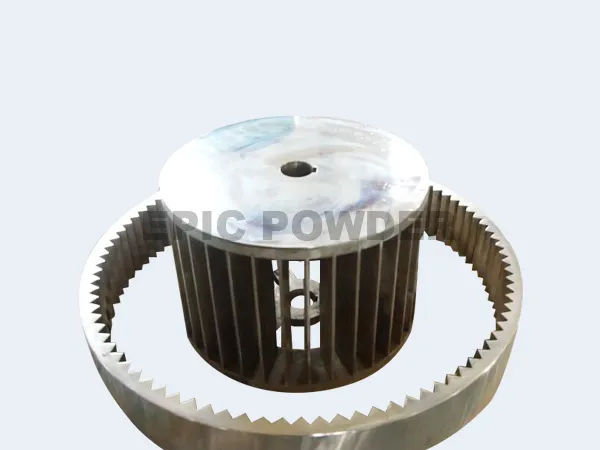
The classifier wheel spins on a vertical axis at the top of the chamber. Coarse particles cannot follow the tight airflow around the blades, so centrifugal force throws them outward and they fall back for regrinding. Fine particles, by contrast, pass through the wheel and exit with the air.
Stage 5 — Collection
Product leaves with the air and is separated in a cyclone, a bag filter or a combination of both. Meanwhile a fan keeps the whole circuit under slight negative pressure, which prevents dust escaping at the feed point.
4. What is inside the machine
Five assemblies do the work. Since wear life and spare-part cost depend on them, it pays to know which ones you will replace and how often. Our separate article on the main components of an air classifier mill goes deeper into each part.
| Assembly | Функция | Wear behaviour |
|---|---|---|
| Impact rotor | Accelerates and breaks particles | Highest wear; elements are replaceable |
| Grinding track | Provides the impact surface | Wears with abrasive minerals |
| Колесо классификатора | Sets the cut point | Slow wear, but balance is critical |
| Deflector liner | Guides the air and material flow | Moderate, depends on velocity |
| Discharge and seals | Keeps product in, dust out | Seals are a consumable item |
Because the wheel rotates at up to 8,500 rpm on our high-speed models, its balance matters more than its hardness. In fact, a badly fitted wheel causes vibration long before it causes wear. That is why wheel material selection is discussed separately in our note on the classifying wheel in an air classifier mill.
5. Why the wheel, not a screen, sets the particle size
A screen mill separates by hole size, so the cut is fixed by hardware and the fines keep getting hit until they escape. An ACM mill separates by aerodynamics instead, and therefore the cut point becomes a setting rather than a component.
Two variables move the cut:
- Wheel tip speed. A faster wheel throws coarser particles outward, so the product gets finer.
- Air volume. More air carries more material, yet it also drags coarser particles through, so the top size drifts up.
Consequently, operators tune fineness with wheel speed and tune throughput with air volume. Nevertheless, the two interact, because pushing air to raise output will always widen the curve slightly. That trade-off is unavoidable, and any supplier who promises otherwise is oversimplifying.
How to read a particle size curve
A single D97 figure hides as much as it reveals, so ask for the full curve whenever the measurement matters. Three points on that curve tell you almost everything:
- The shoulder at the coarse end. A steep drop just above D97 means the classifier is doing its job; a long tail means coarse particles are slipping through.
- The amount below 5 μm. This fraction costs the most energy and often adds nothing to product performance.
- The slope between D50 and D97. A narrow gap indicates a sharp cut, whereas a wide gap indicates a broad distribution.
Therefore two mills quoting the same D97 can behave very differently downstream. For instance, a broad curve loads a filter harder and disperses less evenly in a coating, even though the top size matches on paper.
D97, D50 and what they mean for you
D97 is the size below which 97% of the powder falls, so it describes the top of the curve. D50 is the median. Buyers usually specify D97 because it governs downstream behaviour such as filter loading, coating smoothness or battery slurry viscosity. Meanwhile D50 tells you how much fine material you are paying energy for.
6. What it can and cannot grind
An ACM mill handles most dry, free-flowing material. Even so, five conditions decide whether it is the right machine, and ignoring them is the most common reason a trial fails.
| Condition | Practical limit | What happens beyond it |
|---|---|---|
| Feed size | Usually below 3–5 mm | Rotor overload and uneven output |
| Moisture | Roughly 1–2% for most powders | Material sticks, the wheel blinds over |
| Hardness | Up to Mohs 6–7 with wear protection | Wear parts fail within weeks |
| Stickiness | Low to moderate | Blocked classifier, unstable cut |
| Target fineness | About 5 μm and coarser | Below that, a jet mill is more realistic |
Two of these deserve emphasis. Firstly, moisture is a harder constraint than hardness, since a damp powder will blind a classifier regardless of how well the machine is built. Secondly, the 5 μm floor is economic rather than mechanical, because grinding below it consumes energy out of proportion to the benefit.
For heat-sensitive grades, chilled or conditioned air solves most problems. Besides that, reactive metals need an inerted circuit, and our page on factors that influence ACM performance lists the operating variables in order of impact.
7. How it compares with other mill types
Four grinding principles compete for the same duty. The comparison below is about physics and cost, so it applies whatever brand you end up buying.
| Type | Typical fineness | Energy use | Best fit |
|---|---|---|---|
| ACM / air classifier mill | 5–300 μm | Умеренный | Fine grinding with a controlled top size |
| Струйная мельница | 1–20 μm | Высокий | Very fine, contamination-sensitive products |
| Шаровая мельница | 10–100 μm | High per tonne | Hard, abrasive material and large batches |
| Шпиндельная мельница | 50–500 μm | Низкий | Coarse duty where the top size is not critical |
| Молотковая мельница | 100 μm and coarser | Низкий | Crushing and pre-grinding |
Above roughly 20 μm, therefore, the ACM mill usually wins on energy per tonne and on curve sharpness. Below about 5 μm the advantage moves to the jet mill. Between those two numbers the decision comes down to how tight your specification really is, and our selection guide walks through that judgement.
8. Where an ACM mill is used
Eight material groups account for most industrial demand. Because each one stresses a different part of the machine, the wear package changes with the application.
- Minerals — calcium carbonate, talc, kaolin, bentonite and barite, where output is therefore measured in tonnes per hour.
- Carbon materials — graphite, carbon black and petroleum coke, where the top size directly drives conductivity, so the curve matters as much as the mean.
- Battery materials — anode graphite and cathode precursors, where metal contamination is unacceptable and wear protection is therefore specified.
- Coatings and pigments — where D97 controls gloss and dispersion stability.
- Chemicals — resins, waxes and flame retardants, which are often heat-sensitive and therefore need cooled or conditioned air.
- Food and feed — sugar, cocoa and seaweed, since these lines are cleaned to hygienic standards.
- Ceramics and glass — frits and technical ceramics, which are usually abrasive and therefore need a wear-protected build.
- Recycling — biomass char, PCB scrap and other secondary streams, where feed quality varies and the mill must therefore tolerate swings.
For a material-specific view, browse the air classifier mill category or read the published project cases, which show the actual model, throughput and fineness we installed.
9. The MJW range in three structures
EPIC builds the MJW series in three mechanical layouts, and the choice between them is mostly about accessibility and drive arrangement rather than grinding performance. All three are our own design and our own build at our Qingdao factory.

MJW-A
Horizontal layout with the grinding and classifying drives arranged side by side, which gives a compact footprint.
- Тонкость
- 10–300 μm
- Емкость
- 5–6,000 kg/h
- Models
- 300–1100
MJW-L
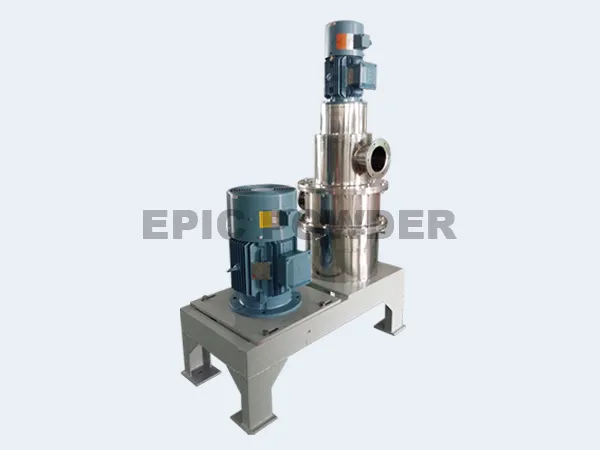
Vertical body with the classifier drive on top, and the widest capacity range in the family.
- Тонкость
- 5–300 μm
- Емкость
- 2–15,000 kg/h
- Models
- 300–2000
MJL-W
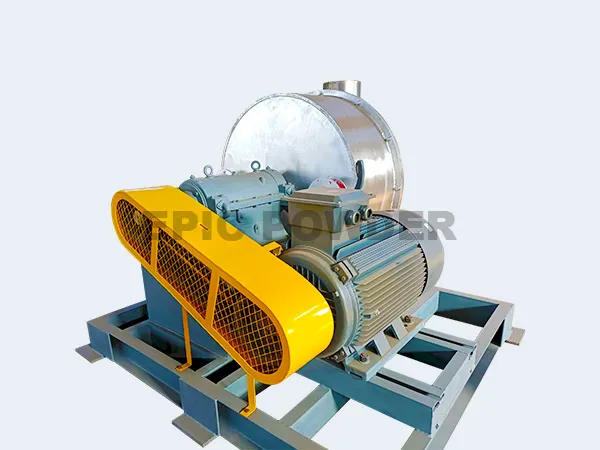
Belt-driven impact mill without a classifier wheel, used for coarse to medium duty ahead of fine grinding.
- Duty
- Coarse to medium
- Классификатор
- None
- Typical use
- Pre-grinding
Alongside those three, the лабораторная воздушная классификационная мельница runs at pilot scale so that a curve can be proven before a production unit is ordered. Once the structure is settled, the individual model pages for MJW-A, MJW-L и MJW-W list every frame size with its motor rating.
10. What to tell a supplier before you ask for a price
A quotation without these five inputs is a guess. Since every one of them changes the model, sending them together saves a week of back-and-forth.
- Material and hardness. Name the substance and its Mohs value, because both drive the wear package.
- Target fineness. Give D97 and, if you have it, D50, because “fine powder” cannot be quoted.
- Required output. State kg/h and whether that figure is finished product or feed, since the two differ by the circulating load.
- Plant conditions. Voltage, frequency, available height and whether the area is classified for dust, because these decide the electrical build.
- Destination and duty. Import terms and continuous or single-shift operation both affect the build, so state them early.
Capacity deserves a warning here. Published kg/h figures assume a specific bulk density and a specific fineness, so a mill rated at 1,000 kg/h on calcium carbonate may deliver 300 kg/h on a light, fibrous material. Therefore always ask for the basis behind the number, and expect a supplier to state the density and D97 it was measured at.
What a written quotation should contain
A one-line price is not a quotation. Besides the price itself, six items belong in the document, because each one becomes a dispute later if it is missing:
- Model, frame size and installed motor power, stated separately for the mill and the classifier, since the two drives are sized independently.
- The capacity basis — bulk density and D97 at which the kg/h figure was measured, because a number without a basis cannot be compared.
- Scope of supply: whether feeder, cyclone, filter, fan, ducting and cabinet are included, so that nothing is assumed.
- Material of construction for the wetted parts, plus the wear-part specification, because these two decide the maintenance cost.
- Voltage, frequency, protection class and any certification documents you require, so the offer matches your grid.
- Lead time, packing method, Incoterm and the warranty terms in months, as these four decide the landed cost.
Moreover, ask for the drawing revision number. Since drawings change, a quotation that references a revision is the only one you can compare against a later offer.
The air volume trap
Ducting, cyclone and filter must be sized from the mill’s air volume, not from its motor power. If the ducting is undersized, the mill will never reach its rated output, no matter how large the motor is. Roughly 1.5–3 m³ of air per kg of product is a working figure for fine grinding.
11. Four things buyers get wrong
“A bigger motor means more capacity”
Not really. Capacity is limited by air volume and by the classifier’s ability to reject coarse particles, so an oversized motor mostly adds installed load without adding tonnage.
“Finer must be better”
Finer costs energy, and it often costs yield too. Indeed, many coatings and mineral fillers perform best at a controlled D97 rather than at the smallest number the mill can reach.
“Any mill can be tuned to any curve”
Each design has a physical floor. An ACM mill cannot reach 1 μm economically, and a jet mill cannot deliver 200 μm cheaply. Consequently, matching the principle to the target matters more than matching the price.
“The spare parts are all the same”
Impact elements and wheels are built to a drawing, so pattern parts rarely fit or balance correctly. Unless the supplier still holds the drawing, a cheap spare can turn into a vibration problem that costs more than the part saved.
12. Questions buyers ask most
The basics
What is an ACM mill in one sentence?
An ACM mill is an impact grinding mill that uses a rotating classifier wheel inside the same housing to hold a precise top size, usually between 5 and 300 μm.
Is an ACM mill the same as an air classifier mill?
Yes. ACM is simply the abbreviation, and both terms describe a machine that combines impact grinding with dynamic air classification.
What does ACM stand for?
Air Classifier Mill. Some catalogues write “air classifying mill” or “classifier mill”, yet the machine is identical.
Performance and limits
How fine can an ACM mill grind?
Around 5 μm as a practical floor, with 10–45 μm being the common industrial range. Below about 5 μm, a jet mill is usually the more economic choice.
Can it handle heat-sensitive material?
Yes, because the residence time is short and the grinding is air-cooled. For very sensitive grades, chilled or conditioned air is added to keep the chamber below the material’s softening point.
What is the maximum feed size?
Typically 3–5 mm depending on the frame size. Larger feed overloads the rotor and produces an unstable curve, so coarse material is normally pre-crushed.
Does it work for sticky or damp powders?
Only up to a point. Above roughly 1–2% moisture, material tends to build up on the classifier wheel, so drying or a different design is needed.
How is the particle size adjusted during operation?
Wheel speed sets the cut point, therefore raising the speed makes the product finer. Air volume controls throughput, and the two are balanced against each other.
Testing, parts and ownership
Can we test our material before buying?
Yes. Send 5–10 kg of representative material and we return a report with the achievable curve, recommended model, throughput and power draw. The test itself is free, and you cover the freight.
What are the main wear parts?
Impact elements, the grinding track, the deflector liner and the classifier wheel. Life ranges from a few months on abrasive minerals to several years on soft carbon black.
Find out what your material will do
Send us 5–10 kg of your powder. We run it on a laboratory MJW unit and return the achievable particle size curve, the recommended model, the throughput and the power draw. You get numbers instead of a brochure claim.
Written by the EPIC Powder engineering team, Qingdao, China. The MJW series is designed, built and supported by EPIC Powder; drawings, wear-part specifications and spare parts all come from the same engineering team that builds the machine. Last updated 30 October 2026.