La calidad del azúcar glas depende del tamaño de partícula. La medida clave es el d90, que significa que el 90% de las partículas son más pequeñas que este tamaño. ¿Por qué es importante el d90? Porque afecta directamente la textura, la solubilidad y el comportamiento del azúcar en las recetas. Las partículas más finas se disuelven más rápido y crean esa textura suave y sedosa en glaseados y cremas de mantequilla. A continuación, se muestra un breve resumen de los tamaños de partícula típicos del azúcar glas molido:
- Azúcar glas casera: 30–50 μm: ideal para proyectos de bricolaje rápidos, pero puede tener una textura granulada y disolverse más lentamente.
- Azúcar glas comercial: 10–20 μm: estándar en el mercado minorista; liso, pero a veces todavía un poco áspero para aplicaciones delicadas.
- Azúcar en polvo ultrafino de primera calidad: 6–8 μm: utilizado por profesionales para obtener texturas ultrasuaves y una rápida disolución en chocolate y confitería.
| Tamaño de partícula (μm) | Sensación en boca | Aplicación típica |
|---|---|---|
| 30–50 | Ligeramente granulado | Repostería casera, uso ocasional |
| 10–20 | Liso | Azúcar glas para la venta al por menor |
| 6–8 | Sedoso, ultrafino | Confitería y chocolate de primera calidad |
Comprender estos rangos te ayudará a elegir el método adecuado para moler el azúcar glas o a saber cuándo necesitas ayuda industrial para lograr un acabado ultrafino. Recuerda que cuanto más fino sea el azúcar, mejor será su textura y solubilidad, características cruciales para obtener glaseados reales, cremas de mantequilla y coberturas que no se derritan, todo perfecto.

Por qué el pulido en casa no es suficiente para los profesionales
Los métodos de molienda caseros, como las licuadoras o los molinillos de café, permiten obtener una molienda aproximada, pero alcanzan un límite de finura de entre 50 y 80 μm. Para uso profesional, esta finura no es suficiente. Los electrodomésticos de cocina tienen dificultades con la acumulación de calor durante la molienda prolongada, lo que puede provocar que los cristales de azúcar se derritan ligeramente y se aglutinen. Esto da como resultado un tamaño de partícula irregular y una textura granulada, lo que afecta negativamente la suavidad y la sensación en boca del azúcar glas.
Además, al procesar lotes grandes necesarios para panaderías o pastelerías, los molinillos pequeños suelen fallar al mantener la consistencia. La distribución del tamaño de las partículas se vuelve irregular, lo que provoca grumos y una menor solubilidad en las recetas. Esta inconsistencia puede arruinar productos delicados como el glaseado real o la crema de mantequilla ultrasuave.
La molienda profesional de azúcar exige partículas ultrafinas y uniformes, además de una producción constante, algo que los equipos de cocina simplemente no pueden ofrecer. Por ello, las soluciones de molienda de azúcar en polvo de grado industrial son esenciales.
Molienda de azúcar en polvo de grado industrial: Molinos clasificadores de aire
Un molino clasificador neumático es una máquina de molienda especializada diseñada para producir azúcar en polvo ultrafino con un control preciso del tamaño de partícula. A diferencia de los molinos tradicionales que simplemente trituran el azúcar, los molinos clasificadores neumáticos combinan la molienda y la clasificación en un solo paso. Esto significa que las partículas de azúcar se muelen y luego se clasifican inmediatamente por tamaño mediante el flujo de aire dentro del molino, lo que garantiza que solo pasen las partículas más finas.
La principal ventaja de los molinos clasificadores de aire radica en su capacidad para lograr un tamaño de partícula d90 ultrafino entre 6,3 y 6,7 μmEsto va mucho más allá de lo que pueden lograr los molinillos de cocina o de martillos convencionales. Esta finura extrema mejora la solubilidad y la sensación en boca, cualidades esenciales para el azúcar glas y el azúcar impalpable de primera calidad.
Además, estos molinos funcionan a baja temperatura gracias a sus camisas de refrigeración integradas. Esto evita la degradación o caramelización del azúcar durante la molienda. La distribución precisa del tamaño de partícula garantiza un flujo constante y reduce la formación de grumos, lo que hace que los molinos clasificadores de aire sean ideales para confiterías industriales, panaderías y fabricantes de alimentos.
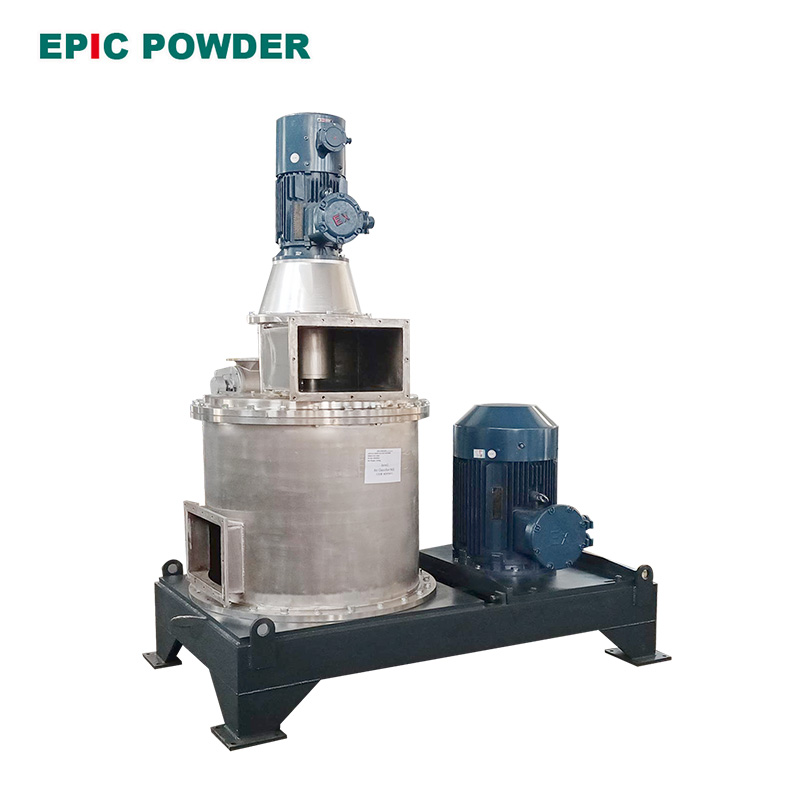
Molino clasificador de aire de Epic Powder modelos Estos beneficios se ejemplifican con una construcción en acero inoxidable apto para uso alimentario, un funcionamiento energéticamente eficiente y capacidades adaptadas a la producción comercial. Su control preciso y su proceso de molienda limpio los convierten en la mejor opción para la molienda de azúcar en polvo ultrafino en todo el mundo.
Consideraciones de seguridad e higiene
Al moler azúcar en polvo, la seguridad y la higiene deben ser prioritarias. Es fundamental utilizar maquinaria apta para uso alimentario para evitar la contaminación y garantizar que el producto final cumpla con las normas sanitarias. Se prefieren materiales como el acero inoxidable, ya que resisten la corrosión y son fáciles de limpiar.
El polvo fino de azúcar supone un grave riesgo de explosión, especialmente en entornos industriales o a gran escala. Una ventilación adecuada, sistemas de recolección de polvo y una monitorización regular reducen significativamente este peligro. Evite que el polvo de azúcar se acumule alrededor de los molinillos o las áreas de procesamiento.
La limpieza y el mantenimiento adecuados de su molinillo de azúcar glas garantizan su buen funcionamiento y evitan la formación de grumos por acumulación de azúcar residual. La limpieza diaria, las inspecciones rutinarias y la limpieza profunda ocasional con productos no abrasivos ayudan a mantener la higiene y prolongar la vida útil del equipo. Seguir estas buenas prácticas garantiza una molienda de azúcar glas segura, eficiente y de alta calidad en todo momento.
Polvo épico Molino clasificador de aire
El molino clasificador de aire de Epic Powder ofrece un rendimiento excepcional al moler azúcar granulada hasta obtener un tamaño de partícula ultrafino d90 de 6,3–6,7 μm. Este nivel de finura garantiza una textura suave y una excelente solubilidad, ideal para pasteleros profesionales y fabricantes de alimentos que exigen una calidad constante.
Especificaciones técnicas clave
| Característica | Detalles |
|---|---|
| Tamaño de partícula (d90) | 6,3–6,7 μm |
| Capacidad | Hasta varios cientos de kg/hora |
| Fuerza | Opciones de motores de bajo consumo energético |
| Materiales | Acero inoxidable 100% apto para uso alimentario |
| Enfriamiento | Chaquetas de refrigeración opcionales disponibles |
Estas características ayudan a mantener una temperatura baja durante la molienda, evitando la degradación y la formación de grumos en el azúcar. La clasificación precisa del molino con clasificador de aire garantiza una distribución estrecha del tamaño de partícula, fundamental para obtener un azúcar en polvo ultrafino, ideal para glaseados, coberturas y postres delicados.

Gracias por leer. Espero que mi artículo les sea útil. Dejen sus comentarios abajo. También pueden contactar al servicio de atención al cliente de Zelda para cualquier otra consulta.
— Publicado por Emily Chen