In the industrial mineral processing sector, calcium carbonate is one of the most widely used inorganic fillers. Whether dealing with Ground Calcium Carbonate (GCC) or Precipitated Calcium Carbonate (PCC), the particle size distribution and whiteness directly determine the value of downstream products. As global industries demand finer powders, adopting efficient calcium carbonate grinding technology has become a top priority for manufacturers. While Raymond Mills were once the standard for coarse processing, the shift toward “ultrafine and high-purity” production has made the Air Classifier Mill (ACM) the preferred choice. This article explores why the ACM is superior in modern calcium carbonate grinding workflows.

The Generational Gap in Technical Principles: From “Forced Compression” to “Impact Classification”
To understand the pros and cons of both, we must first analyze the fundamental differences in their grinding mechanisms.
The Raymond Mill Grinding Method
The Raymond Mill belongs to the category of compression grinding equipment. It uses a central shaft to drive grinding rollers on a plum blossom stand, utilizing centrifugal force to press the rollers against a grinding ring. Material is crushed by strong extrusion and rubbing between the rollers and the ring.
- Drawbacks: This method exerts heavy destructive force on the material, leading to severe metal wear of the rollers and rings. This often results in metal powder contamination, which negatively impacts the whiteness of the calcium carbonate. Furthermore, the high heat generated by compression is unfavorable for maintaining the physical activity of the material.
그만큼 Air Classifier Mill (ACM) Grinding Method
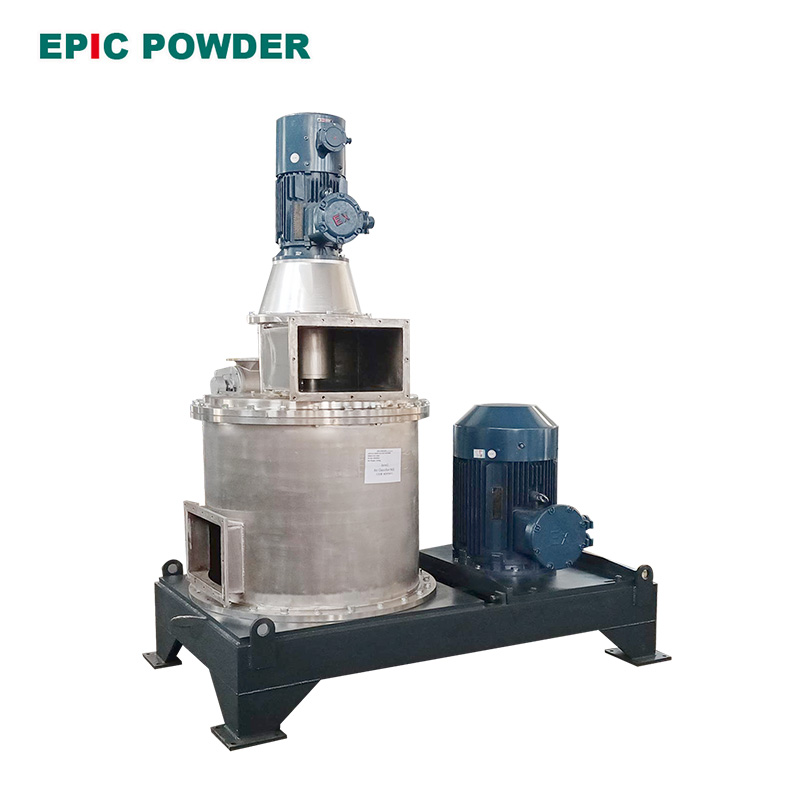
The ACM integrates high-speed impact grinding 그리고 precision air classification into a single unit. Once the material enters the grinding chamber, it is instantaneously shattered by high-speed rotating rotor blades (or hammers) and undergoes high-frequency collisions with the liner.
- Advantages: Impact grinding is far more efficient for achieving fine particles. Because the material stays in the chamber for a very short time, heat buildup is minimized. The integrated classifier wheel ensures that only the desired fineness is discharged.
Why is the 미국화학물질관리협회(ACM) Superior to the Raymond Mill? Five Core Advantages
1. Precision of Particle Size Control (D50 and D97)
In the calcium carbonate industry, customers look beyond average particle size; they prioritize the control of top-cut particles (D97).
- Raymond Mill: Classification typically relies on an impeller at the top of the machine, which is less efficient and prone to “coarse particle leakage.” Due to uneven grinding pressure, the resulting powder has a broad particle size distribution.
- ACM: It utilizes a high-precision horizontal or vertical classifier wheel. By adjusting the wheel speed, the particle size can be cut precisely. An ACM can easily produce ultrafine powder ranging from D97: 10μm to 45μm with a very narrow distribution, ensuring stability in coating or plastic applications.
2. Protection of Product Whiteness
Whiteness is a core metric for calcium carbonate as a filler.
- Raymond Mill: The rollers and rings involve typical “metal-on-metal” heavy friction. Over time, metal wear debris mixes into the powder, causing the calcium carbonate to turn dark, bluish, or grayish.
- ACM: It employs non-contact grinding or low-wear impact. The interior can be lined with ceramics or special wear-resistant materials, minimizing iron contamination and ensuring the original whiteness of the calcium carbonate is perfectly preserved.
3. Continuity and Stability of Production Capacity
- Raymond Mill: Adjusting batches is cumbersome. Replacing rollers and rings requires long downtime, and as they wear, the fineness of the finished product gradually drifts.
- ACM: It supports fully automated control. With fewer wear parts that are easy to replace, the equipment can run stably for long periods. For large-scale production lines, the ACM offers higher single-machine capacity, and the yield rate (percentage of qualified powder) is significantly better.
4. Adaptability to Heat-Sensitive and Moist Materials
Calcium carbonate can be sensitive to heat during fine processing.
- Raymond Mill: It has a relatively small circulating air volume and slow heat dissipation, which can cause material to stick to the walls or agglomerate.
- ACM: It operates with a massive airflow. This high air pressure acts not only as a transport force but also as a significant cooling mechanism. For surface-treated calcium carbonate (e.g., coated with stearic acid), the ACM effectively prevents the coating agent from melting, ensuring the quality of the modification.
5. Environmental and Energy Performance
- Raymond Mill: It operates with significant noise and a high risk of dust leakage.
- ACM: The system typically operates under full negative pressure and is equipped with high-efficiency pulse dust collectors, keeping the workshop environment clean. Although the ACM motor rotates quickly, its integrated “grinding-classification” design reduces wasted energy, often making the energy consumption per unit of output more favorable.

Deep Dive: How the ACM Optimizes “Deep Processing”
For calcium carbonate enterprises, choosing an ACM is not just about replacing a machine—it is an upgrade of the production process.
- Competitiveness from Narrow PSD: Powder produced by Raymond mills lacks a distinct “peak,” whereas ACM powder exhibits excellent normal distribution. In plastic granulation, narrow-distribution calcium carbonate significantly improves filling rates, lowers base material costs, and enhances the tensile and impact strength of the final product.
- Versatility: By simply adjusting the classifier parameters, the ACM can flexibly switch between 325 mesh (coarse), 800 mesh, 1250 mesh, or even finer specifications. This flexibility is unattainable for traditional Raymond mills.
Practical Application: A Comparison of Results
In a comparative test for a company producing 50,000 tons of GCC annually:
- Using Raymond Mills: When trying to reach 1250 mesh, the yield rate was only 65%. Frequent downtime was required to replace worn rollers.
- Switching to MJW Series ACM: The yield rate exceeded 88% for the same 1250 mesh target. The D97 was consistently held below 10μm. Maintenance cycles were extended from every two weeks to every three months, significantly cutting operational costs.
Critical Questions in Calcium Carbonate Grinding
When upgrading to an ACM system, engineers often ask:
Q1: How does the ACM handle the “over-grinding” issue common in ultrafine production?
Answer: Unlike mills that keep material in the chamber until it randomly falls through a screen, the ACM uses an active classifier wheel. This wheel creates a centrifugal force that only allows particles of the target size to pass. By removing finished powder immediately, the system prevents over-grinding, saves energy, and ensures a narrow particle size distribution.
Q2: Can the ACM be used for surface-treated (coated) calcium carbonate?
Answer: Yes. In fact, it is the ideal choice for calcium carbonate grinding combined with coating. The high-volume airflow within the ACM acts as a cooling agent. This prevents the coating fatty acids (like stearic acid) from melting or unevenly clumping, resulting in a superior, free-flowing coated product.
결론
While the Raymond Mill remains a cost-effective option for low-grade coarse powder, the Air Classifier Mill is the gold standard for high-performance applications. It offers unmatched quality control and environmental safety. For any manufacturer serious about excelling in calcium carbonate grinding, the transition to ACM technology is the most effective way to secure a competitive edge in the global market.

“Thanks for reading. I hope my article helps. Please leave a comment down below. You may also contact Zelda online customer representative for any further inquiries.”
— Posted By Emily Chen