Konjac root powder, derived from the tuber of the Amorphophallus konjac plant, has experienced a massive surge in global demand. Konjac powder is rich in glucomannan—a hydrophilic dietary fiber with exceptional water-locking capabilities. Therefore, it has become a core ingredient in clean-label food thickeners, plant-based meat (vegetarian), dietary supplements, and pharmaceutical formulations.
However, achieving the premium, ultra-fine particle size (often 120 to 200+ mesh) required for modern applications is a notorious challenge for manufacturers. Traditional milling systems frequently fail, resulting in ruined product texture, clogged machinery, and degraded viscosity.
To overcome these obstacles, processing industries have turned to the Паветраны класіфікатар (ACM). This article will explore why air classifier mills are the definitive technology for processing konjac root powder and provide a step-by-step operating guide. It will guide you on how to configure your system to achieve perfect ultrafine grinding without sacrificing quality.

The Unique Challenges of Milling Konjac Root Powder
To understand why the Air Classifier Mill is so effective, one must first understand the hostile nature of raw konjac during mechanical reduction. Konjac root behaves unlike standard agricultural products or hard minerals due to two inherent properties:
High Viscosity & Extreme Hygroscopicity
Glucomannan can absorb up to 50 times its weight in water. When raw konjac chips are subjected to friction in a standard grinding chamber, they absorb any ambient moisture or humidity instantly. As the particles get smaller, their surface area increases, accelerating this moisture absorption. The powder quickly transforms from a dry solid into a sticky, gummy paste that adheres to internal machinery parts, blinds screens, and completely halts production.
Heat Sensitivity and Viscosity Degradation
The commercial value of konjac root powder is directly tied to its viscosity. High-quality konjac must retain its high molecular weight to form stable gels. Traditional mechanical mills, such as hammer mills or pin mills, rely on pure impact and shear, generating intense localized heat within the grinding zone. If the internal temperature exceeds critical thresholds, the long-chain glucomannan polysaccharides fracture. This thermal degradation permanently destroys the powder’s gelling capacity, compromises its water-holding capability, and discolors the final product from a pristine off-white to an unmarketable brown.
Why the Air Classifier Mill (ACM) is the Perfect Match
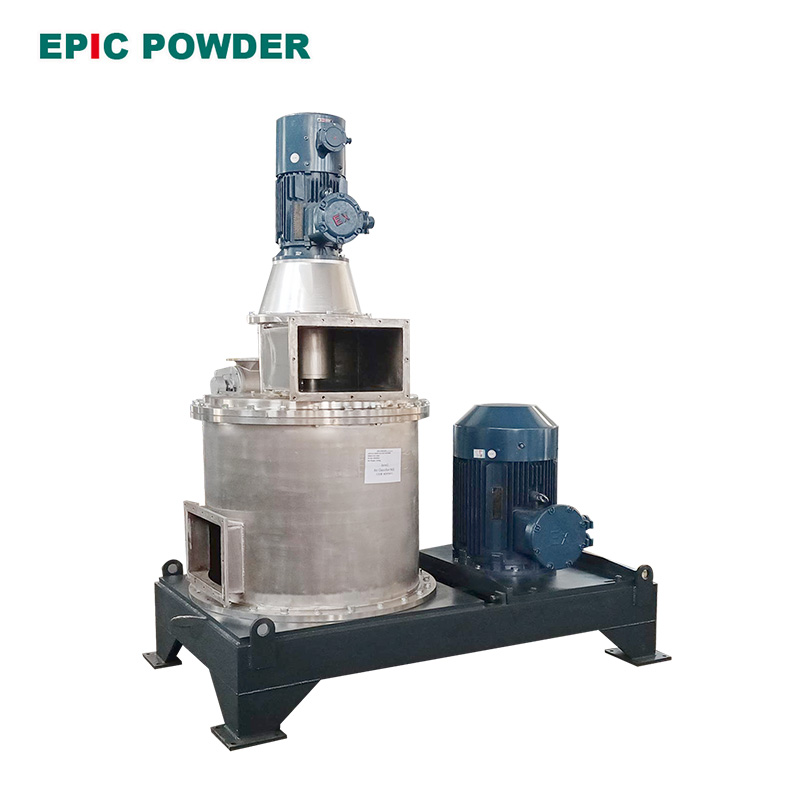
The Air Classifier Mill solves the inherent flaws of traditional crushing systems by combining mechanical impact grinding with an integrated, high-speed air classification system within a single unit.
The Cooling Power of High-Volume Airflow
Unlike traditional grinders that trap heat, ACM relies on a continuous, high-volume airflow to transport materials. This high air-to-solid ratio acts as a natural cooling mechanism. The airflow absorbs and carries away the heat generated by the mechanical impact of the rotor pins or hammers. Consequently, this keeps the temperature inside the grinding chamber well below the degradation point of glucomannan.
Seamless Integration of Milling and Classifying
In an ACM, particle size reduction and separation happen simultaneously. As the internal rotor breaks down the konjac chips, the air streams carry the particles upward toward an integrated, independently driven classifier wheel.
- Fine particles that match the required aerodynamic profile pass through the wheel and move to the cyclone collector.
- Oversized particles are rejected by the centrifugal force of the wheel and thrown back down into the grinding zone for immediate re-milling.
This mechanism eliminates the need for physical mesh screens, which are the primary failure point for sticky materials like konjac. Without screens, there is nothing to blind or clog. Furthermore, it prevents “over-milling”—fine particles are evacuated instantly rather than being repeatedly struck, minimizing thermal exposure.
Step-by-Step: Operational Settings for Ultra-Fine Konjac Root Powder
Achieving a consistent 120 to 200 mesh ultra-fine konjac powder requires precise control over the ACM’s variables. Below is the operational blueprint for optimization.
Step 1: Raw Material Preparation and Moisture Control
Before the konjac ever reaches the mill, its moisture content must be strictly managed. Raw konjac slices or coarse granulates should be pre-dried to a moisture level of between 8% and 10%. Any moisture higher than 12% exponentially increases the risk of agglomeration inside the milling chamber, regardless of the airflow volume.
Step 2: Optimizing the Classifier Wheel Speed
The final particle size is primarily controlled by the relationship between the air velocity and the rotational speed of the classifier wheel. To shift the particle size distribution (PSD) toward ultra-fine levels (e.g., 95% passing through 150 mesh):
- Increase the classifier speed: High RPMs increase the centrifugal force, ensuring that only the finest particles can escape the wheel’s vanes.
- Balance the tip speed: The tip speed of the grinding rotor must be high enough to break the fibrous chunks of konjac but calibrated so it does not cause localized melting.
Step 3: Managing Air Volumetric Flow & Temperature
To guarantee the preservation of glucomannan quality, the air handling unit must be carefully monitored. For optimal ultra-fine production, integrating a chiller or dehumidifier into the ACM’s air intake system is highly recommended. By supplying dry, cool air (typically between 10°C and 15°C), a miniature internal environment is created. This prevents the konjac from absorbing moisture or overheating, thus maintaining a stable system balance during continuous operation for several hours.
Key Benefits of Using ACM for Your Konjac Root Powder Production Line
Narrow Particle Size Distribution (PSD)
For applications like instant diet shakes or pharmaceutical binders, uniformity is everything. A wide PSD results in unpredictable hydration rates and a gritty mouthfeel. Because the ACM utilizes precise aerodynamic classification, the resulting powder features an incredibly narrow, bell-curved distribution. Every batch hydrates at the exact same rate, delivering a smooth, premium mouthfeel in food formulations.
| Feature / Metric | Traditional Hammer Mill | Паветраны класіфікатар (ACM) |
| Дасягальная тонкасць | 60 – 80 mesh (Inconsistent) | 120 – 200+ mesh (Highly Uniform) |
| Clogging Risk | High (Requires frequent shutdowns) | Low (Screenless design prevents blinding) |
| Viscosity Retention | Low (Thermal damage common) | Maximum (Continuous airflow cooling) |
| Operation Mode | Batch / Intermittent | Continuous Automated Production |
Maximum Preservation of Viscosity
Because the material is continuously cooled by the system’s airflow and evacuated the microsecond it hits its target size, thermal degradation is virtually eliminated. This ensures that the final powder retains its highest nominal viscosity (measured in mPa·s).This allows you to capture a premium in the B2B market.
Automated, Dust-Free, Continuous Operation
Modern ACM loops operate under negative pressure. This enclosed system prevents fine, allergen-prone or irritating organic dust from escaping into the factory environment, ensuring strict compliance with local safety and environmental standards. Furthermore, it supports 24/7 continuous automation, drastically reducing labor overhead.
Conclusion & Equipment Selection
Achieving ultra-fine konjac root powder is an exercise in balancing force, airflow, and temperature. While the raw material presents significant processing hurdles due to its high viscosity and heat sensitivity, the Air Classifier Mill provides the exact physical environment needed to neutralize these issues.
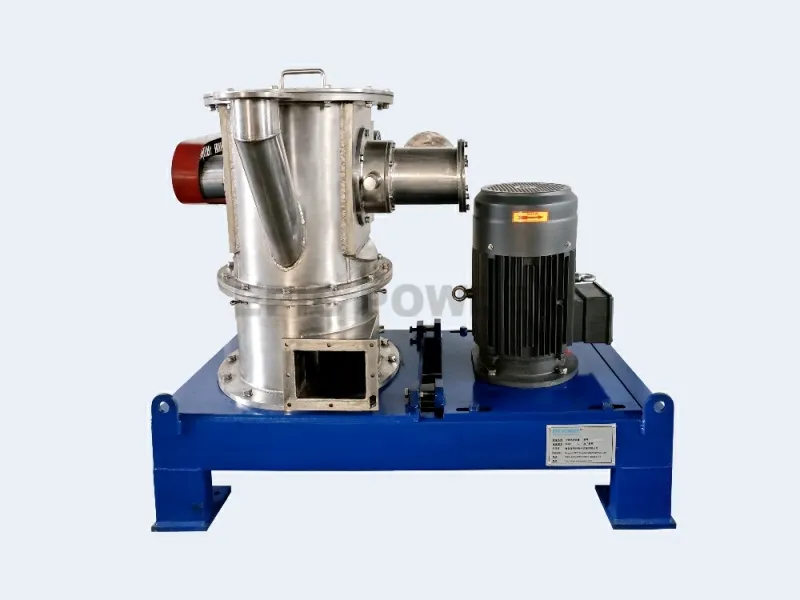
When choosing an ACM system for your konjac production line, standard configurations are rarely enough. Ensure you partner with a manufacturer capable of providing customized systems equipped with chilled air inlets, anti-stick internal polished surfaces, and precision variable-frequency drives (VFD) for both the rotor and classifier. With the right system configuration, your processing facility can consistently unlock a premium, ultra-fine product that meets the stringent demands of the modern global market.
Frequently Asked Questions (FAQs)
Q1: How do you prevent blocking or clogging when grinding konjac with an ACM?
Clogging is prevented through two main design elements: screenless operation і moisture control. Because the ACM uses an aerodynamic wheel instead of a physical screen mesh to classify size, there are no holes to get blinded by sticky material. Additionally, ensuring your feed raw material has an initial moisture level below 10% prevents the powder from forming an paste inside the system.
Q2: Can we inject chilled air into the Air Classifier Mill for konjac processing?
Yes, and it is highly recommended for high-capacity industrial production lines. Integrating a chilling unit into the air intake loop cools the incoming ambient air to around 10°C–15°C. This acts as an active heat sink, guaranteeing that even during extended, multi-hour production runs, the internal system temperature never spikes to a degree that threatens the quality of the konjac.

«Дзякуй за чытанне. Спадзяюся, мой артыкул будзе карысным. Калі ласка, пакіньце каментар ніжэй. Вы таксама можаце звязацца з прадстаўніком службы падтрымкі кліентаў Zelda онлайн, калі ў вас ёсць дадатковыя пытанні».
— Апублікавана Эмілі Чэн