Impact Mill vs Air Classifier Mill: Which One Fits Your Material and Budget?
They look alike on a quotation and differ by one part. That part decides whether your D97 is a promise or an average.
- A hard top size at 45 μm or finer is bought with the classifier wheel. No screen holds that line in production.
- At 100 μm and above, a plain impact mill does the same work for less capital and cheaper wear parts.
- The expensive mistakes we see are over-grinding: paying for 20 μm when the specification accepts 45.
Two machines, one purchase order, and a decision that stays in the plant for a decade. Start with the cut point, then the feed, then the budget, in that order. A 45 μm top size at 5 t/h is a plain impact mill problem. A 20 μm top size at the same tonnage is an air classifier mill problem.
The price gap between the two is real, and it is smaller than the cost of choosing wrong: a machine that cannot hold your D97 gets replaced, and a machine that over-grinds for ten years takes the difference out of your electricity bill. The numbers below let you run that comparison on your own duty.

01Let the cut point pick the machine
Your top-size tolerance picks the machine, and everything else negotiates the price. Three branches cover most of the inquiries that reach us, and each one has a clear loser as well as a winner.
100 μm and above: plain impact mill
At this band a screen or a hammer set does the job, and a wheel adds cost without adding capability. Hammer and pin mills hold 20–150 μm on mineral fillers in our own project experience, with throughput per kilowatt at its highest in the whole mechanical range. The same duty on a screen mill quotes 25–40% below an equivalent ACM.
20–45 μm: air classifier mill, sized for the top
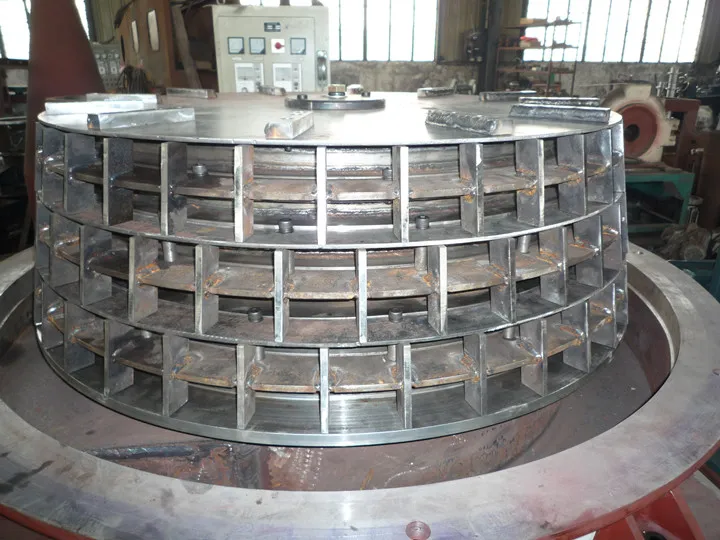
This is the band where a screen stops being a specification. Screen aperture is a hole; the particle that leaves is a shape, and elongated particles pass a hole narrower than their long axis. A wheel sorts by drag against mass, so the cut follows the particle’s behaviour in air, whatever the hole size.
Below 20 μm: ACM at its edge, jet mill beyond
Mechanical classification stays economic down to about 5 μm. Below that the wheel has to run so fast that tip wear and heat become the limiting cost, and a jet mill takes over. Projects that sit on that line get a straight comparison before anyone signs.
| Duty | Plain impact mill | Vzduchový třídičový mlýn |
|---|---|---|
| D97 150–500 μm, high tonnage | First choice: lowest capex, highest kW efficiency | Works, and you pay for control you do not need |
| D97 45–100 μm | Workable on soft, free-flowing feed | First choice when the top size is contractual |
| D97 20–45 μm | Unstable: screen wear and an oversize tail | First choice, sized at your cut |
| D97 5–20 μm | Out of range | Edge of range: test the material first |
| Abrasive feed, Mohs 7+ | Cheap castings, replaced often | Precision wear parts, protected by design |
| Six product changes a week | Screen swap in minutes | Cleaning and wheel change cost hours |
| Damp or sticky feed | Blinds the screen quickly | Tolerates more, still needs dry feed |
02An impact mill is a class of machines, an ACM is one member of it
The two names sit at different levels of the same family tree, which is why quotations compare machines that were never equivalent.
An impact mill is a size-reduction machine that breaks particles by striking them with a fast-moving rotor, hammer or pin; the energy arrives as a collision, and the breakage follows from it.
That definition covers hardware from a hammer mill to a jet mill, and the entry on the subject divides milling devices into two general classes, impact and attrition, tracing the modern impact form to high-speed rotors, hammers and pins (Wikipedia, accessed November 2026; the underlying treatment is Swain, Patra and Roy, Mechanical Operations, Tata McGraw-Hill, 2011). The category describes the force. It says nothing about how the product size is controlled, and that is the part buyers actually need to know.
An air classifier mill is an impact mill with a rotating classifier wheel mounted in the same housing, so the cut point becomes a setpoint instead of a screen aperture.
Four variants you will be quoted
- Kladivový mlýn — hammers swing or are fixed against a breaker plate, with a screen at the discharge. The workhorse for 20–150 μm and the cheapest route to a coarse powder.
- Kolíkový mlýn — two pin discs, one stationary, and the material is caught between them. Narrow distributions on brittle feed, and a clean chamber that suits frequent product changes.
- Turbine or beater mill — a bladed rotor without a screen, used for coarse reduction ahead of a finer stage.
- Disc mill — toothed discs for tough and elastic materials that bounce off hammers instead of breaking.
Trade usage blurs the line. Suppliers write “impact mill” for any of the four, and “air classifying impact mill” for the version with a wheel. When a quotation says impact mill, ask whether a wheel is included, because that one question changes the machine, the achievable D97 and the price. If you want the full picture of the machine itself, we keep it on the air classifier mill specification walkthrough.
03The classifier wheel is the part you are actually paying for
Remove the wheel and you still have a grinder. What you lose is the top-size guarantee, and that is the only feature a specification cares about.
Size reduction continues for as long as particles stay in the chamber. A screen ends that stay by geometry: anything larger than the aperture goes back for another hit. A wheel ends it aerodynamically: particles above the cut are thrown outward by centrifugal force, particles below it pass with the air. Wheel speed sets the cut, so a change of product becomes a keypad entry, with no shutdown and no parts change. The direction of that relationship is predictable, since a faster wheel throws coarser particles outward and lowers the cut; the slope is machine-specific, and a test curve is a better guide than any formula.
D97 is the particle size below which 97% of the powder by volume falls, and it is the number a top-size specification is written against.
Specific energy is the electrical energy consumed per tonne of product, expressed in kWh/t, and it is the figure that separates a cheap machine from a cheap process.
Both numbers usually come from laser diffraction. ISO 13320:2020 fixes the procedure so that two laboratories differ by a known amount instead of an unknown one, which matters when your customer tests the incoming powder with a different instrument than the one you used to release it (ISO 13320:2020).
Without a wheel, residence time sets the size, and fines that already meet the spec stay in the chamber and keep being struck. The energy goes into narrowing a distribution nobody asked to narrow. With a wheel, those fines leave as soon as they qualify, and the mill spends its power on the coarse tail that still needs work. The mechanical difference between the two approaches is covered in more depth in pin mill and ACM particle-size control, side by side.
04Where a plain impact mill wins
Coarse, abrasive and frequently changing duties still belong to the plain impact mill, and on those duties the gap is wide enough to matter.
Coarse tonnage. At D97 100–300 μm no other mechanical mill moves more material per kilowatt. The rotor does not have to be precise, the screen does the sorting, and the whole assembly is built for volume.
Abrasive feed. Hammers and liners are simple castings. A set costs a fraction of a classifier wheel, and a worn hammer is swapped on a shift, and it never leaves the plant for rebalancing. On a Mohs 7 mineral, that difference in replacement cost shows up every quarter.
Fast changeover. A screen swap takes 10–20 minutes. Cleaning a classifier circuit and changing a wheel takes half a day, and on a plant running six products a week the accumulated hours are a real capacity loss.
Particle shape. Impact breakage produces angular particles with clean edges. For some fillers that raises packing fraction and is welcome; for powders that must flow through a 200 μm nozzle it is not. Shape is rarely on a datasheet and almost always visible downstream.
The limits are just as clear. There is no top-size guarantee, and there is always an oversize tail, because a screen passes the particle that fits and a real particle is not a sphere. On a 100 μm screen, a fraction above 100 μm gets through, and that fraction is what your customer’s sieve finds.
05Where the air classifier mill wins
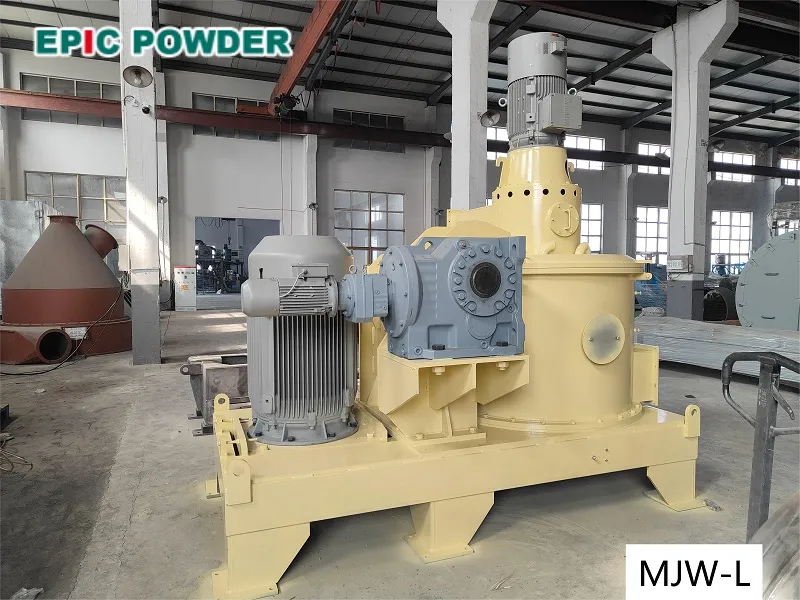
At 10–45 μm with a contractual top size, the ACM is the cheaper machine across five years even though it costs more on the purchase order.
| Dimenze | Plain impact mill | Vzduchový třídičový mlýn |
|---|---|---|
| Cut point | Fixed by screen aperture per product | Set by wheel speed, adjustable while running |
| Achievable D97 | 20–150 μm in practice | 5–300 μm across the MJW range |
| Distribution width | Wider, with an oversize tail | Narrower, tail cut by the wheel |
| Specific energy | Lower at coarse sizes | 15–60 kWh/t in our machines |
| Opotřebitelné díly | Hammers, screen | Hammers, liner, classifier wheel |
| Changeover | Minutes | Hours, including cleaning |
| Heat in the chamber | Rises as the target gets finer | Lower: the air stream carries heat out |
Capacity falls as the cut tightens, and the fall is steep enough to change a project’s economics. On the same frame, in our own project experience, moving a D97 target from 45 μm to 20 μm costs 35–50% of throughput and adds roughly 10–15 kWh/t. Ask for the capacity at your cut, with the test method named, and treat a brochure figure quoted at a coarser reference point as a different machine.
The practical ceiling is around 5 μm. Below it the wheel has to run fast enough that tip speed, heat and wear dominate the cost, and the economics move to a jet mill, which is when a jet mill earns its higher running cost.
06Four materials, four different answers
The material decides more than the price list does, and four common feeds split the decision cleanly.
Graphite: keep the flake intact
Anode graphite is judged on tap density and cycle performance, and both fall when flakes are rounded or broken. An ACM run at low rotor speed with the wheel doing the sizing keeps the platelet shape; a plain impact mill at high tip speed hammers it into rounds. For a 20 μm D97 with shape retention, the wheel is not optional. We wrote up the process in graphite anode grinding that keeps the flake intact.
Calcium carbonate: the forgiving one
Ground calcium carbonate at 10–45 μm is the easiest of the four. It is brittle, free-flowing and only moderately abrasive, so both machines work above 45 μm and the choice reduces to capital against controllability. Below 20 μm the wheel pays for itself within a year on most duties we quote.
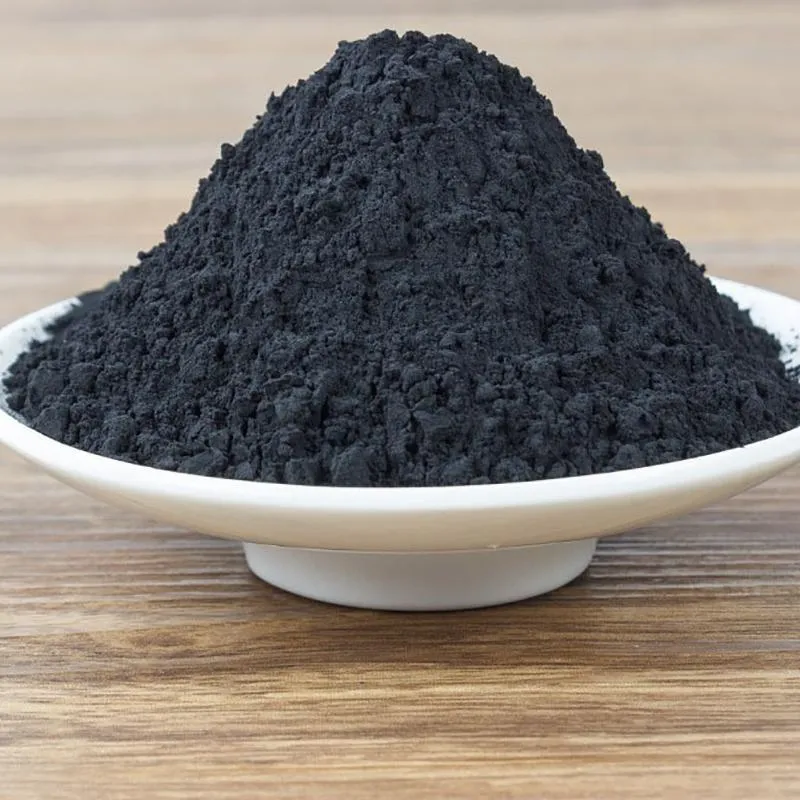
Carbon black: feed is the bottleneck
Conveying is the hard part and grinding is the easy one: an over-fed chamber chokes before it does any work. A long-gap rotor with a wheel handles the low density better than a screen mill, which blinds as the material packs against the mesh. Soft feed also over-grinds quickly without a wheel, because nothing leaves until the air decides.
Bentonite: moisture decides
Above roughly 2% moisture the wheel blinds and the cut drifts coarse. Drying, or a heated air stream through the mill, is part of the machine choice, and it belongs in the budget. A screen mill blinds faster and is harder to clean, which is why bentonite tends to end up on an ACM once the deposit is variable. The bentonite line we commissioned in Greece needed inlet moisture controlled before the wheel would hold its cut for a full shift, and that control became part of the scope.
07What five years actually costs
The purchase order covers part of the cost. Electricity, wear parts and lost hours take the rest, and only one of the three appears on the quotation.
Split the number into five lines before comparing offers: the mill, the system around it (fan, filter, feeder, ducting, foundation), wear parts per year, energy per tonne, and downtime per changeover. The mill is the line buyers negotiate hardest and the line that matters least over a decade.
Energy is easy to under-estimate because the unit is small. Take 1,000 t/year at 30 kWh/t, which is 30,000 kWh. At US$0.10/kWh that is US$3,000 a year. Move to 45 kWh/t and it becomes US$4,500, a 50% increase that never shows up in a machine-to-machine comparison. Across five years the difference is US$7,500, which at this scale is often larger than the price gap between the two machines.
Wear follows the material, and the calendar has little to do with it. In our own project experience, abrasive minerals take a set of hammers in a few months, while soft carbon black runs for years on the same parts. Ask for a wear cost per tonne on your material, and treat a supplier who quotes only a parts price as incomplete.
Downtime is the line nobody puts in the spreadsheet. Two hours per changeover, twice a week, is 200 hours a year; on a line worth US$400 an hour in contribution, that is US$80,000, more than the difference between the machines in most projects we see. The MJW range and its working widths is where those changeover hours get priced.
08Twelve checks before you sign
Every one of these has killed a project we were later asked to rescue, so run them before the purchase order.
- D97 and D50 both specified, with the test method named. A single number hides the distribution.
- Capacity quoted at your cut, not at a reference cut. Ask for the derating curve.
- Feed size upper limit in mm, and what happens above it. Pre-crushing may be cheaper than a bigger mill.
- Moisture at the inlet, worst month rather than annual average. 2% is the usual wheel limit.
- Hardness and silica content. Mohs 6–7 is where wear cost changes order of magnitude.
- Bulk density and flowability, with a photo of the feed. Feeding problems look like grinding problems.
- Specific energy in kWh/t at your duty. Convert it to annual cost before comparing prices.
- Wear parts list with life in months and price per set. Then compute cost per tonne.
- Changeover time and cleaning procedure, in hours. Multiply by your product mix.
- Air volume and filter area, with the dust load. The system is quoted separately for a reason.
- Turn-down ratio: lowest stable feed rate. Most lines run below nameplate most weeks.
- Witnessed test on your material, with the report attached to the order. Numbers in a contract beat numbers in a brochure.
09What to send a supplier to get a real answer
Five items turn a quotation into a commitment, and a supplier who does not ask for them is quoting a catalogue.
Send the material name with an SDS, 5–10 kg of representative sample (not a dried lab scoop), the target D97 and D50 with the instrument method, the required kg/h and operating hours, and the feed conditions: moisture, bulk density, and the largest particle in the stream. Add what happens downstream, because a powder that flows badly through a bagging line fails in the plant even when it passes the sieve.
Our lab runs the sample through a pilot frame, measures the curve on a laser diffraction unit, and reports four numbers at your cut: achievable D97, throughput, specific energy and the frame that produced them. A curve without those four numbers is a catalogue figure with a test report stapled to it. Without it, every supplier is guessing at the same duty, and the cheapest guess usually wins the order.
Často kladené otázkyQuestions buyers ask us
Is an air classifier mill a type of impact mill?
Yes. It breaks particles by impact and adds a rotating classifier wheel in the same housing. That wheel is what turns the cut point into an adjustable setpoint.
Can a plain impact mill reach D97 10 μm?
Rarely, and not repeatably. A screen mill at that size blinds, wears and passes oversize. The 10 μm band belongs to a classifier mill or a jet mill.
Which one costs less to run?
Above roughly 45 μm the plain impact mill uses less energy per tonne. Below 45 μm the classifier mill wins, because it stops grinding particles that already meet the spec.
Do I need a wheel for a 100 μm product?
Usually not. A screen holds 100 μm well enough on free-flowing feed, and the capital saved is better spent on the feed system.
Why does my ACM produce more fines than the curve shows?
Three usual causes: feed rate below the turn-down limit, wheel speed set finer than the specification, or air volume too high for the classifier load. Check the feed first.
What is the difference between D97 and D50?
D50 is the median: half the powder is finer. D97 is the top end: 97% is finer. A specification written on D97 controls oversize; one written on D50 controls the average and says nothing about the tail.
How this page was written
Capacity, energy and wear figures marked as our own experience come from commissioning records and test reports between 2019 and 2026, not from a model catalogue. Where a figure is published elsewhere, the source and year are named in the sentence. We will send the underlying test report for a comparable duty on request. The page is revised when a figure changes, the date at the top is the last revision, and the previous version stays available on request.
Send 5–10 kg and get a curve, not a brochure
Tell us the material, the target D97 and the kg/h you need. We run the test and return the achievable cut, the throughput at that cut and the specific energy, with the report attached to the quotation.
Request a free grinding testRelated reading
- Air classifier mill: models, applications and how to specify oneThe pillar page, with the full model table and the five decisions that fix a specification.
- ACM grinder vs pin mill: which offers better PSD controlWhere the two distributions actually separate, with curves.
- Jet mill vs air classifier millThe 5 μm boundary, and what each machine costs on either side of it.
- Air classifier mill in ultrafine graphite grindingShape retention, tap density and the rotor speed that keeps flakes whole.
- MJW air classifier mill rangeWorking widths, drive sizes and the capacity at each cut.