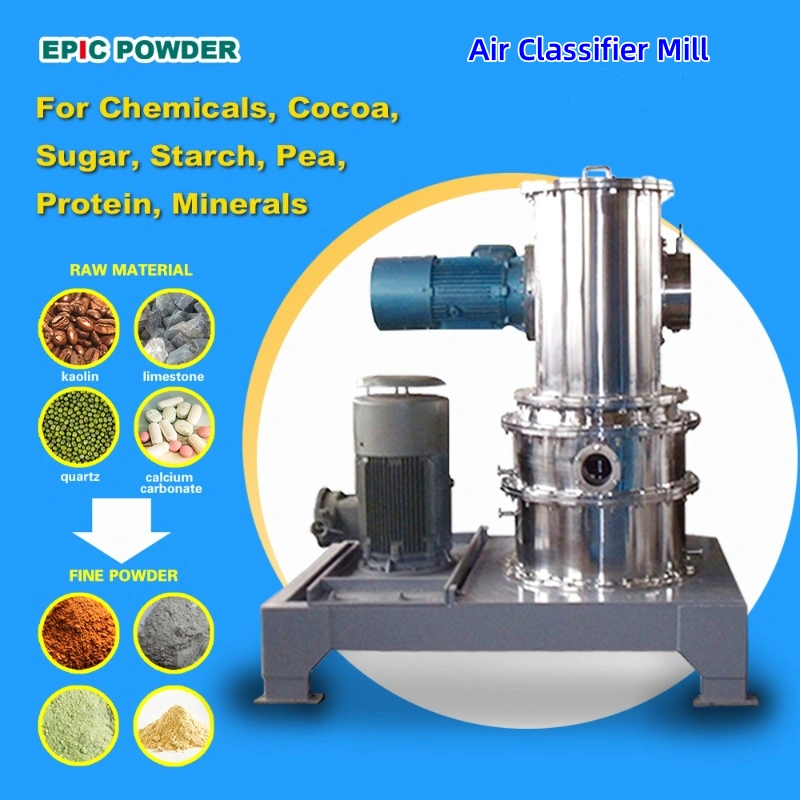
In the field of industrial grinding, the air classifying impact mill, with its unique structural design and working principle, has become a “star device” for processing hard and brittle materials. Through the synergistic effect of high-speed impact and classifying screening, it can achieve both ultrafine grinding and precise control of particle size distribution. It is widely used in industries such as chemical, food, pharmaceutical, and new energy. This article will systematically analyze the core value of the classifying impact mill from three dimensions: principle, advantages, and application scenarios.
I. Core Working Principle of the Air Classifying Impact Mill
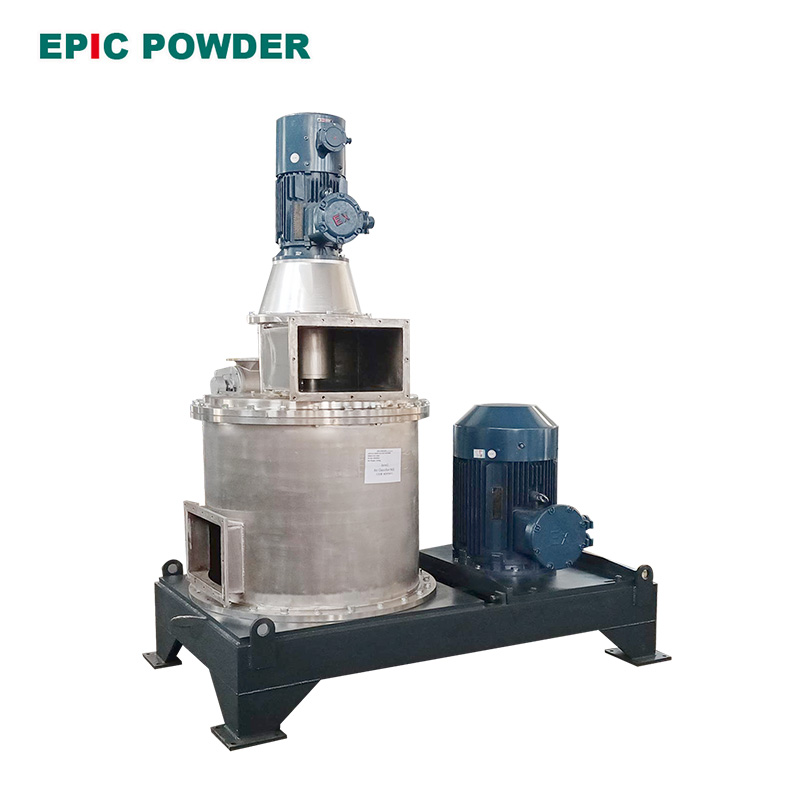
The working process of a air classifying impact mill can be divided into two steps:
The first step is impact zdrcující
The material enters the crushing chamber through the feed inlet. The high-speed rotating rotor drives the hammers or pins to violently impact the material. Simultaneously, the material repeatedly collides with the inner wall and toothed plates of the chamber. Under the combined action of impact force, shear force, and friction, the material is rapidly crushed into fine particles.
The second step is classification and screening
The crushed material rises with the airflow to the classification zone. The centrifugal force generated by the high-speed rotation of the classification wheel balances the airflow drag force. Only particles smaller than the set value can pass through the classification wheel and enter the collection system. Coarse particles are thrown back into the crushing chamber for further crushing until the target particle size is reached. This “crushing-classification-re-crushing” cycle mechanism ensures the uniformity of the product particle size.
II. Three Core Advantages of Air Classifying Impact Mills
High-Efficiency Grinding with Lower Energy Consumption
Compared to traditional mills, classifying impact mills achieve “one-pass grinding” through high-speed impact. This reduces the energy consumption of repeated grinding. For example, when processing hard materials such as calcium carbonate and quartz, its unit energy consumption can be reduced by 30%-50%, while grinding efficiency is increased by more than 2 times.
Precise and Controllable Particle Size:
he rotational speed of the classifying wheel directly affects the separated particle size. Precise control of the particle size within the range of 5-200 micrometers can be achieved by adjusting the frequency converter. This flexibility allows it to meet the stringent particle size requirements of different industries. For example, the pharmaceutical industry requires raw materials to be ground to D90 < 10 micrometers. The building materials industry may only require D50 < 50 μm.
Strong Adaptability and Wide Application
From brittle materials (such as ores and ceramics) to medium-hard materials (such as plastics and rubber), classifying impact mills are capable of handling a wide range of applications. Especially in the field of new energy, it is used to crush lithium battery cathode materials (such as lithium iron phosphate and ternary materials). By optimizing the structure of the grader wheel, it can avoid the crystal structure damage caused by excessive crushing of materials and ensure battery performance.
III. How to Choose a Suitable Air Classifying Impact Mill? Three Key Factors:
Materiálové vlastnosti
Hardness, moisture content, and viscosity are core parameters. Hard materials require mills made of highly wear-resistant materials (such as tungsten carbide hammers). Materials with a moisture content exceeding 5% require a drying system; otherwise, the classifying wheel is prone to clogging. Sticky materials require optimized chamber structure to reduce wall adhesion.
Capacity Requirements
Small laboratory equipment has a capacity of approximately 5-50 kg/h, suitable for the R&D stage. Industrial-grade equipment can reach 5-20 t/h, requiring matching based on the production line scale. It’s important to note that higher capacity is not always better. Excessively pursuing high capacity may lead to a wider particle size distribution.
Ease of Maintenance
The frequency of replacing easily worn parts such as classifying wheels and hammers directly affects operating costs. Prioritize modular designs, allowing for quick disassembly and replacement of components, reducing downtime. Furthermore, equipping the mill with intelligent monitoring systems (such as vibration and temperature sensors) can provide early warnings of malfunctions, extending equipment lifespan.
Závěr
With its high efficiency, precision, and flexibility, the classifying impact mill has become the preferred solution for modern industrial rozmělnění. Whether it’s improving product quality, reducing production costs, or exploring new application areas, it provides strong support. If you are struggling with material pulverization challenges, consider learning more about the technical details of the classifying impact mill. Or consult with professional engineers for customized solutions—let technology empower production, starting with a single micro-particle!

„Děkuji za přečtení. Doufám, že vám můj článek pomůže. Zanechte prosím komentář níže. V případě dalších dotazů se můžete také obrátit na online zákaznického zástupce Zeldy.“
— Zveřejnil(a) Emily Chenová