
ACM Mill: The Air Classifier Mill for Ultrafine Grinding
In short, one machine does two jobs — impact grinding and dynamic air classification. That is why an ACM mill holds a tight particle size distribution between 5 and 300 μm at industrial throughput, without the over-grinding a screen mill produces.
An ACM mill (Air Classifier Mill) grinds material with a high-speed impact rotor and classifies it in the same housing with a rotating classifier wheel. Because air carries the ground particles upward, anything coarser than the cut point is rejected by the wheel and falls back into the grinding zone. Only particles below the target size leave the mill, so the product curve stays narrow and repeatable from one shift to the next.
Above all, the MJW series on this page is EPIC Powder’s own machine line — designed, engineered and built at our factory in Qingdao, China, and sold worldwide under the EPIC brand. Moreover, it covers three rotor configurations and 25 model variants, from a 2 kg/h laboratory unit to a 15 t/h production mill. Finally, this page explains how the machine works, what it can and cannot do, and how to specify one correctly.
- Carbon black
- Graphite & anode material
- Calcium carbonate
- Talc & kaolin
- Bentonite
- Powder coating
- Pigments
- Phenolic & melamine resin
- Sodium bicarbonate
- Metal oxides
What “ACM Mill” Actually Means
ACM stands for Air Classifier Mill. However, the same machine appears under several names depending on the supplier and the region, which is why buyers searching for it get inconsistent results:
| Term you will see | Where it is common | Same machine? |
|---|---|---|
| ACM mill / ACM pulverizer | North America, Asia, most Chinese catalogues | Yes — the industry shorthand |
| Air classifier mill | Full written form, used in tenders and specs | Yes |
| Air classifying mill | Same product, participle flipped | Yes |
| Classifier mill | Common in European supplier literature | Yes |
| Air-swept mill | Often used loosely; can also mean a roller mill with an air sweep | Not always — check for a rotating classifier wheel |
The name became standard because of one design idea: the grinding rotor and the classifier sit in the same housing and share the same air stream. A conventional impact mill grinds and then relies on a screen to hold back coarse particles; an ACM mill classifies aerodynamically instead, so there is no screen to blind, tear, or limit the fineness.
What it is not
- First, it is not a standalone air classifier. A classifier separates powder that is already fine enough. An ACM mill also reduces it. If you only need to cut a coarse stream, look at our air classifier inside an ACM explainer instead.
- Second, it is not a jet mill. A jet mill has no grinding rotor at all — particles collide with each other in high-pressure gas. For the full trade-off, see the jet mill vs air classifier mill comparison.
- Finally, it is not a hammer mill. By contrast, a hammer mill crushes against a screen and cannot hold a D97 below roughly 50 μm with any stability.
About the EPIC brand
In fact, EPIC Powder Machinery is the manufacturer of the MJW series. Moreover, the machines are our own design and our own build — engineered and assembled at our Qingdao factory, sold under the EPIC brand, with our own model numbering (MJW-A, MJW-L, MJW-W) and our own drawings and wear-part specifications. When you buy an MJW mill you are buying from the company that designs and builds it, not through a trading intermediary and not a rebadged machine from another maker.
Therefore it matters that spare parts, drawing revisions and modification requests all go to the same engineering team that built the machine.
How an ACM Mill Works: Five Stages in One Housing
In fact, the whole process happens in a single vertical body. Then material enters at the side, is ground at the bottom, is classified at the top, and leaves through the outlet — typically in under two seconds of residence time.
Feed
First, a screw feeder or pneumatic line delivers material at a constant rate. Feed consistency matters more than most operators expect.
Impact grinding
Then the rotor throws particles against a toothed deflector ring, where impact, shear and attrition all act at once.
Upward conveying
Meanwhile, air lifts the ground powder through a shroud and baffle that separates the grinding zone from the classifying zone.
Classification
Next, the rotating wheel passes fine particles and rejects coarse ones back down for another pass.
Collection
Finally, product leaves with the air stream into a cyclone and then a bag filter, while clean air returns or discharges.
The cut point is a force balance, not a setting
Two forces act on every particle at the face of the classifier wheel:
- Drag force from the air stream, pulling the particle inward and out with the product.
- Centrifugal force from the spinning wheel, throwing it back toward the wall.
When the two balance for a given particle mass, that particle has an equal chance of passing or being rejected. Change the wheel speed and you move the balance point; change the air volume and you move it too. That is why an ACM mill can hold D97 within a few microns across a production run — and why operators who only adjust one of the two usually fight the machine all shift.
Our engineers also cover the interaction in more detail in the factors that influence ACM performance and in the classifier wheel guide.
What Is Inside: Components and Wear Parts
First, an ACM mill has six functional groups. In fact, knowing them makes spare-parts planning and quotation comparison much easier — two machines with the same tonnage can differ by a factor of two in wear cost.
| Component | What it does | Typical material options |
|---|---|---|
| Grinding rotor / disc | Accelerates feed into the impact zone; sets tip speed | Carbon steel, SS304, SS316L |
| Impact elements | Hammers, pins or teeth that fracture particles | Hardened alloy, tungsten-carbide overlay |
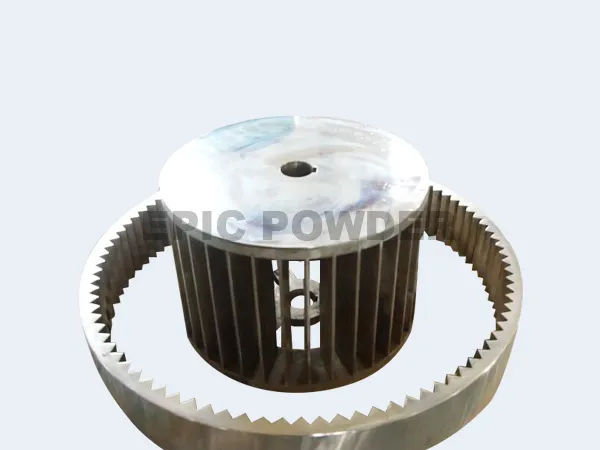
| Deflector liner (ring gear) | Slows the peripheral velocity and throws material back into the rotor path | Wear-resistant cast steel, ceramic tiles |
| Classifier wheel | Rotating cage that separates fine from coarse; sets the cut point | SS, ceramic-coated for metal-free product |
| Shroud & baffle | Divides grinding zone from classifying zone and steers the air path | SS with wear protection |
| Discharge, seals, bearing housing | Product/air outlet, shaft sealing, bearing protection | Air-purged housing for hot or dusty service |
Wear-part life depends far more on the material’s Mohs hardness and silica content than on tonnage, so see the full component breakdown for details.
MJW Series: Three Rotor Configurations
Moreover, the MJW family covers the same duty from three mechanical approaches. However, the right choice depends on your fineness target, your floor space, and how abrasive the material is — not on which one is “best”.

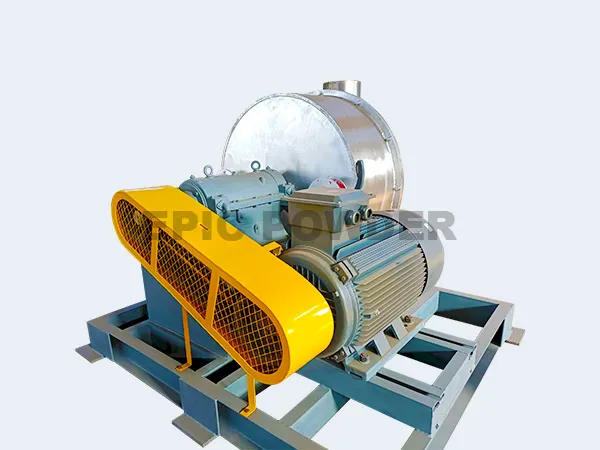
MJW-A Air Classifier Mill
A horizontal layout with the grinding and classifying motors arranged side by side therefore gives a compact footprint and easy access to both drive ends.
- Fineness
- 10–300 μm
- Capacity
- 5–6,000 kg/h
- Frame sizes
- 300–1100
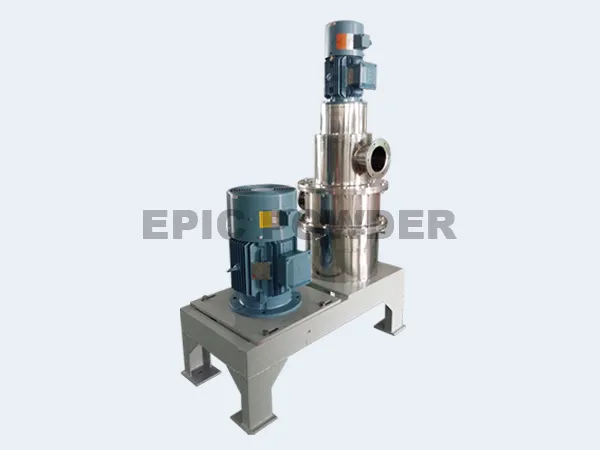
MJW-L Air Classifier Mill
A vertical body with a top-mounted classifier drive, and the widest range in the family — from laboratory-scale output to full production tonnage.
- Fineness
- 5–300 μm
- Capacity
- 2–15,000 kg/h
- Frame sizes
- 300–2000
MJW-W Air Classifier Mill
An independently driven grinding disc and classifying wheel, with the wheel installed horizontally. Because the classifier runs faster, this is the sharpest cut in the range.
- Fineness
- 5–300 μm
- Capacity
- 2–10,000 kg/h
- Classifier
- up to 8,500 rpm
In addition, two more formats round out the range: a heavier belt-driven MJL-W impact mill for coarse-to-medium duty, and a laboratory air classifier mill for scale-up trials. Meanwhile, browse the full air classifier mill category or the complete product overview for a wider view.
When to step outside the ACM family
An ACM mill is the right answer for precise PSD work. However, it is not always the cheapest answer, and two situations call for something else:
- You only need 100–300 μm. A belt-driven impact mill such as the MJL-W does that job with fewer wear parts and a lower capital cost. Also, adding a classifier you do not need just adds maintenance.
- You are still developing the process. Run the trial on a laboratory ACM first. And scale-up from a lab unit to a production frame is predictable, whereas guessing at production scale is not.
If your target is below 50 μm and your tonnage is measured in hundreds of kilos per hour or more, then the ACM mill is almost always the better investment.
MJW-L Technical Specifications
Meanwhile, the L series is the workhorse for ultrafine work. All models share the same 5–300 μm fineness window, while what changes is the drive power, the rotor speed, and therefore the throughput.
| Model | Grinding motor (kW) | Grinding speed (rpm) | Classifier motor (kW) | Classifier speed (rpm, max) | Fineness (μm) | Capacity (kg/h) |
|---|---|---|---|---|---|---|
| MJW-300L | 7.5 | 7,500 | 2.2 | 4,500 | 5–300 | 2–100 |
| MJW-400L | 22 | 4,800 | 4 | 3,250 | 5–300 | 10–1,000 |
| MJW-500L | 30 | 4,200 | 5.5 | 3,000 | 5–300 | 15–1,500 |
| MJW-700L | 45 | 3,000 | 7.5 | 2,920 | 5–300 | 20–2,000 |
| MJW-800L | 55 | 2,800 | 7.5–11 | 2,500 | 5–300 | 25–2,500 |
| MJW-900L | 75–90 | 2,350 | 15 | 2,200 | 5–300 | 40–4,000 |
| MJW-1000L | 90 | 2,100 | 15–22 | 2,000 | 5–300 | 45–4,500 |
| MJW-1100L | 110–132 | 1,920 | 22–30 | 1,800 | 5–300 | 60–6,000 |
Larger frames (1250–2000) reach approximately 15 t/h, although capacity figures are material-dependent — light, friable powders run at the top of the range, dense or tough materials at the bottom. Therefore always confirm with a grinding test on your own sample.
MJW-A Technical Specifications
By contrast, the A series trades the widest fineness window for a lower minimum of 10 μm and a more compact frame.
| Model | Grinding motor (kW) | Grinding speed (rpm) | Classifier motor (kW) | Classifier speed (rpm, max) | Fineness (μm) | Capacity (kg/h) |
|---|---|---|---|---|---|---|
| MJW-300A | 30 | 7,000 | 1.5 | 4,500 | 10–300 | 5–100 |
| MJW-400A | 22 | 4,350 | 5.5 | 3,200 | 10–300 | 20–1,000 |
| MJW-500A | 30 | 3,850 | 5.5 | 3,000 | 10–300 | 30–1,500 |
| MJW-700A | 45 | 2,760 | 7.5 | 3,000 | 10–300 | 40–2,000 |
| MJW-900A | 75–90 | 2,350 | 15 | 2,200 | 10–300 | 80–4,000 |
| MJW-1100A | 110–132 | 1,920 | 30 | 2,000 | 10–300 | 120–6,000 |
Need a specific model’s drawing, motor voltage or material of construction? If so, send the requirement and we will return a datasheet rather than a brochure.
ACM Mill vs Other Grinding Mills
In fact, most enquiries we receive are really a mill-selection question. So this table compares the five technologies that come up most often in mineral, chemical and carbon processing.
| Technology | Size reduction | Typical fineness | PSD width | Heat build-up | Wear parts | Best fit |
|---|---|---|---|---|---|---|
| ACM mill | Impact rotor + dynamic classifier | 5–300 μm | Narrow | Moderate, air-cooled | Rotor, liner, wheel | Precise PSD at industrial tonnage |
| Jet mill | Particle-on-particle in gas jets | 1–20 μm | Narrowest | Very low | Minimal — no rotor | Ultrafine, contamination-sensitive product |
| Ball mill | Tumbling grinding media | 5–100 μm | Wide | Low | Liners and media | Coarse bulk, abrasive feed |
| Pin mill | High-speed pins | 20–200 μm | Medium | Moderate | Pins | Simple, medium-fine duty |
| Hammer mill | Swing hammers against a screen | 50–1,000 μm | Wide | High | Hammers and screen | Coarse crushing, high capacity |
Rule of thumb. If you need D97 below about 20 μm on a hard material, a jet mill usually wins on product quality but loses badly on energy per tonne. If, instead, you need 20–100 μm at more than a few hundred kilos per hour, an ACM mill is almost always the cheaper route — because it grinds and classifies in one step instead of two. Finally, the full jet mill comparison quantifies the energy gap.
What Materials Can an ACM Mill Process
Because the machine handles any dry, free-flowing material up to roughly Mohs 6–7 with the right wear protection, the eight groups below are the ones we build for most often.
Carbon materials
Carbon black, activated carbon, petroleum coke and graphite. For example, carbon black vs white carbon black explains why the two need different rotor speeds.
Industrial minerals
Calcium carbonate, talc, kaolin, bentonite, barite, quartz and feldspar. For instance, the calcium carbonate case shows a worked example.
Battery materials
Graphite anode, lithium carbonate and cathode oxides. Also, ceramic-lined versions keep iron contamination out of the product — see the graphite anode benchmark.
Coatings & pigments
Powder coating reprocessing, organic and inorganic pigments and colour masterbatch. Therefore tight D50 control protects shade consistency.
Plastics & resins
PVC, phenolic resin, melamine, PLA and other polymers. However, heat-sensitive grades need chilled or conditioned air.
Chemicals
Sodium bicarbonate, citric acid, sulfur, metal oxides and hydroxides. Explosion-proof and inert-gas builds are also available.
Metal powders
Cobalt oxide, nickel alloys, iron powder and aluminium powder. Besides that, reactive metals need inerted circuits.
Building materials
Gypsum, hydrated lime, slag, fly ash and phosphogypsum. Because these run continuously, high-tonnage frames handle cement-plant duty.
Overall, for a broader industry view, see the industries that benefit most from an ACM mill. Otherwise, if your material is not listed, send a sample — the test tells us more than any table.
How to Specify an ACM Mill: Five Decisions
Indeed, almost every sizing error we see comes from specifying tonnage without specifying fineness. In fact, those two numbers together define the machine, while either one alone does not.
1. Target particle size and how tight it must be
D97 is the usual contract figure, but D50 and the span matter just as much. For example, a mill that hits D97 20 μm with a wide span may fail your downstream process even though it meets the spec on paper. Therefore read how the classifier wheel sets the cut before you write the purchase order.
2. Throughput — and whether it is average or peak
So quote the sustained rate, not the best hour. A mill sized at 95% of peak will spend its life at maximum rotor speed, which shortens wear-part life and consequently leaves no headroom for a harder batch.
3. Hardness and abrasiveness
First, Mohs hardness drives the choice between standard alloy, tungsten-carbide overlay and ceramic lining. Indeed, silica-bearing minerals at Mohs 7 will destroy a mild-steel liner in weeks.
4. Heat sensitivity
Because an ACM mill moves a lot of air, product temperature stays down naturally. However, for resins, waxes and other low-softening materials, add chilled air or a water-cooled jacket rather than accepting degradation.
5. Dust explosion class
Therefore organic powders and fine metals need an explosion-proof build: rupture panels, grounding, ATEX-rated motors, and often nitrogen inerting. In short, this is a design decision rather than an accessory, because retrofitting it later costs far more than specifying it up front.
In addition, for a structured walk-through, see the selection guide and operating precautions.
A Complete ACM Milling System
The mill is the centre of the line, but it cannot run alone. A typical installation looks like this:
Two details decide whether the line performs as specified. First, the feeder must hold a constant rate — a fluctuating feed shows up directly as a fluctuating D97. Second, the air balance across mill, cyclone and filter must be designed as one system, since undersized ducting will cap your capacity no matter how large the mill is. Then browse the auxiliary equipment range.
What Drives the Price of an ACM Mill
Indeed, buyers often ask for a price per tonne of capacity. That number does not exist, because two mills rated at the same throughput can differ by a factor of two or three in cost. Instead, these six variables are what actually move the quotation.
| Cost driver | Why it matters | Effect on price |
|---|---|---|
| Frame size and drive power | The rotor and classifier motors are the single largest cost item | Dominant — roughly scales with power, not linearly with tonnage |
| Fineness target | A tighter cut needs a faster classifier, more precise machining and better balancing | Significant — 5 μm duty is not the same machine as 100 μm duty |
| Material of construction | Carbon steel, SS304 and SS316L sit in different price bands | Moderate to large |
| Wear protection | Tungsten-carbide overlay or ceramic lining on rotor, liner and wheel | Moderate, but pays back quickly on abrasive feed |
| Explosion-proof / inerting | ATEX motors, rupture panels, grounding, nitrogen circuit and oxygen monitoring | Large — often 20–40% of the mill cost |
| Scope of supply | Bare mill versus feeder, cyclone, filter, fan, ducting, controls and commissioning | Can exceed the mill price itself |
How to get a comparable quotation. So ask every supplier for the same five items: model and frame size, motor kW for both drives, fineness at your specified D97, scope of supply (which components are included), and wear-part material and price. Otherwise, a quotation that lists only a model number and a total price cannot be compared with anything.
Running and Maintaining an ACM Mill
An ACM mill is a low-attention machine when it is set up correctly, and a constant irritation when it is not. In fact, four things account for most day-to-day problems.
Stable feed rate
Also, every fluctuation in feed shows up as a fluctuation in D97. A gravimetric feeder costs more than a volumetric one, but it removes an entire category of quality complaints. If you run volumetric, keep the hopper level in a narrow band, because bulk density changes as the hopper empties.
Air balance
But blocked ducting, a saturated bag filter or a damper left half-closed will all reduce air volume, and reduced air volume shifts the cut point. Therefore check differential pressure across the filter on a schedule, not when product quality drifts.
Wear inspection
In turn, inspect the impact elements and the deflector liner at fixed intervals and record the wear pattern. Still, a changing pattern usually means the feed distribution is off rather than that the parts are poor. Ceramic and tungsten-carbide options are worth their cost on silica-bearing minerals, yet unnecessary on soft carbon.
Cleaning between products
So if you change materials frequently, specify the quick-clean design: the housing opens without removing the drive, and the grinding chamber is accessible without disturbing the classifier. This is also covered in the easy-to-clean design note.
Meanwhile, operating limits and safety practice are summarised in precautions for using an air classifier mill.
Installed Projects
Overall, these are commissioned ACM lines in Asia, the Middle East, Africa and Europe. Therefore each link opens the full project note with material, configuration and measured result.
Further references: bentonite grinding in Greece, powder coating fine grinding in Spain, and the full project portfolio.
Frequently Asked Questions
ACM mill basics
What does ACM stand for?
In short, ACM stands for Air Classifier Mill, which describes a mill combining an impact grinding rotor with a dynamic air classifier in the same housing. Then the classifier — not a screen — decides what leaves the machine.
What is the difference between an ACM mill and a jet mill?
A jet mill has no grinding rotor; instead, particles collide with each other in high-pressure gas, so it reaches finer sizes (down to 1 μm) with almost no contamination. An ACM mill, in contrast, uses a mechanical rotor, reaches 5–300 μm, and costs far less energy per tonne at production scale. Above roughly 20 μm, therefore, the ACM mill is normally the better economic choice.
What fineness can an ACM mill achieve?
Typically between 5 and 300 μm on the MJW-L and MJW-W, and 10–300 μm on the MJW-A. However, the lower limit depends on material density and friability; very light powders can go slightly finer, while dense or tough ones stop short of the nominal figure.
What capacity range is available?
From 2 kg/h on the smallest laboratory configuration to about 15 t/h on the largest production frames, although capacity is material-dependent: the same model will run several times faster on a light friable powder than on a dense abrasive one.
Specifying and operating
Can it grind heat-sensitive materials?
Yes, indeed. Because the air-to-material ratio is high, the product spends very little time at temperature, and conditioned or chilled inlet air can be added for resins, waxes and other low-softening materials. In addition, the bearing housing can be insulated and air-purged for hot service.
How is particle size controlled during operation?
Indeed, two variables control it: classifier wheel speed and air volume through the mill. So the wheel speed sets the centrifugal force, the air volume sets the drag force, and the cut point sits where the two balance. In fact, most plants hold fineness by fixing airflow and trimming wheel speed.
Is it suitable for explosive dust?
Nevertheless, with the right build it can: explosion-proof motors and wiring, rupture panels, full grounding and bonding, and often nitrogen inerting for solvents, fine metals and reactive organics. Still, it must be specified at the quotation stage rather than added later.
What are the main wear parts and how often do they need replacing?
First, the impact elements, the deflector liner and the classifier wheel see the most wear. Life ranges from a few months on abrasive silica-bearing minerals to several years on soft carbon black, so ceramic and tungsten-carbide options extend the interval considerably.
Can we test our material before buying?
Yes, and that is normally the first step. Then send 5–10 kg of representative material and we return a test report with the achievable PSD curve, recommended model, throughput and power draw. The test itself is free, although you cover the freight.
Commercial and delivery questions
What air volume does the mill need?
It depends on the frame size and the material’s bulk density, but a working figure is roughly 1.5–3 m³ of air per kg of product for fine grinding. Therefore the air handling — ducting, cyclone and filter — must be sized from that figure, because undersized ducting will cap your capacity regardless of how large the mill is.
Can it run continuously, 24 hours a day?
Yes, when the drives and bearings are specified for continuous duty and the wear parts are matched to the material. Plants running three shifts therefore keep a spare set of impact elements and one classifier wheel on site, so that a wear change does not stop production.
What is the typical delivery time?
Usually, standard models ship in 45–75 days after drawing approval, with larger or explosion-proof builds at the longer end. Moreover, custom material of construction, ceramic lining and complete-line scope add to that. Ask for a production schedule with your quotation, because a single lead-time number without a schedule is not very useful.
Can the mill be supplied as a complete production line?
In short, we supply the mill, feeder, cyclone, bag filter, fan, ducting and control cabinet as one matched system, with commissioning support. Standalone mill supply is also possible, however, if you already have the air handling in place.
Send Your Material, Get a Real Answer
First, tell us the material, the fineness you need and the tonnage you run. Then we will come back with a recommended model, a capacity estimate and a test report — not a generic catalogue.
Page last reviewed October 2026. Also, specifications are subject to material testing; final figures are confirmed in the quotation. In short, EPIC Powder Machinery builds air classifier mills in Qingdao, China, and supplies them worldwide.