In powder engineering, new energy materials (such as lithium battery cathodes and anodes), pharmaceutical APIs, electronic ceramics, fine chemicals, and high-end pigments, ultra-fine grinding combined with precise classification at the laboratory stage has become a critical bottleneck determining downstream product performance. Traditional mechanical grinding methods (e.g., planetary ball mills or vibratory mills) are low-cost but suffer from high temperature rise, contamination risks, and broad particle size distribution. Standalone jet milling provides low-temperature, media-free processing but often lacks sufficient classification precision for demanding requirements like D97 ≤ 2–5 μm with SPAN ≤ 1.5–2.0. High-performance laboratory air classifier mills (Air Classifier Mill, abbreviated as ACM or lab-scale air classifying mill) deeply integrate mechanical impact/attrition grinding with built-in dynamic turbine air classification, enabling a closed-loop process of “one feed, one qualified finished product.” This has become the preferred solution for an increasing number of R&D laboratories and pilot-scale platforms.
This article provides a systematic guide to selecting the right high-performance Air Classifier Mill for laboratory use, covering principle analysis, core selection criteria, comparison of mainstream integrated models, and practical purchasing pitfalls.
Why Laboratories Prefer an “Ultra-Fine Grinding + Air Classification” Integrated Solution?
Laboratory environments differ fundamentally from industrial production, with key pain points including:
- Extremely small throughput: Typically 0.1–5 kg/h, with some needs as low as tens of grams per batch;
- Stringent fineness requirements: D50 mostly 1–8 μm, D97 often ≤ 2–5 μm, or even sub-micron;
- Material sensitivity: Heat-sensitive (e.g., polymers, drugs), easily oxidized (e.g., metal powders, silicon-carbon anodes), high-purity (electronics-grade), explosion-proof (powders with residual flammable solvents);
- Frequent material changes: Zero tolerance for cross-contamination, cleaning time ideally <30 minutes;
- Process repeatability: Parameters (rotor speed, airflow, feed rate) must be precisely adjustable, storable, and traceable;
- Space and noise: Footprint ≤ 1.5–2.5 m², noise <75 dB preferred.
Traditional equipment struggles to balance these demands. Air Classifier Mills achieve a compromise of low temperature (temperature rise usually <15–35°C), narrow distribution (excellent SPAN values), and high cleanliness (optional ceramic/PTFE lining) through the combination of mechanical rotor impact + independent variable-frequency turbine classification, making them the most mainstream integrated ultra-fine grinding and classification solution in laboratories today.
Core Working Principle Overview
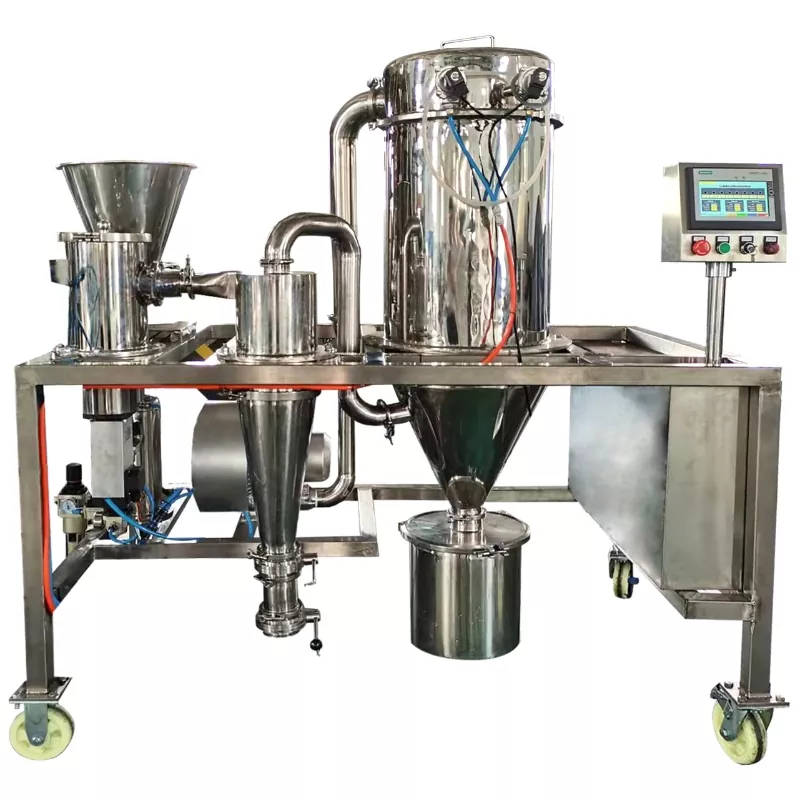
Typical high-performance laboratory ACMs adopt a vertical/horizontal rotor impact + built-in dynamic turbine classification structure:
- Grinding Zone: Material enters the grinding chamber via a screw feeder or vibratory feeder. A high-speed rotating impact rotor (hammers/blades/toothed discs) delivers strong mechanical impact, shear, and inter-particle collision to the material, while ascending airflow assists fluidization and transport for efficient size reduction.
- Classification Zone: Ground particles rise with the airflow into the upper turbine classification zone. The high-speed rotating classifier wheel generates a strong centrifugal force field:
- Fine particles (dominated by airflow drag) pass through the gaps between classifier blades and are carried by clean air to cyclone + bag collection;
- Coarse particles (dominated by centrifugal force) are thrown to the outer wall and returned to the grinding zone for continued processing.
- Adjustment Mechanism: Final particle size is determined collaboratively by classifier wheel speed (variable frequency control, commonly 3000–12000 rpm), system airflow, and feed rate, enabling adjustable D97 from tens of microns down to 2 microns.
Integration advantages: Grinding and classification occur within the same machine body, avoiding contamination, deposition, and energy losses from external conveying; high classification efficiency (80%–92%) and sharper particle size distribution.
Core Selection Criteria and Priority Ranking (2026 Reference)
| Selection Dimension | Key Indicators & Recommended Lab Values | Importance Ranking | Key Inspection Points & Red Flags |
|---|---|---|---|
| Fineness & Distribution | D97 stably ≤2–5 μm, SPAN ≤1.5–1.8 | ★★★★★ | Require actual test particle size curves (laser diffraction data) for similar materials |
| Throughput | 0.1–5 kg/h (mainstream), ultra-small batch optional 0.05–1 kg/h | ★★★★ | Match actual experiment frequency; avoid oversized models causing waste |
| Temperature Rise Control | Grinding chamber rise <20–30°C, optional low-temp nitrogen/liquid nitrogen interface | ★★★★★ | Essential for heat-sensitive materials; rise >40°C is disqualifying |
| Cleanliness & Materials | 316L/ceramic/PTFE lining, GMP/FDA level, quick-disassembly no-dead-zone design | ★★★★★ | Electronics/pharma must have zero metal contamination; cleaning time <30 min |
| Classification Precision & Adjustability | Classifier wheel speed variable 0–12000 rpm, online adjustable d97 | ★★★★ | Support PLC touchscreen + recipe storage, parameter repeatability RSD <5% |
| Footprint & Integration | Footprint ≤1.5–2.5 m², integrated feeder + cyclone + bag + silencer | ★★★ | Modular design for easy movement and maintenance |
| Safety & Explosion Protection | Explosion-proof motor/inert gas protection, oxygen monitoring, optional ATEX | ★★★★ | Mandatory for flammable/metal powders; oxygen <5% controllable |
| Energy & Consumption | Low unit product power/gas consumption (prefer efficient impeller + nozzle design) | ★★★ | Important for long-term running cost-sensitive labs |
| Trial & Service | Free trial grinding, similar material cases, process database support | ★★★★★ | Extremely high risk without trial support |
2026 Recommended Priority: Fineness precision + temperature/cleanliness > Trial service & cases > Classification adjustability > Throughput matching > Brand & after-sales
Comparison of Mainstream Laboratory High-Performance Air Classifier Mill Models (2026 Market Trends)
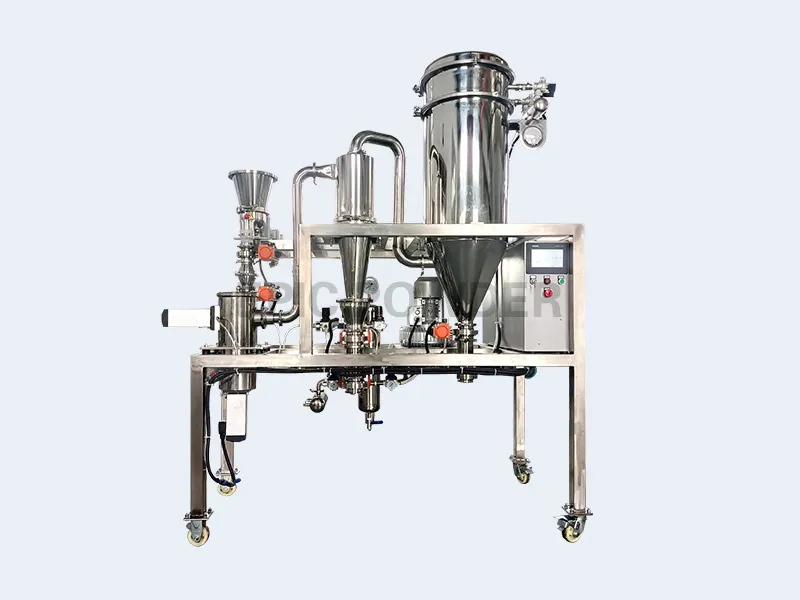
- Classic Vertical Rotor + Built-in Turbine Classification (Most Versatile)
- Fineness range: D97 3–25 μm (optimized to 2 μm)
- Representatives: Epic Powder ACM lab series, various domestic “three-in-one” models
- Applications: General chemicals, pigments, non-metallic minerals, food additives, etc.
- High-Precision/Low-Temperature Enhanced Type (Preferred for New Energy/Pharma)
- Fineness: D97 ≤2–4 μm stable, temperature rise <15°C
- Features: Ceramic/PTFE lining + nitrogen cryogenic system + online particle size feedback
- Applications: Lithium ternary/LFP/silicon-carbon anodes, API drugs, electronic pastes
- Ultra-Compact/Modular Type (For Very Small Batches + Frequent Changes)
- Throughput: 0.05–1 kg/h, footprint <1 m²
- Features: Quick-disassembly structure, disposable liner design, easy integration with glove boxes
- Applications: Precious metal powders, nano-catalysts, high-value small-batch R&D
Purchasing Pitfalls to Avoid and Final Recommendations
Common Major Pitfalls:
- Focusing only on advertised “D97=1 μm” while ignoring actual material distribution width and repeatability;
- Overlooking cleaning difficulty, resulting in hours of disassembly for the next experiment;
- Selecting equipment without free trial grinding, only to discover incompatibility after purchase;
- Pursuing extreme miniaturization at the expense of classifier wheel speed range and stability;
- Ignoring inert gas protection, creating safety hazards with flammable powders.
2026 Final Recommendations: Prioritize leading powder equipment suppliers with free small-sample trial grinding, extensive laboratory cases, and optional online particle size monitoring (e.g., EPIC POWDER , etc.). Before purchasing:
- Provide material properties (Mohs hardness, density, melting point, moisture/volatiles, ease of oxidation/agglomeration, etc.);
- Specify target D50/D97, throughput, and inert gas needs;
- Request actual test particle size distribution curves + temperature rise data + cleaning demonstration videos for similar materials;
- Conduct on-site or video verification of quick-disassembly and cleanliness.
A truly high-performance laboratory Air Classifier Mill not only enables rapid attainment of target powders but also provides reliable process windows and parameter benchmarks for subsequent pilot-scale amplification. Choosing the right equipment can shorten R&D cycles by 30%–60%.

“Thanks for reading. I hope my article helps. Please leave a comment down below. You may also contact Zelda online customer representative for any further inquiries.”
— Posted by Emily Chen