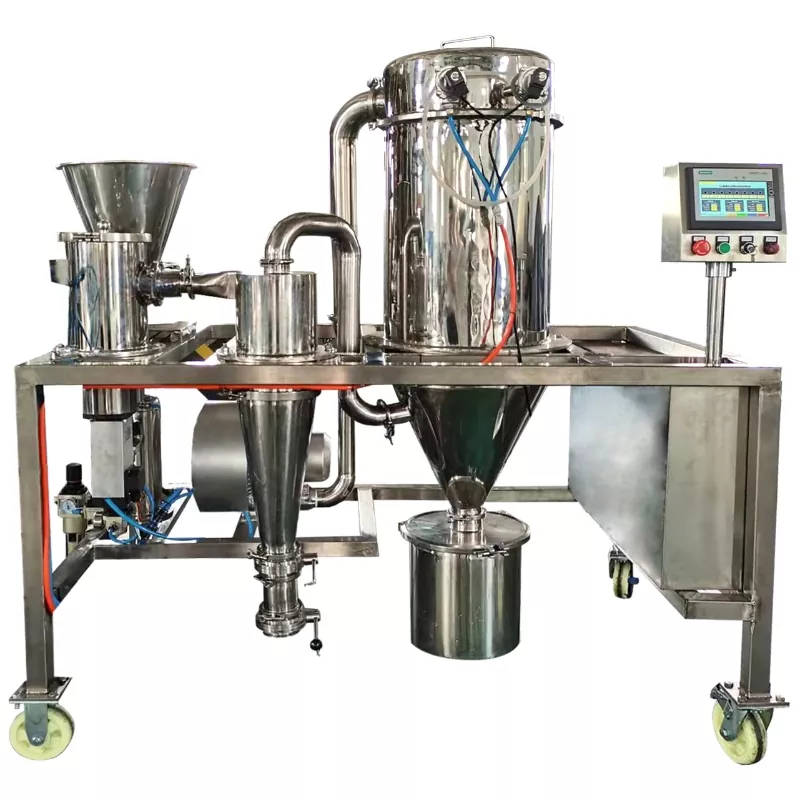
In der Pulvertechnik, bei neuen Energiematerialien (wie Lithium-Batterie-Kathoden und -Anoden), pharmazeutischen Wirkstoffen, Elektronikkeramiken, Feinchemikalien und hochwertigen Pigmenten hat sich die Ultrafeinvermahlung in Kombination mit präziser Klassierung im Labormaßstab zu einem entscheidenden Faktor für die Produktleistung entwickelt. Traditionelle mechanische Mahlverfahren (z. B. Planetenkugelmühlen oder Vibrationsmühlen) sind zwar kostengünstig, weisen jedoch einen hohen Temperaturanstieg, Kontaminationsrisiken und eine breite Partikelgrößenverteilung auf. Die Strahlvermahlung ermöglicht zwar eine Verarbeitung bei niedrigen Temperaturen und ohne Mahlmedien, bietet aber oft nicht die erforderliche Klassierungsgenauigkeit für anspruchsvolle Anforderungen wie D97 ≤ 2–5 μm mit SPAN ≤ 1,5–2,0. Hochleistungs-Labor-Luftklassierer Die Luftklassiermühle (ACM, auch als Labor-Luftklassiermühle bezeichnet) integriert die mechanische Schlag-/Schleifmahlung mit einer eingebauten dynamischen Turbinen-Luftklassierung und ermöglicht so einen geschlossenen Kreislaufprozess nach dem Prinzip „ein Aufgabegut, ein qualifiziertes Endprodukt“. Dies hat sich zur bevorzugten Lösung für eine wachsende Zahl von Forschungs- und Entwicklungslaboren sowie Pilotanlagen entwickelt.
Dieser Artikel bietet eine systematische Anleitung zur Auswahl der richtigen Hochleistungs-Luftklassierermühle für den Laboreinsatz. Er behandelt die Grundlagenanalyse, die wichtigsten Auswahlkriterien, den Vergleich gängiger integrierter Modelle und praktische Fallstricke beim Kauf.
Warum Labore eine integrierte Lösung aus „Ultrafeinmahlung + Windsichtung“ bevorzugen?
Laborumgebungen unterscheiden sich grundlegend von der industriellen Produktion, wobei folgende Punkte zu den wichtigsten Problemen gehören:
- Extrem geringer Durchsatz: Typischerweise 0,1–5 kg/h, wobei in manchen Fällen nur wenige zehn Gramm pro Charge benötigt werden;
- Strenge Feinheitsanforderungen: D50 meist 1–8 μm, D97 oft ≤ 2–5 μm oder sogar im Submikrometerbereich;
- Materialempfindlichkeit: wärmeempfindlich (z. B. Polymere, Arzneimittel), leicht oxidierbar (z. B. Metallpulver, Silizium-Kohlenstoff-Anoden), hochrein (Elektronikqualität), explosionsgeschützt (Pulver mit Resten brennbarer Lösungsmittel);
- Häufige Materialwechsel: Null Toleranz für Kreuzkontaminationen, Reinigungszeit idealerweise <30 Minuten;
- Prozesswiederholbarkeit: Parameter (Rotordrehzahl, Luftstrom, Vorschubgeschwindigkeit) müssen präzise einstellbar, speicherbar und rückverfolgbar sein;
- Platzbedarf und Geräuschentwicklung: Grundfläche ≤ 1,5–2,5 m², Geräuschpegel <75 dB bevorzugt.
Herkömmliche Anlagen stoßen bei der Erfüllung dieser Anforderungen an ihre Grenzen. Windsichter erreichen einen Kompromiss aus niedriger Temperatur (Temperaturanstieg üblicherweise <15–35 °C), enger Partikelgrößenverteilung (ausgezeichnete SPAN-Werte) und hoher Reinheit (optionale Keramik-/PTFE-Auskleidung) durch die Kombination von Mechanischer Rotoreinfluss + unabhängige Turbinenklassifizierung mit variabler FrequenzDamit sind sie heute die am weitesten verbreitete integrierte Lösung für die Ultrafeinvermahlung und -klassierung in Laboren.
Überblick über die wichtigsten Arbeitsprinzipien
Typische Hochleistungs-ACMs für Labore verwenden eine Vertikaler/horizontaler Rotoraufprall + integrierte dynamische Turbinenklassifizierung Struktur:
- SchleifzoneDas Material gelangt über eine Schnecken- oder Vibrationsförderanlage in die Mahlkammer. Ein schnell rotierender Prallrotor (Hämmer/Klingen/Zahnscheiben) bewirkt starke mechanische Stöße, Scherkräfte und Kollisionen zwischen den Partikeln, während ein aufsteigender Luftstrom die Fluidisierung und den Transport für eine effiziente Zerkleinerung unterstützt.
- KlassifizierungszoneBodenpartikel steigen mit dem Luftstrom in die obere Turbinenklassierzone auf. Das schnell rotierende Klassierrad erzeugt ein starkes Zentrifugalkraftfeld.
- Feine Partikel (die hauptsächlich durch den Luftwiderstand bestimmt werden) passieren die Spalten zwischen den Klassierschaufeln und werden von sauberer Luft zum Zyklon und zur Beutelabscheidung transportiert;
- Grobe Partikel (die hauptsächlich durch die Zentrifugalkraft entstehen) werden an die Außenwand geschleudert und zur weiteren Verarbeitung in die Mahlzone zurückgeführt.
- EinstellmechanismusDie endgültige Partikelgröße wird gemeinsam bestimmt von Drehzahl des Klassierrades (variable Frequenzregelung, üblicherweise 3000–12000 U/min), Systemluftstrom, Und Vorschubgeschwindigkeitwodurch ein einstellbarer D97-Wert von mehreren zehn Mikrometern bis hinunter zu 2 Mikrometern ermöglicht wird.
Integrationsvorteile: Mahlen und Klassieren erfolgen innerhalb desselben Maschinenkörpers, wodurch Verunreinigungen, Ablagerungen und Energieverluste durch externe Förderung vermieden werden; hohe Klassiereffizienz (80%–92%) und schärfere Partikelgrößenverteilung.
Kernauswahlkriterien und Prioritätenrangfolge (Referenz 2026)
| Auswahldimension | Wichtige Indikatoren und empfohlene Laborwerte | Wichtigkeitsrangfolge | Wichtige Prüfpunkte und Warnsignale |
|---|---|---|---|
| Feinheit und Verteilung | D97 stabil ≤2–5 μm, SPAN ≤1,5–1,8 | ★★★★★ | Für ähnliche Materialien werden tatsächliche Partikelgrößenverteilungskurven (Laserbeugungsdaten) benötigt. |
| Durchsatz | 0,1–5 kg/h (Hauptstrom), optional für Kleinstchargen 0,05–1 kg/h | ★★★★ | Die tatsächliche Versuchshäufigkeit berücksichtigen; überdimensionierte Modelle, die zu Verschwendung führen, vermeiden. |
| Temperaturanstiegskontrolle | Temperaturanstieg in der Mahlkammer <20–30 °C, optionale Schnittstelle zwischen Niedertemperatur-Stickstoff und flüssigem Stickstoff | ★★★★★ | Unerlässlich für wärmeempfindliche Materialien; ein Temperaturanstieg von über 40 °C führt zum Ausschluss. |
| Sauberkeit und Materialien | 316L/Keramik/PTFE-Auskleidung, GMP/FDA-konform, schnell demontierbares Design ohne Totzonen | ★★★★★ | Elektronik-/Pharma-Produkte dürfen keine Metallverunreinigungen aufweisen; Reinigungszeit < 30 Minuten |
| Klassifizierungsgenauigkeit und Einstellbarkeit | Drehzahl des Klassierrades variabel 0–12000 U/min, online einstellbar d97 | ★★★★ | Unterstützung von SPS-Touchscreen + Rezeptspeicher, Parameterwiederholgenauigkeit RSD <5% |
| Fußabdruck & Integration | Stellfläche ≤1,5–2,5 m², integrierter Zuführer + Zyklon + Filtersack + Schalldämpfer | ★★★ | Modulares Design für einfachen Transport und Wartung |
| Sicherheit und Explosionsschutz | Explosionsgeschützter Motor/Schutzgas, Sauerstoffüberwachung, optionale ATEX-Ausführung | ★★★★ | Obligatorisch für brennbare/metallische Pulver; Sauerstoff <5% kontrollierbar |
| Energie und Verbrauch | Geringer Energie-/Gasverbrauch pro Produkteinheit (effizientes Laufrad- und Düsendesign bevorzugt) | ★★★ | Wichtig für den langfristigen Betrieb kostensensibler Labore |
| Test & Service | Kostenloses Probeschleifen, ähnliche Materialfälle, Unterstützung der Prozessdatenbank | ★★★★★ | Extrem hohes Risiko ohne Unterstützung durch eine Studie |
Empfohlene Priorität 2026Feinheitsgenauigkeit + Temperatur/Reinheit > Testservice & Fallstudien > Klassifizierungsanpassung > Durchsatzoptimierung > Marke & Kundendienst
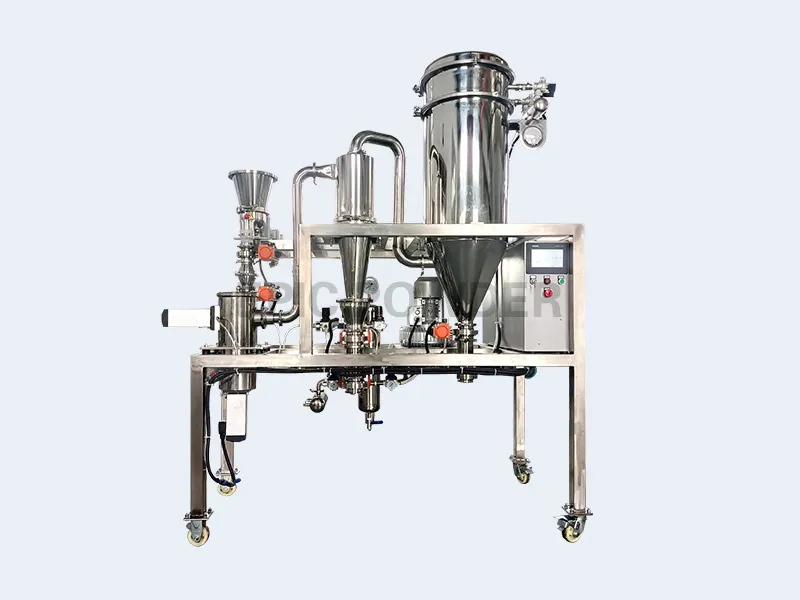
Vergleich gängiger Hochleistungs-Labor-Luftklassierer-Mühlenmodelle (Markttrends 2026)
- Klassischer Vertikalrotor + Eingebaute Turbinenklassifizierung (Am vielseitigsten)
- Feinheitsbereich: D97 3–25 μm (optimiert auf 2 μm)
- Vertreter: Epic Powder ACM-Laborserie, diverse inländische „3-in-1“-Modelle
- Anwendungsgebiete: Allgemeine Chemikalien, Pigmente, nichtmetallische Mineralien, Lebensmittelzusatzstoffe usw.
- Hochpräzisions-/Tieftemperatur-Verbesserungstyp (Bevorzugt für New Energy/Pharma)
- Feinheit: D97 ≤2–4 μm stabil, Temperaturanstieg <15°C
- Merkmale: Keramik-/PTFE-Auskleidung + Stickstoff-Kryosystem + Online-Partikelgrößenrückmeldung
- Anwendungen: Lithium-Ternär-/LFP-/Siliziumkohlenstoff-Anoden, Wirkstoffe, Elektronikpasten
- Ultrakompakter/Modularer Typ (Für sehr kleine Chargen + häufige Änderungen)
- Durchsatz: 0,05–1 kg/h, Stellfläche <1 m²
- Merkmale: Schnell zerlegbare Struktur, Einweg-Einlage, einfache Integration in Handschuhkästen
- Anwendungsgebiete: Edelmetallpulver, Nanokatalysatoren, hochwertige Forschung und Entwicklung in kleinen Chargen
Fallstricke beim Kauf, die es zu vermeiden gilt, und abschließende Empfehlungen
Häufige Hauptfehler:
- Fokus ausschließlich auf den beworbenen Wert „D97=1 μm“, während die tatsächliche Materialverteilungsbreite und Wiederholbarkeit außer Acht gelassen werden;
- Die Schwierigkeit der Reinigung wurde außer Acht gelassen, was stundenlanges Auseinanderbauen für das nächste Experiment erforderlich machte;
- Geräte ohne kostenlose Probeschleifung auswählen und dann nach dem Kauf Inkompatibilität feststellen;
- Das Streben nach extremer Miniaturisierung geht auf Kosten des Geschwindigkeitsbereichs und der Stabilität der Klassierräder;
- Die Missachtung des Schutzes durch Inertgase führt zu Sicherheitsrisiken durch brennbare Pulver.
Abschließende Empfehlungen 2026: Führende Anbieter von Pulveranlagen sollten priorisiert werden, die kostenlose Probemahlungen mit kleinen Proben, umfangreiche Laboranwendungen und optionale Online-Partikelgrößenüberwachung (z. B. EPISCHES PUDER usw.). Vor dem Kauf:
- Materialeigenschaften angeben (Mohs-Härte, Dichte, Schmelzpunkt, Feuchtigkeit/flüchtige Bestandteile, Oxidations-/Agglomerationsneigung usw.);
- Zielwerte für D50/D97, Durchsatz und Inertgasbedarf angeben;
- Fordern Sie die tatsächlichen Partikelgrößenverteilungskurven aus Tests + Daten zum Temperaturanstieg + Reinigungsdemonstrationsvideos für ähnliche Materialien an;
- Führen Sie vor Ort oder per Video eine Überprüfung der schnellen Demontage und der Sauberkeit durch.
Eine hochleistungsfähige Labor-Windsichtermühle ermöglicht nicht nur die schnelle Herstellung von Zielpulvern, sondern liefert auch zuverlässige Prozessfenster und Parameter-Benchmarks für die anschließende Pilotversuchsvergrößerung. Die Wahl der richtigen Ausrüstung kann die F&E-Zyklen um 30 bis 601 Tsd. Minuten verkürzen.

Vielen Dank fürs Lesen. Ich hoffe, mein Artikel war hilfreich. Hinterlassen Sie gerne einen Kommentar. Bei weiteren Fragen können Sie sich auch an den Online-Kundendienst von Zelda wenden.
— Gepostet von Emily Chen