
Das Verständnis der Partikelgröße ist bei der Arbeit mit Calciumcitrat entscheidend. Je feiner das Pulver, desto besser sind Löslichkeit, Auflösungsgeschwindigkeit und Bioverfügbarkeit – allesamt wichtige Faktoren für wirksame Calciumpräparate und Arzneimittel. Durch Feinvermahlung wird die Partikelgröße typischerweise auf einen D99-Wert von 20 μm reduziert, wodurch ultrafeines Calciumcitratpulver mit hervorragenden Eigenschaften entsteht.
| Besonderheit | Groberes Calciumcitrat | Superfeines Calciumcitrat (D99 20μm) |
|---|---|---|
| Löslichkeit | Mäßig | Hoch |
| Auflösungsrate | Langsam | Schnell |
| Bioverfügbarkeit | Untere | Erweitert |
| Fahrwerksstabilität | Arm | Verbessert |
| Fließfähigkeit | Variable | Konsistent |
Im Vergleich zu anderen Calciumsalzen bietet superfeines Calciumcitrat eine bessere Dispergierbarkeit in Flüssigkeiten und eignet sich daher ideal nicht nur für Nahrungsergänzungsmittel, sondern auch für funktionelle Lebensmittel und Arzneimittel.
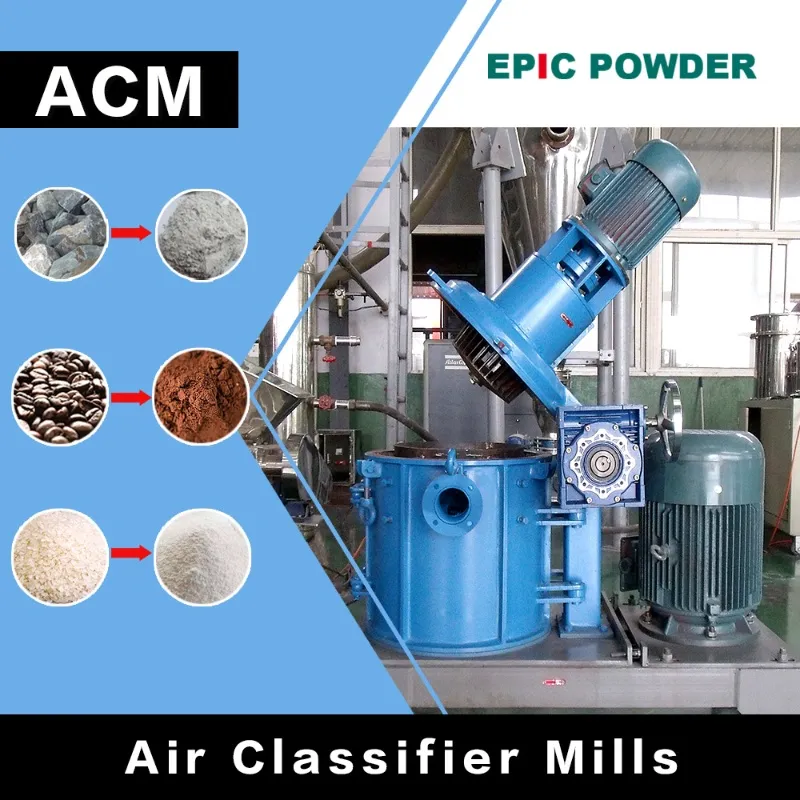
Direkte Vorteile der Feinstvermahlung
- Verbesserte Löslichkeit und schnellere Auflösung Verbesserung der Absorption.
- Verbesserte Bioverfügbarkeit Unterstützt eine effektive Dosierung mit kleineren Mengen.
- Stabile Aufhängungen ermöglichen eine bessere Formulierung in Flüssigkeiten.
- Gleichmäßige Fließfähigkeit erleichtert die Herstellung und Verpackung.
Branchenanwendungen
- Nahrungsergänzungsmittel: Verbesserte Kalziumaufnahme für gesunde Knochen.
- Lebensmittelindustrie: Angereicherte Getränke und Nahrungsergänzungsmittel.
- Pharmazeutika: Präzise Dosierung und verbesserte Bioverfügbarkeit.
Herausforderungen bei Standardmahlverfahren
Konventionelle Mühlen erzeugen oft ungleichmäßige Partikelgrößen mit breiteren Verteilungen, was folgende Folgen hat:
- Geringere Löslichkeit und variable Bioverfügbarkeit.
- Schlechter Pulverfluss und Probleme bei der Handhabung.
- Erhöhtes Kontaminationsrisiko durch Hitze und Reibung.
- Schwierigkeiten bei der Erreichung der für Premiumqualität erforderlichen engen PSD.
Aus diesem Grund werden Windsichtermühlen, die für die Feinvermahlung von Calciumcitrat optimiert sind, zum Industriestandard für die Erfüllung strenger Produktspezifikationen.
Die Wissenschaft hinter der Reduzierung der Calciumcitrat-Partikelgröße
Die physikalischen und chemischen Eigenschaften von Calciumcitrat beeinflussen maßgeblich sein Verhalten bei der Feinvermahlung. Seine Kristallstruktur und Härte wirken sich auf die Mahleffizienz und den Partikelzerfall aus. Die Reduzierung der Partikelgröße, insbesondere mit dem Ziel einer D99-Verteilung von 20 μm, vergrößert die Oberfläche signifikant, was die Löslichkeit und Bioverfügbarkeit – entscheidend für Nahrungsergänzungsmittel und pharmazeutische Produkte – direkt steigert.
Feinere Partikel bedeuten auch eine bessere Dispersion in Flüssigkeiten, was die Stabilität der Suspension erhöht und die Haltbarkeit verlängert. Eine enge Partikelgrößenverteilung (PSD), bei der die meisten Partikel zwischen den Schwellenwerten D50 und D90 nahe 20 Mikrometern liegen, gewährleistet gleichbleibende Qualität und Leistung.
Studien zeigen, dass die Erreichung eines D99-Wertes von etwa 20 μm mittels Windsichtermühle die funktionellen Eigenschaften von Calciumcitrat optimiert, ohne strukturelle Schäden zu verursachen. Dieser Feinheitsgrad verbessert die Bioverfügbarkeit und die Formulierungshomogenität, wodurch die Feinvermahlung ein unerlässlicher Schritt bei der Herstellung von hochwertigem, ultrafeinem Calciumcitratpulver ist.
Für präzise Partikelgrößenverteilung und effektive Partikelgrößenkontrolle werden fortschrittliche Mahlanlagen eingesetzt, die Folgendes verwenden: Windsichtermühle Technologie ist der Standard, um den Anforderungen der Industrie gerecht zu werden.
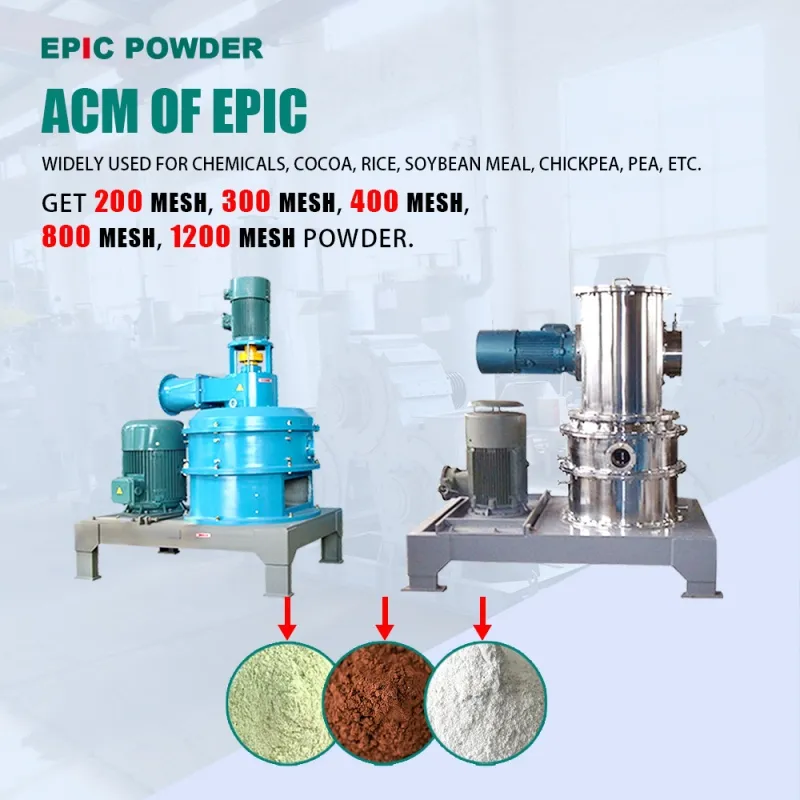
Empfohlene Ausrüstung: Windsichtermühlen für Calciumcitrat
Luftklassierermühlen (ACM) vereinen Mahlen und Klassieren in einer Einheit und eignen sich daher ideal zur Herstellung von ultrafeinem Calciumcitratpulver. Dieses integrierte System ermöglicht eine präzise Partikelgrößenkontrolle und gewährleistet eine gleichmäßige Partikelgrößenverteilung (D99 ≤ 20 µm), die für eine verbesserte Bioverfügbarkeit und Löslichkeit entscheidend ist.
Warum ACM optimal für die Feinstvermahlung ist
- Präzisionsklassifizierung: ACMs trennen Feinpartikel sofort von Grobpartikeln, was zu einer engen Partikelgrößenverteilung führt.
- Reduzierte Wärmeerzeugung: Durch schonendes Mahlen bleibt die chemische Integrität des Calciumcitrats erhalten.
- Energieeffizient: Geringerer Stromverbrauch im Vergleich zu herkömmlichen Mühlen.
- Skalierbar und konsistent: Geeignet sowohl für Kleinserien als auch für die industrielle Fertigung.
Merkmale der Windsichtermühlen von Epic Powder
- Anpassbare Rotordrehzahl und Klassierradeinstellungen für maßgeschneiderte Feinheit
- Fortschrittliches Luftstrommanagement für stabile Pulversuspension und Fließfähigkeit
- Robuste Konstruktion, geeignet für Calciumcitrat in Lebensmittel- und Pharmaqualität
- Einfache Wartung mit minimalen Ausfallzeiten
- Nachgewiesene Fähigkeit zur Erzielung einer engen Partikelgrößenverteilung, ideal für ultrafeines Calciumcitratpulver
Prozessablauf und Betrieb
- Rohes Calciumcitrat wird über eine Schneckenförderanlage in die ACM-Kammer geleitet.
- Rotoraufprall zerkleinert Partikel
- Das Klassierrad wählt Partikel mit einem Durchmesser unter 20 Mikrometern (D99) für den Austrag aus.
- Gröbere Partikel werden zur weiteren Vermahlung zurückgeführt.
- Das endgültige ultrafeine Pulver wird im Zyklon- oder Filtersystem aufgefangen.
Vergleich von ACM mit anderen Mahlmühlen
| Mühlentyp | PSD-Steuerung | Wärmeerzeugung | Energieverbrauch | Eignung für Calciumcitrat-Superfeinpulver |
|---|---|---|---|---|
| Luftklassierermühle | Ausgezeichnet (D99 20μm) | Niedrig | Hohe Effizienz | Beste Wahl für ultrafeine, Lebensmittel- und Pharmaqualität |
| Strahlmühle | Gut | Mäßig | Hoch | Gut, aber höherer Energieverbrauch |
| Vibrationsmühle | Mäßig | Hoch | Medium | Weniger präzise, Gefahr des Überschleifens |
| Kugelmühle | Schlecht/Variabel | Hoch | Niedrig | Nur für grobes Mahlen geeignet, nicht für superfeines Mahlen. |
Die spezielle ACM-Technologie von Epic Powder zeichnet sich durch die Herstellung von ultrafeinem Pulver in Lebensmittelqualität mit verbesserter Dispergierbarkeit und Fließfähigkeit von Calciumcitrat aus und ist damit die optimale Lösung für Hersteller, die Wert auf Qualität und Effizienz legen.
Weitere Einblicke in das Luftstrommanagement und die Schneckenförderung in integrierten Mahlsystemen finden Sie in unserer detaillierten Übersicht zu … Schneckenfördermechanismen Wird in Windsichteranlagen verwendet.
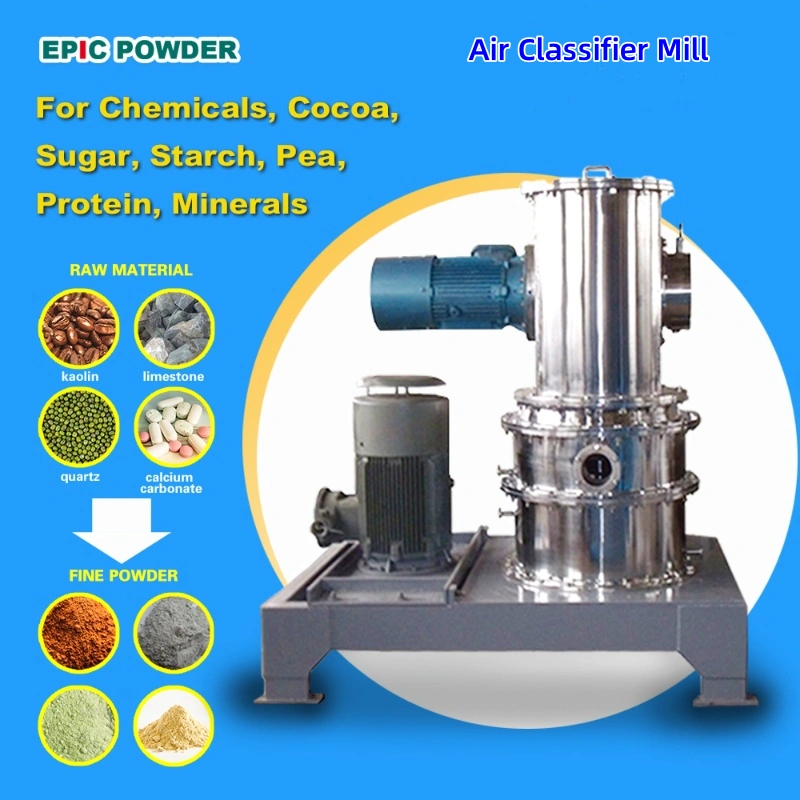
Schrittweises Verfahren zur Feinstvermahlung von Calciumcitrat
Um ein gleichmäßiges, ultrafeines Calciumcitratpulver mit einer D99-Partikelgrößenverteilung von 20 µm zu erhalten, beginnt der Prozess mit einer sorgfältigen Rohstoffaufbereitung. Hochreines Calciumcitrat ist unerlässlich – Verunreinigungen beeinträchtigen sowohl die Mahleffizienz als auch die Qualität des Endprodukts. Die Einhaltung von Lebensmittel- oder Pharmaqualitätsstandards beim Ausgangsmaterial vermeidet Kontaminationsrisiken in nachfolgenden Prozessschritten.
Anschließend müssen die Betriebsparameter präzise gesteuert werden. Rotordrehzahl, Einstellungen des Sichterrads, Luftstrom und Zufuhrrate beeinflussen Partikelgröße und -verteilung. Beispielsweise verbessert eine Erhöhung der Rotordrehzahl und des Luftstroms in der Regel die Feinheit, erfordert jedoch eine Feinjustierung, um Übermahlung oder Wärmeentwicklung zu vermeiden. Die Feinjustierung des Sichterrads optimiert die Partikelsortierung und trägt zur Aufrechterhaltung einer engen Partikelgrößenverteilung bei, die für die Verbesserung der Bioverfügbarkeit von Calciumcitrat und eine gleichmäßige Dispergierbarkeit entscheidend ist.
Nach dem Mahlen ist die sachgemäße Handhabung entscheidend für den Erhalt der Pulverqualität. Fließmittel können zugesetzt werden, um die Fließfähigkeit zu verbessern und Verklumpungen beim Verpacken und Lagern zu verhindern. Strenge Qualitätsprüfungen gewährleisten, dass das Pulver die Zielvorgaben hinsichtlich Feinheit, Reinheit und Feuchtigkeitsgehalt erfüllt und somit für die Verwendung in Nahrungsergänzungsmitteln, pharmazeutischen Produkten oder Lebensmitteln geeignet ist.
Während des gesamten Prozesses haben Sicherheit und die Einhaltung gesetzlicher Vorschriften höchste Priorität. Der Einsatz von lebensmittelgeeigneten Windsichtern, die speziell für empfindliche Materialien entwickelt wurden, minimiert das Kontaminationsrisiko und gewährleistet gleichzeitig die Einhaltung der Hygienestandards. Einen detaillierten Einblick in die Technologie dieser Windsichter und deren Funktionsweise bei der Temperatur- und Feuchtigkeitsregulierung wärmeempfindlicher Pulver wie Calciumcitrat finden Sie in unserem ausführlichen Leitfaden. Temperatur- und Feuchtigkeitsregelung in der Windsichteranlage.
Die sorgfältige Einhaltung dieser Schritte gewährleistet ein hochwertiges, superfeines Calciumcitratpulver mit ausgezeichneter Löslichkeit und Leistungsfähigkeit in verschiedenen Formulierungen.
Vorteile und Leistungsergebnisse von D99 20 μm Calciumcitratpulver
Feinstvermahlung, um eine D99 20μm Partikelgrößenverteilung bietet bedeutende technische und praktische Vorteile für Calciumcitratpulver.
| Leistungskategorie | Wichtigste Vorteile | Auswirkungen |
|---|---|---|
| Technisch | Erhöhte Löslichkeit und schnellere Auflösungsgeschwindigkeit | Verbessert die Bioverfügbarkeit von Calciumcitrat für bessere Gesundheitsergebnisse |
| Größere Oberfläche durch kleinere Partikel | Verbessert die Interaktion mit flüssigen Medien und steigert die Absorption | |
| Formulierung | Überlegene Dispergierbarkeit und Suspensionsstabilität | Lässt sich leichter in Nahrungsergänzungsmittel, Lebensmittel und pharmazeutische Produkte einmischen. |
| Verbesserte Kompressibilität und Fließfähigkeit | Ermöglicht eine gleichbleibende Tablettenproduktion und Dosierungsgenauigkeit | |
| Potenzial zur Dosisreduktion | Effektive Kalziumzufuhr mit weniger Pulver | |
| Endbenutzer | Gewährleistet die Einhaltung gesetzlicher Vorschriften bei pharmazeutischen und lebensmitteltauglichen Pulvern. | Erfüllt strenge Sicherheits- und Qualitätsstandards |
| Potenzial für Premium-Etikettierung | Unterstützt Marketingaussagen zu „ultrafeinen“ oder „mikronisierten“ Produkten. |
Fallstudien zur Verdeutlichung der Produktionssteigerungen
- Hersteller berichteten 30% schnellere Auflösungsraten mit D99 20μm superfeinem Calciumcitrat im Vergleich zu gröberen Körnungen.
- Ein Nahrungsergänzungsmittelhersteller erreichte bessere Chargen-zu-Chargen-Gleichmäßigkeit und verringerte Probleme durch Ballungsräume.
- Lebensmittelentwickler stellten eine verbesserte Pulverdispersion in Getränken fest, was zu einem besseren Mundgefühl und einer höheren Produktstabilität führte.
Diese Ergebnisse bestätigen, warum die Verwendung von Systemen wie dem Superfeinmahlverfahren so wichtig ist. Windsichtermühle ist die Methode der Wahl zur Herstellung von Calciumcitratpulvern mit optimierter Leistung und maximalem Anwendernutzen.
.webp)
Häufig gestellte Fragen und Antworten (Q&A)
Frage 1: Wie kann ich bei der Herstellung von D99 20μm Calciumcitrat ein Gleichgewicht zwischen „Feinheit“ und „Ausbeute“ herstellen?
A: Dies ist ein entscheidender technischer Balanceakt. In einer Windsichtermühle (ACM) verbessert eine höhere Sichterdrehzahl die Feinheit. Hohe Drehzahlen führen jedoch dazu, dass mehr Material in die Mahlkammer zurückgelangt. Dies erhöht die interne Belastung und verringert den Stundenausstoß.
- Optimierungstipp: Verwenden Sie eine hochpräzise Schneckenförderanlage. Sie gewährleistet einen gleichmäßigen Materialfluss und verhindert Luftdruckschwankungen.
- Der „Goldene Schnitt“: Passen Sie das Verhältnis von Luftstrom zu Klassierergeschwindigkeit an. Dadurch wird eine enge D99-20μm-Verteilung bei gleichzeitig maximalem Durchsatz aufrechterhalten.
- Technischer Kern: Verwenden Sie eine ACM mit Frequenzregelungssystem. Dies ermöglicht Echtzeit-Anpassungen, um den Energieverbrauch niedrig und die Produktion hoch zu halten.
Frage 2: Wie geht das ACM-System mit statischer Aufladung und Pulververklumpung um?
A: Feineres Calciumcitrat besitzt eine größere Oberfläche. Dies erhöht die Oberflächenenergie, was zu statischer Aufladung und Agglomeration führt. Dadurch können die Fließfähigkeit und Dispergierbarkeit des Pulvers beeinträchtigt werden.
- Luftstromkühlung: Das ACM nutzt einen hohen Luftvolumenstrom. Dadurch wird die Mahlwärme abgeführt und die Partikel werden physikalisch verteilt. Dies verhindert hitzebedingte Verklumpungen.
- Material & Erdung: Wir verwenden hochglanzpolierten Edelstahl (Lebensmittel- und Pharmaqualität). Eine ordnungsgemäße Systemerdung trägt ebenfalls zur Ableitung statischer Ladungen bei.
- Prozesshilfe: Sie können geringe Mengen an lebensmittelgeeigneten Fließmitteln hinzufügen, sofern die Vorschriften dies zulassen.
- Sammelphase: Unsere Hochdruck-Impuls-Staubabscheider nutzen Luftstöße, um „weiche“ Klumpen aufzubrechen. Dadurch wird sichergestellt, dass das resultierende D99-Pulver mit einer Korngröße von 20 μm eine ausgezeichnete Fließfähigkeit aufweist.

Vielen Dank fürs Lesen. Ich hoffe, mein Artikel war hilfreich. Hinterlassen Sie gerne einen Kommentar. Bei weiteren Fragen können Sie sich auch an den Online-Kundendienst von Zelda wenden.
— Gepostet von Emily Chen