
1. Contexte du projet
Avec la croissance rapide du secteur des véhicules à énergies nouvelles à l'échelle mondiale, le Japon s'est imposé comme l'un des principaux centres de production de batteries au monde. De ce fait, les exigences de qualité relatives aux matières premières utilisées dans la fabrication des batteries sont devenues extrêmement strictes.
Un fabricant japonais de matériaux pour batteries au lithium avait besoin d'un broyage ultrafin du carbonate de lithium (Li₂CO₃) afin d'améliorer sa dispersion et sa réactivité dans les applications d'électrodes. Le client a finalement choisi le broyeur et classificateur ultrafin MJW Series ACM. Poudre épique, dans le but d'obtenir un contrôle exceptionnellement précis de la taille des particules.
2. Spécifications et exigences techniques
Matière première essentielle pour les batteries, le carbonate de lithium est extrêmement sensible à la pureté du produit et à la granulométrie. Les exigences spécifiques du client étaient les suivantes :
- Matières transformées : Carbonate de lithium (Li₂CO₃)
- Modèle d'équipement : Broyeur à classification pneumatique Epic Powder série MJW (broyeur ultrafin et classificateur)
- Taille finale des particules : d50 = 7 μm
- Capacité nominale : 50 kg/h
3. Principaux avantages de Poudre épique Série MJW Moulin classificateur d'air pour le traitement du carbonate de lithium
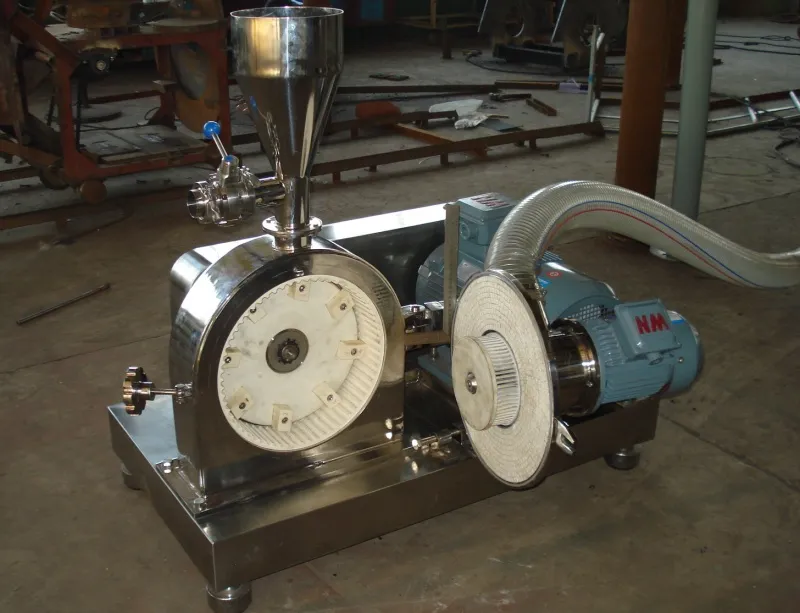
En réponse à la nature hygroscopique du carbonate de lithium et à sa sensibilité à la contamination métallique, le broyeur à classification pneumatique de la série MJW pour le traitement du carbonate de lithium a démontré des performances techniques exceptionnelles :
A. Conception intégrée « broyage + classification »
La série MJW intègre le broyage ultrafin et le classement pneumatique de précision au sein d'un seul système. Grâce à une roue de classement rotative à grande vitesse, les particules supérieures à 10 μm sont éliminées avec précision, garantissant ainsi un d50 stable de 7 μm pour le produit final.
Ce contrôle précis du point de coupe améliore considérablement la constance du produit.
B. Convient à la production en laboratoire et à petite échelle de produits de haute pureté
Sa capacité de production de 50 kg/h est parfaitement adaptée aux lignes pilotes de R&D de matériaux pour batteries au lithium ou à la fabrication sur mesure de petites séries haut de gamme. L'équipement se caractérise par une structure compacte et un faible encombrement, facilitant ainsi son intégration aux lignes de production existantes des clients japonais.
C. Contrôle de la contamination métallique (pour les matériaux de batteries)
Pour répondre aux exigences strictes de contrôle des métaux étrangers de l'industrie des batteries au lithium, les principales pièces de contact de la série MJW sont équipées de revêtements en céramique et de matériaux en alliage dur.
Cela permet d'éviter efficacement la contamination par le fer pendant le processus de broyage et garantit la pureté chimique du produit final.
4. Valeur de la mise en œuvre du projet
En adoptant la solution Epic Powder MJW, le client a atteint avec succès les objectifs de production suivants :
| Valeur du projet | Description |
|---|---|
| Obtention d'une granulométrie précise | Le produit fini d50 reste stable à 7 μm, répondant aux exigences de finesse des batteries lithium-ion haute densité énergétique de nouvelle génération. |
| Contrôle du broyage à basse température | Le procédé de broyage à l'air procure un effet de refroidissement naturel, empêchant efficacement la dégradation thermique du carbonate de lithium causée par l'accumulation de chaleur pendant le broyage. |
| Environnement de production optimisé | Un système de production entièrement clos à pression négative élimine totalement les fuites de matériaux et la contamination croisée, conformément aux normes environnementales élevées de l'industrie coréenne des matériaux électroniques. |