
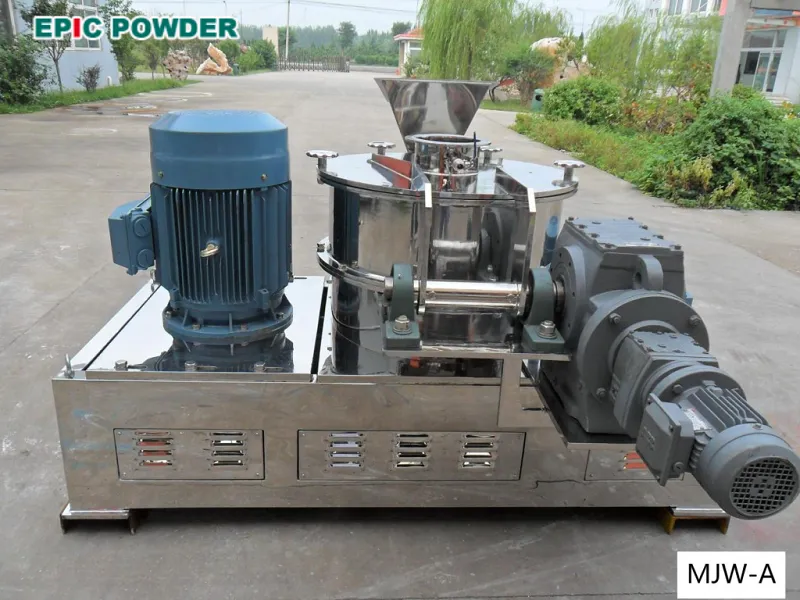
MJW-A
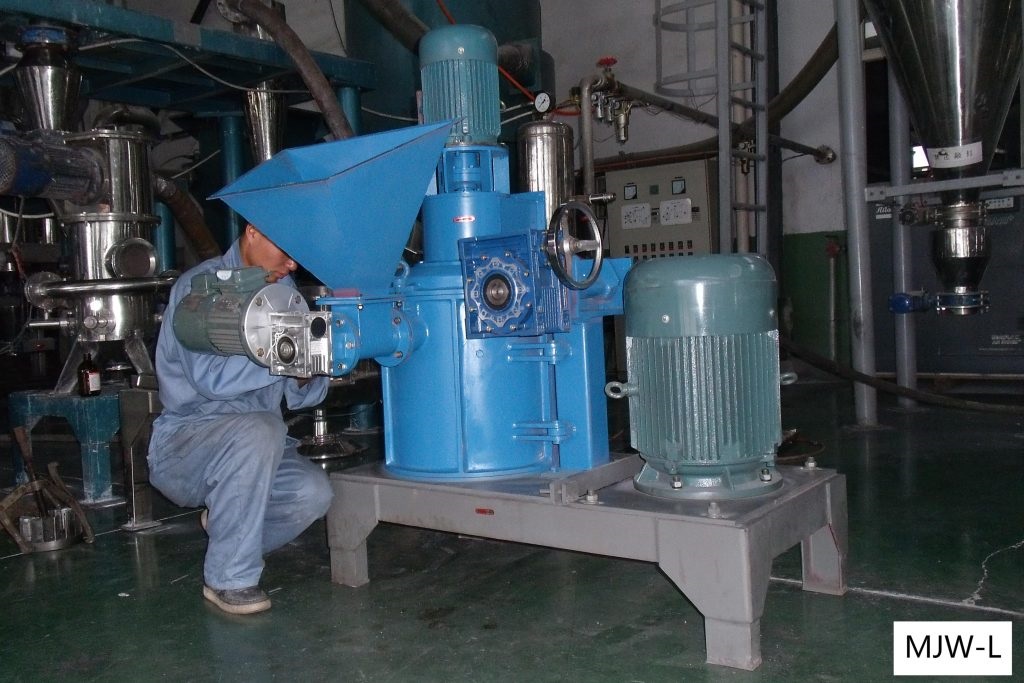
Both drives sit side by side in a horizontal frame, so the footprint stays short and each end remains reachable
- D97
- 10–300 μm
- Capacità
- 5–6,000 kg/h
- Frames
- 300–1100
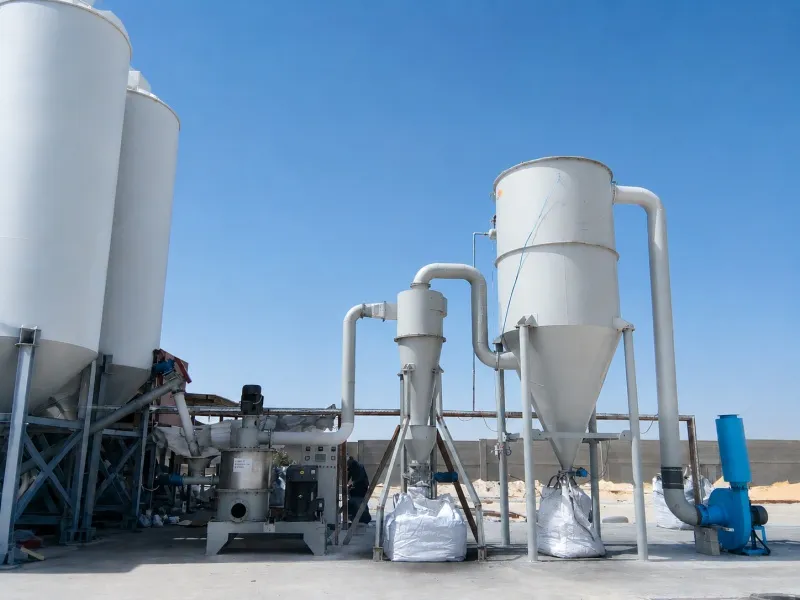
One machine grinds with a high-speed rotor and separates with a rotating wheel in the same housing. Therefore the top size is a setting, not a screen — and one frame can hold 5–300 μm at throughput from 2 to 15,000 kg/h.
An air classifier mill is an impact grinding mill with a dynamic air classifier built into the grinding chamber. A rotor throws material against a toothed track, an air stream lifts the result into a rotating wheel, and the wheel returns coarse particles for another pass. Only fines leave with the air.
That arrangement removes the weakness of a screen mill, where material keeps getting hit until it happens to fit through a hole. Because the classifier decides what leaves, residence time is short and the curve stays narrow. In addition, the air stream carries heat away, which is why the machine suits heat-sensitive products far better than a ball mill.
For the terminology behind the name — ACM, air classifying mill, classifier mill — see what an ACM mill is. For frame-by-frame specifications, the ACM mill range page lists every model with its motor rating.
Why the classifier carries the whole design: a rotor can always make fines, but it cannot stop making them. Once the grinding energy is applied, only a classifier can separate the finished powder from the coarse fraction and send the coarse back. That is the difference between a mill that produces a curve and a mill that produces a range.
A note on names: “air classifier mill”, “air classifying mill” and “ACM mill” describe the same machine. Suppliers differ in wording, not in principle. Therefore compare rotor type, classifier drive and air volume — not the label on the catalogue.
Open the chamber and the logic becomes visible: grinding happens at the bottom, classification at the top, and the air stream connects the two.
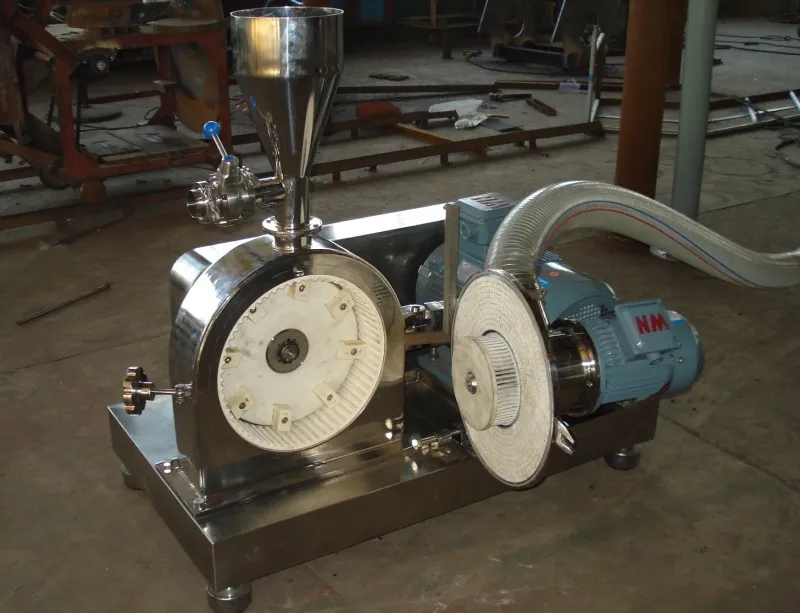

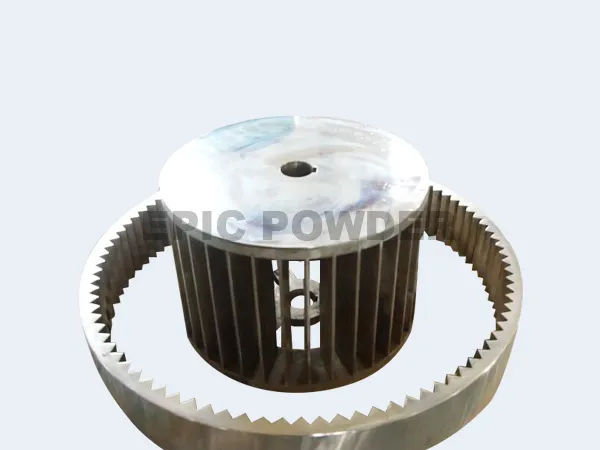
Wear follows the same logic. Because the rotor and the track do the breaking, they take the abrasion; because the wheel only classifies, it wears slowly but must stay balanced. That is why a rebuilt machine usually needs impact elements and a liner, not a new wheel.
The choice between them is about access and drive arrangement rather than grinding performance. All three are designed and built at our own factory.
Both drives sit side by side in a horizontal frame, so the footprint stays short and each end remains reachable
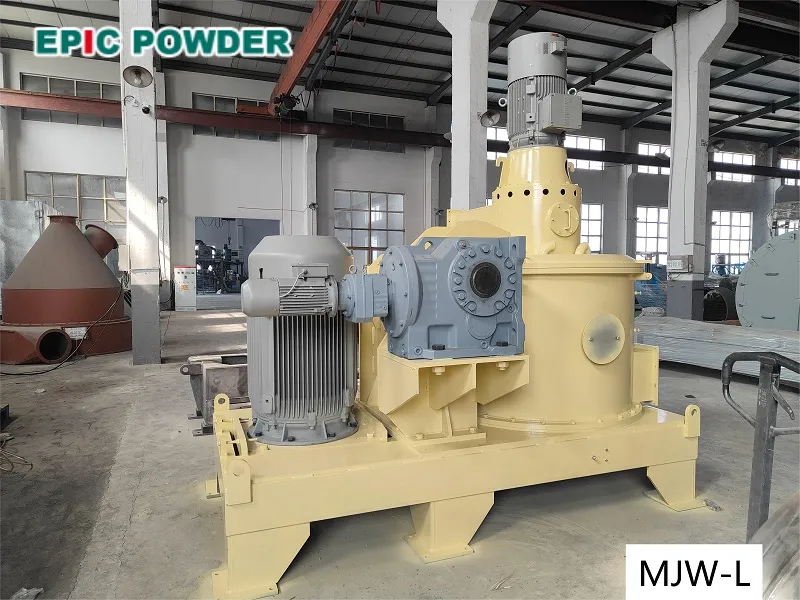
A vertical body carries the classifier drive on top, which frees floor space and gives the widest capacity range

The disc and the wheel run on independent drives, so the classifier reaches the highest speed for the sharpest cut
Two further formats complete the range. The MJL-W impact mill is belt driven and carries no wheel, so it suits coarse duty ahead of fine grinding. Meanwhile the laboratory unit proves a curve at pilot scale before a production frame is ordered.
Across the three structures we build 25 model variants, from a frame that fits a pilot bay to one that fills a production hall. Because the classifier speed range is preserved through the range, the same material can be tested on a small frame and produced on a large one without changing the principle — only the tonnage per hour changes.
Published kg/h figures assume a bulk density, a target D97 and a material. Therefore the same frame can be rated at 1,000 kg/h on calcium carbonate and 300 kg/h on a light fibrous feed, and both numbers are honest.
The useful comparison fixes three variables and lets the fourth move. Fix the material, the D97 and the tonnage, then compare frame size and installed power. In turn, that exposes a model that has been down-sized to win on price.
A practical way to test a quotation: ask for the specific energy in kWh per tonne at your duty point. Because that single figure folds density, fineness and machine efficiency into one number, two offers can be compared even when their kg/h ratings were measured on different materials.
Air volume, not motor power, sets the ceiling. Ducting, cyclone and filter must match the mill’s air volume, or the machine will never reach its rated output.
| Figure in the offer | What it depends on |
|---|---|
| Capacity, kg/h | Bulk density, target D97 and feed size |
| Fineness, μm | Whether it is D97 or D50, and on which material |
| Installed power | Rotor and classifier motors stated separately |
| Air volume | Roughly 1.5–3 m³ per kg of product |
| Specific energy | Usually 15–60 kWh per tonne |
Versatility has edges. Five conditions decide whether this is the right machine, and four competing principles decide whether it is the right principle.
| Condition | Limit | Beyond it |
|---|---|---|
| Feed size | 3–5 mm | Rotor overload, unstable curve |
| Moisture | 1–2% | Wheel blinds over |
| Hardness | Mohs 6–7 | Wear parts fail in weeks |
| Stickiness | Low to moderate | Bridging at the feed |
| Finezza | ≥ 5 μm | Energy cost outruns the gain |
| Type | Range | Best fit |
|---|---|---|
| Mulino classificatore ad aria | 5–300 μm | Controlled top size |
| Mulino a getto | 1–20 μm | Very fine, low contamination |
| Mulino a sfere | 10–100 μm | Hard, large batches |
| Mulino a perni | 50–500 μm | Coarse duty |
| Mulino a martelli | ≥ 100 μm | Crushing, pre-grinding |
Two limits deserve a word. Moisture is harder than hardness, because a damp powder blinds the wheel regardless of how the machine is built — drying upstream is cheaper than fighting it inside the mill. The 5 μm floor is economic rather than mechanical: the rotor will keep grinding, but the energy per tonne climbs faster than the product improves. Reactive metals and dusty organics add a third dimension, since inerting, venting and earthing all change the build.
Above roughly 20 μm the classifier mill usually wins on energy per tonne and on curve sharpness; below about 5 μm the advantage moves to the jet mill. Between those numbers the decision comes down to how tight the specification really is — see the full mill comparison.
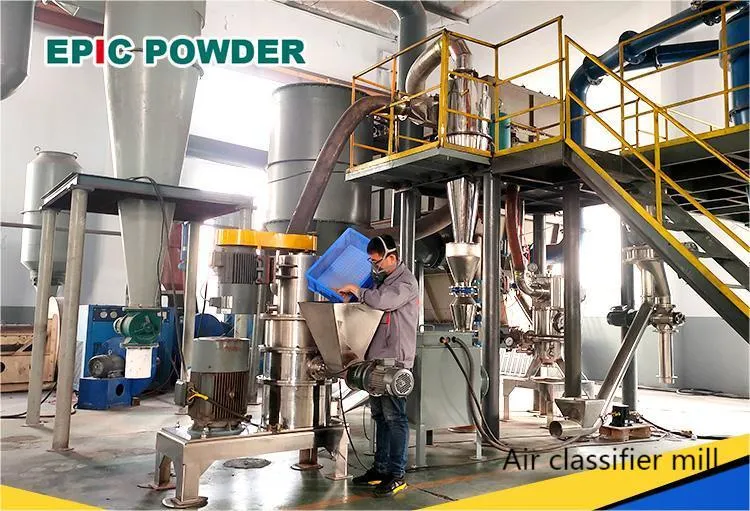
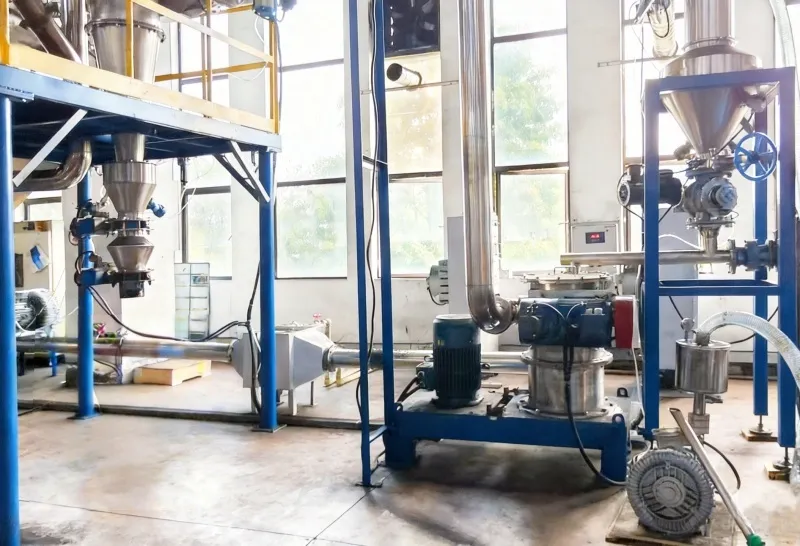
A mill on its own cannot run. It needs a feeder to meter material, an air stream to carry it, a cyclone or filter to collect it, and a fan to hold the circuit under negative pressure.
Therefore the scope decision comes before the model decision. We supply mill, feeder, cyclone, bag filter, fan, ducting and control cabinet as one package with commissioning support — or the mill alone, if your local fabricator builds the circuit.
Scope also decides the layout. A complete circuit needs floor area for the filter and the fan, headroom for the cyclone, and a duct route that does not add pressure drop at every bend. Therefore the arrangement drawing matters as much as the machine drawing, and it is the document to request first when space is tight.
Component detail sits in the component guide, and the product overview lists the auxiliary equipment we build in-house.
Almost any dry, free-flowing material up to Mohs 6–7 can be processed with the right wear package. These four groups set most of the enquiries we receive.
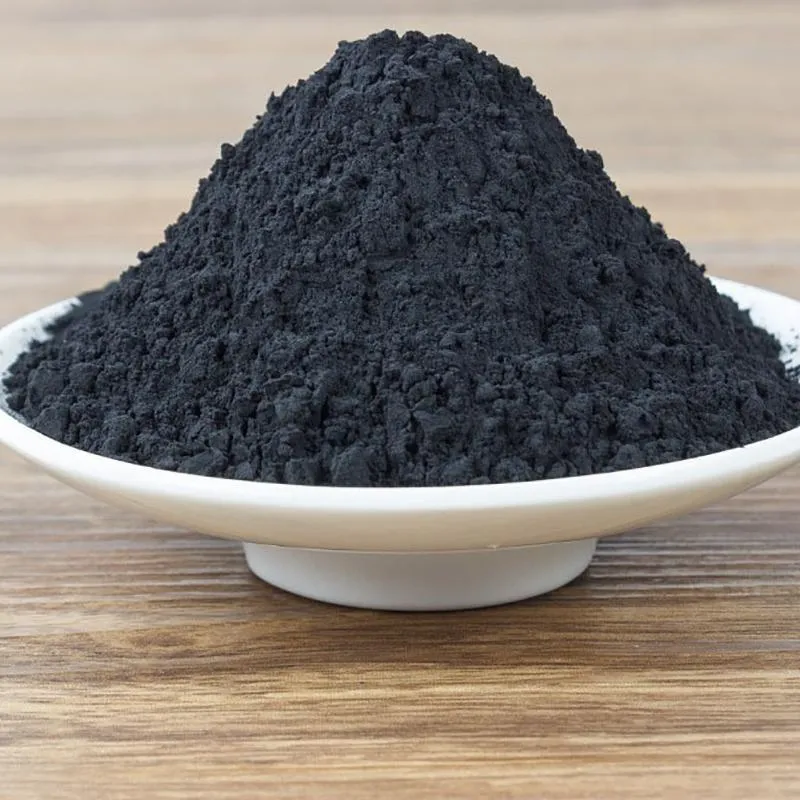 CarbonCarbon black, coke and activated carbon
 BatteryGraphite anode and lithium carbonate
 MineralsCalcium carbonate, talc and bentonite
 FoodSugar, cocoa, chili and rice bran
Two groups deserve a caution. Battery materials tolerate almost no cross-contamination, so the wear package and the cleaning routine are specified before the model. Food powders raise the same question from a hygiene angle, where stainless contact parts and a cleanable chamber matter more than throughput. Everything else is mostly a wear calculation.
Each one changes either the frame size or the wear package, so sending them together saves a round of questions.
Name the substance and its Mohs value, since hardness and silica set the wear package.
Give D97, and D50 if you have it. “Fine powder” cannot be engineered against.
State kg/h and whether it is finished product or feed rate — the two differ by circulating load.
Voltage, frequency, headroom and dust classification decide the electrical build.
Mill only or complete circuit. The air side often exceeds the mill in value.
Two of those deserve emphasis. Fineness sets the energy, so loosening a target from 10 μm to 20 μm can cut running cost substantially. Scope sets the project, so decide it before comparing prices — otherwise two offers are not comparable at all.
Moisture is a harder limit than hardness. Above roughly 1–2% water content most powders build up on the wheel, and no rotor speed fixes it; drying upstream is cheaper than fighting it downstream. See operating precautions for the other practical limits.
Four parts carry almost all the wear: impact elements, grinding track, deflector liner and classifier wheel. Because life is set by abrasiveness rather than tonnage, the same machine can need a set in three months or in three years.
Six variables explain most of the spread between quotations: frame size and motors, target fineness, wear protection, material of construction, explosion or inert build, and how much of the air circuit is included.
Maintenance follows a rhythm rather than a calendar. Inspect the impact elements and the deflector liner at fixed intervals, record the wear pattern, and compare the measured D97 against the commissioning baseline. A curve that drifts finer usually means the wheel or the liner has worn, not that the setting changed.
For the full breakdown — line-by-line comparison, factory audit, import file — read the air classifier mill buying guide, which is written for importers and distributors.
Balance matters more than hardness on the wheel. A wheel refitted without balancing causes vibration long before it shows wear, and that vibration reaches the bearings first.
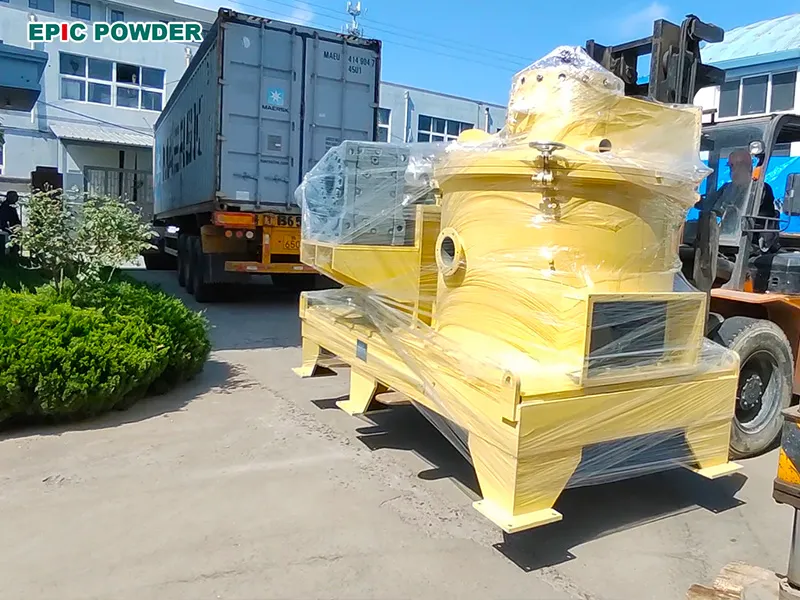
Machines are assembled, run and packed on the same site, which is why a drawing revision can be applied to an order already in build — and why a spare part can be traced back to the frame it was made for.

Concrete references beat brochure claims. Each project note below names the country, the material and the result, and the reading list is grouped by the stage at which each question usually appears.
Wherever a powder needs a controlled top size rather than simple size reduction. Typical duties are carbon black, graphite, calcium carbonate, powder coatings, battery materials and food powders, in the 5–300 μm range.
Around 5 μm as a practical floor, with 10–45 μm the common industrial band. Below about 5 μm a jet mill is normally the more economic choice.
A jet mill grinds by particle collision in high-pressure gas and reaches finer sizes with almost no contamination. An air classifier mill uses a mechanical rotor, therefore it consumes far less energy per tonne above roughly 20 μm.
Yes, because residence time is short and the air stream carries heat away. For very sensitive grades, chilled or conditioned air keeps the chamber below the softening point.
From 2 kg/h on a laboratory frame to 15,000 kg/h on the largest MJW-L. The actual figure depends on bulk density and fineness, so always ask for the basis.
Usually 3–5 mm depending on frame size. Larger feed overloads the rotor and destabilises the curve, so coarse material is normally pre-crushed.
Not normally, because the air stream removes most of the heat. For low-melting products such as waxes, a water jacket or chilled air is specified instead.
Wheel speed sets the cut, so raising the speed produces a finer powder. Air volume controls throughput, and the two are balanced against each other.
Impact elements, grinding track, deflector liner and classifier wheel. Life runs from a few months on abrasive minerals to several years on soft carbon black.
Yes. Send 5–10 kg of representative material and we return the achievable curve, a recommended model, throughput and power draw. The test is free and you cover the freight.
Tell us the material, the fineness you need and the tonnage you run. We come back with a recommended model, a capacity estimate and a test report — not a generic catalogue.
Written by the EPIC Powder engineering team, Qingdao, China. The MJW series is designed, built and supported by EPIC Powder; drawings, wear-part specifications and spare parts all come from the team that builds the machine. Last updated 2 November 2026.